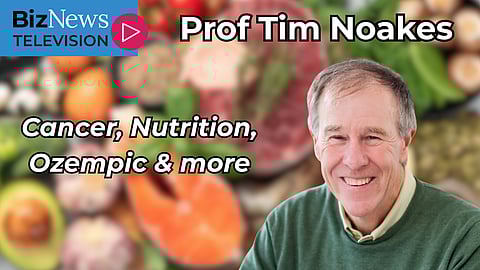
Professor Tim Noakes challenges mainstream medicine and nutrition with a relentless pursuit of truth. In a candid interview, he critiques profit-driven healthcare, defends low-carb diets, and exposes systemic failures in academia and policy. From rewriting his own research to advocating reform, Noakes remains a bold voice calling for science rooted in evidence, merit, and integrity..Sign up for your early morning brew of the BizNews Insider to keep you up to speed with the content that matters. The newsletter will land in your inbox at 5:30am weekdays. Register here.Support South Africa’s bastion of independent journalism, offering balanced insights on investments, business, and the political economy, by joining BizNews Premium. Register here.If you prefer WhatsApp for updates, sign up to the BizNews channel here.The auditorium doors will open for BNIC#2 on 10 September 2025 in Hermanus. For more information and tickets, click here..Watch here.Listen here.BizNews Reporter .In a compelling conversation with Alec Hogg, Professor Tim Noakes – a polarising figure in the world of science and health – shared insights that range from personal philosophy to systemic issues plaguing modern medicine. His views, grounded in decades of research and personal conviction, challenge entrenched paradigms in both academia and healthcare.At the core of Noakes’ philosophy lies a single unshakable belief: truth matters above all. “As long as you are trying to find the truth, you'll never regret it,” he states, urging younger disruptors like Roman Cabanac to stay the course, even in the face of fierce opposition. Noakes, now rewriting his seminal work The Lore of Running, is candid about previous errors in his interpretation of exercise physiology. “Now we know better,” he says, delighted by the intellectual freedom that comes with acknowledging past mistakes and evolving with new evidence.Reading remains central to Noakes’ methodology. He recounts how combing through 100-year-old research helped unlock a clearer understanding of carbohydrate metabolism. What began as standard experiments in the 1990s have now emerged, in hindsight, as studies with revolutionary implications. A 100-page paper, currently under peer review, is being lauded as a “paradigm shift” in the field – a complete reversal of dogma held since 1967.Beyond the physiology of athletes, Noakes’ ideas have had a widespread cultural impact, particularly through his advocacy for the low-carbohydrate, high-fat (LCHF) diet. “Humans are humans because we run,” he explains, tracing the evolution of our species back to our consumption of animal protein and fat. In his view, the widespread dietary shift towards carbohydrates in the 1970s marked the beginning of modern epidemics such as obesity and diabetes.Noakes does not shy away from drawing parallels between his field and broader socio-economic themes. While careful to state he’s not an economist, he remarks critically on South Africa’s economic stagnation under race-based policies like Black Economic Empowerment (BEE), arguing that meritocracy should be the standard across disciplines. “If you exclude merit, you're in trouble,” he says, pointing to his own expulsion from academia as a case of ideology trumping ability.When it comes to healthcare, Noakes takes direct aim at the pharmaceutical and food industries, accusing them of profit-driven agendas that perpetuate chronic illness. “Diabetes is a marvellous disease- for pharmaceutical companies,” he says bitterly. Despite the fact that it is preventable, South Africa records 10,000 new cases each month, a statistic he finds both staggering and damning.The suppression of alternative voices in medicine is another area of concern. Citing the work of Dr Sam Bailey, Noakes highlights how dissenters are marginalised and punished, often at great personal cost. He himself faced censorship and lost funding for criticising grain-based dietary guidelines promoted by institutions like Discovery Health. “If eating grains makes you sick, why do they promote it?” he asks, posing the kind of rhetorical challenge that has come to define his career.Noakes is cautiously optimistic about developments in the United States, especially the rise of Robert F. Kennedy Jr. and his vocal opposition to pharmaceutical industry dominance. “He's the last hope we have for medicine,” says Noakes. By challenging vaccine orthodoxy and confronting financial entanglements in the media, RFK Jr. represents, in Noakes’ eyes, a pivotal moment for reform.On cancer treatment, Noakes remains open-minded but critical. While he doesn’t discourage standard treatment, he believes patients should be informed about alternative therapies showing anecdotal success, such as the Makis Protocol and repurposed medications like ivermectin and fenbendazole. “We don’t know which is the most important, but they’re all benign,” he explains, highlighting the relative safety of these unconventional approaches compared to chemotherapy.Ultimately, Noakes champions a healthcare revolution driven by rigorous inquiry, not commercial interest. Whether his views are accepted or rejected, his unwavering commitment to seeking and sharing truth makes him a figure worth listening to - and a force to be reckoned with.