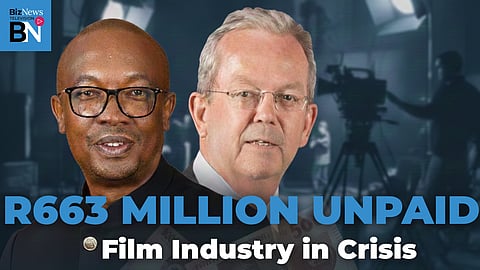
Trade and Industry Minister Parks Tau is in the crosshairs for not releasing over 600 million Rand of government approved payments for completed TV and film projects. In his latest interview with Chris Steyn, Toby Chance, the Democratic Alliance's spokesperson on Trade, Industry and Competition and Portfolio Committee member says: “…it’s our job as the committee to summon the minister to account for his inaction in this regard”. Chance has also written to the Speaker requesting an urgent Parliamentary debate on the matter. “…it’s a serious problem and companies not just are closing down, but they're relocating; some are relocating to Portugal, some to Malta. They're just closing shop - and it was actually tragic on Wednesday when we were walking through the crowds and talking to these producers about how their livelihoods over many years have just been trashed.” .Sign up for your early morning brew of the BizNews Insider to keep you up to speed with the content that matters. The newsletter will land in your inbox at 5:30am weekdays. Register here.Support South Africa’s bastion of independent journalism, offering balanced insights on investments, business, and the political economy, by joining BizNews Premium. Register here.If you prefer WhatsApp for updates, sign up to the BizNews channel here..Watch here.Listen here.Edited transcript of the interview.Chris Steyn (00:02.002)Trade and Industry Minister Parks Tau, is in the crosshairs for not releasing over 600 million Rand of government approved payments for completed TV and film projects. We get the latest from Toby Chance, the Democratic Alliance's spokesperson on Trade, Industry and Competition. Welcome, Toby.Toby Chance (00:23.778)Good morning Chris, thank you.Chris Steyn (00:27.248)Why has this issue suddenly been all over social media?Toby Chance (00:32.962)Because last week the industry organised two marches, the first on Wednesday to Parliament, the second on Thursday to the DTIC offices in Pretoria. And their PR company had done a pretty good job in promoting it and giving advance notice of it. So there was a lot of social media, and I became aware of it, obviously then decided to find out a bit more and that was really what sparked my interest and yeah, there was a huge amount of publicity, not just on social media but across pretty much all media platforms.Chris Steyn (01:17.17)And that was how you became aware of it.Toby Chance (01:19.628)Well, actually, no, I became aware of it in about November last year, because I was contacted by the Independent Producers Organisation in my role as the DA spokesman on Trade Industry Competition, but also because I sit on the Portfolio Committee. And the industry had been making attempts over many, many months, if not years, to get answers from the department. And they were really just at the end of their tether. So that's how I came to know about it. And I had a meeting with them in early December with my colleague Leah Potgieter who's our spokesperson on Sports and Recreation because obviously there's a strong overlap with that. And we then heard about their issues and complaints and they told us about the march that was going to take place in January.Chris Steyn (02:09.778)How does this incentive programme actually work?Toby Chance (02:14.57)It's actually a rebate. It's called the Film and TV Incentive Program, but the way it works is that it's a rebate for monies spent, but they have to apply first. So if you're a producer, a production company, and you want to apply for the rebate, you have to fill in all sorts of forms and give descriptions of the project. And you then apply for a rebate of up to 35% of the costs. If it's approved, then you go ahead with production and then you claim the money afterwards. So that's how it works. There are various types of rebates. It's co-productions with international companies. It's productions which are supporting up-and-coming black film producers as well as productions which are mainly run by international production companies. And it's been in place for over 20 years to stimulate productions in this country. And it's really worked extremely well up until the last few years.Chris Steyn (03:14.662)What are other countries doing to support their industries?Toby Chance (03:19.768)Well, at last count, there were 144 countries around the world with similar incentive programs. And it's become the industry norm that countries that want to build up their industries have to provide government incentives of one sort or another.I mean, if countries as you know, you would expect the UK, the US, Canada, Australia, many of the European countries are attracting production of movies and television because of the incentives that they provide. So as you can imagine, the companies themselves are now chasing after the best incentives. And with South Africa's incentive program having effectively stalled in the last few years, it's had a dramatically negative effect on the industry.Chris Steyn (04:07.516)What are the main complaints of our industry?Toby Chance (04:11.586)Well, there are a number of complaints. I think they boil down to lack of communication for probably five years. And after the march in Parliament, I had a meeting with the leaders of the march in my office in Parliament…We had received the petition from the industry and the petition listed a whole lot of different demands which we listen to, starting off with, as I said, lack of communication. And of course, if you can't communicate with the main funder, then it makes it impossible to do it, to actually undertake any proper planning. Then of course, there's the issue of the money owed. And I received the information after submitting a written question to Minister Tau at the end of last year. I got the answer at the beginning of January which is that the industry is owed 663 million Rand in rebates that haven't been paid. Now that is a huge amount of money bearing in mind that most of these companies are relatively small, they're independent, they're privately owned and that is money that they've already spent and now they have to try and recoup it and many of the businesses have gone under because they just haven't been able to survive the cash flow constraints. Then the other complaint is that the adjudication panel that decides on the awarding of grants to different productions based on the applications has not sat since March 2024. And that means that there's been no activity at all in the industry, which means the productions that should have happened haven't happened. And money that is owed from several years back is still unpaid. So the other thing is the changing of the rules without any consultation. And now what they're saying is because there's no money they claim there's no money is that is the productions will have to take place at risk and they'll have to then apply after the movies have been produced so that means that these companies you know are going to have to really splash out large sums of money without any guarantees that any of their applications will be approved. So it's a total mess and…Toby Chance (06:37.366)We were told that the industry had a meeting in February last year with the Deputy Minister; he gave them assurances that the problem would be solved and that it would be fully addressed but nothing has ever happened and they were so frustrated that they eventually made a PAIA application, essentially an application for information from the government which gave them all sorts of gobbledygook they claimed. It really wasn't providing any useful guidance, which is really why they contacted us in the Portfolio Committee at the end of November to try and break the logjam.Chris Steyn (07:21.008)Why have the Minister and his department been so slow to respond to this?Toby Chance (07:26.05)Well, I wish I knew the answer to that question. The answer to the written question I posed, apart from telling us that 663 million Rand is owed, is that they don't have any money. And I think what I've been able to establish is that they overspent in previous years, and so they are trying to recoup the monies that had been spent that they shouldn't have spent. So I think that there's clearly evidence of mismanagement within this department over many years dating back to the time when…. they were just spending money, you know, left, right and centre. Now, you could argue that that in itself has provided funding for the growth of the industry, which is fair enough, but it doesn't take away from the fact that the money is still owed. And we in the Portfolio Committee haven't seen evidence of this. We weren't told about it in detail.And so that's when it came as a bit of a surprise when I heard from the production industry that this was the problem. So, Minister Tau and the department are going to have to look very hard at their budgets and if necessary, they're going to have to go to Treasury to find extra money. Otherwise, this industry is in dire straits. Well, it already is in dire straits, but it could be even worse if things continue like this.Chris Steyn (08:53.146)What has been the economic fall-out of this.Toby Chance (08:57.304)Well, estimates are that there's been roughly a 50% contraction in the industry. Now, just to give you some of the numbers, it's worth anything up to 10 billion Rand a year, this industry. Employs directly about 60,000 people, indirectly maybe another 100,000 people, mainly in the Western Cape and KZN, but also Gauteng and some of the other provinces. So that's a huge fall-out. And of course, the other indirect consequence is that this industry provides a window for international viewers into South Africa and our beautiful landscapes, our tourism potential. So we are essentially getting 10 billion rands worth of advertising without even batting an eyelid. And this is what the economic impact is really showing, is how...an industry that's not only employing lot of people but also is providing marketing and advertising for South Africa is in danger of shooting ourselves in the foot. So it's a serious problem and companies not just are closing down but they're relocating, some are relocating to Portugal, some to Malta. They're just closing shop and it was actually tragic on Wednesday when we were walking through the crowds and talking to these producers but their livelihoods over many, years have just been trashed . And it's very, very difficult to recover from that, thing like that. So we just have to make sure that we don't see more decline, you know, from 50% to 60%, 70% in the next few months.Chris Steyn (10:39.42)Is there any truth in the rumours of favouritism?Toby Chance (10:44.876)Well, maybe. I'm not close enough to be able to answer that question. I think that the industry has transformed significantly, but I think that's true that as in any industry there are dominant players. I think the question that needs to be asked is there needs to probably be an audit of the programme, of the incentive, and to have a look at the way in which grants have been dispersed and applications have been approved or not approved. So I'm not saying that the system is perfect by any means. I think it probably does need a proper investigation to uncover that, the answer to that question and whether up-and-coming black producers are getting their fair share.Chris Steyn (11:32.038)What has been the outcome of those marches.Toby Chance (11:36.748)Well, the outcome is that a meeting has provisionally been scheduled for the 17th of this month. I was in discussions with the chairperson on Friday and we're trying to get the minister and the department to come and answer questions. We will obviously invite the industry to come as well. And it's our job as the committee to summon the minister to account for for his inaction in this regard.Chris Steyn (12:09.564)So the Portfolio Committee is taking this further.Toby Chance (12:13.002)Absolutely, and I think that was why it was important for the chairperson and myself and my colleague… to be present. You know, the purpose of the march was to hand over the petition and, you know, if we hadn't been there, then there would have been nobody to receive the petition. And I think now that Parliament is aware, I've called for a special debate on the matter.I've sent a letter I wrote to the Speaker on Thursday requesting an urgent Parliamentary debate on the matter and we haven't heard back from the Speaker's office yet as to whether that debate has been approved. But I think now that the issue has become nationwide news, I think that the spotlight is on the Department to get this problem solved urgently.Chris Steyn (13:09.138)Is there any alignment with funding from the National Film and Video Foundation?Toby Chance (13:15.468)Yeah, that's a very good question. I think the answer is no, there isn't. So that foundation is an entity of the Department of Sports, Arts and Culture. And there hasn't been any alignment really that I'm aware of. And that is a problem because that grant is developmental in nature. It's meant to develop the film and television industry, to develop the creative industries, it’s not a rebate in the sense that money is spent and then it's paid back. It's grants for development projects. And I think that what has to happen is that there needs to be an inter-ministerial and inter-departmental conversation between the two departments to see what can be done to have a more strategic approach to this industry. Because there's no doubt, not only in South Africa, but across Africa, in effect there’s…there are funds that I think a billion rand fund was recently announced last year to support the creative arts, the creative industries in Africa. And that's significant sum of money, some of which could end up in our pockets in this country. So I think there's definitely a need to have a sit down around the table for the two departments to figure out how do we maximise the opportunities to grow this industry through the various channels, not just government channels obviously, but also the industry itself. The industry does a lot of its own marketing. In one of the people that I met on Wednesday in my office… who's been in the production industry for 25, 30 years, she's going overseas literally now to go and drum up support for the industry and for her production company. They're very proactive. It's not just waiting for grants and incentives that the industry themselves go out and knock on doors internationally to try and attract productions to this country.Chris Steyn (15:19.366)Where to from here.Toby Chance (15:23.298)Well, I think we have to see the outcome of the meeting if it takes place on the 17th. We have to see whether the Speaker agrees to the urgent debate that I've called for. But now I think that the pressure is on the department to answer questions and to see things move forward. So definitely the Portfolio Committee is on to it. And we'll have to see. I'll be able to give you some feedback after that meeting.Chris Steyn (15:51.612)Thank you. That was Toby Chance, the Democratic Alliance spokesperson on Trade, Industry and Competition. Speaking to BizNews, I'm Chris SteynToby Chance (15:58.158)Thank you. Thanks, Chris.