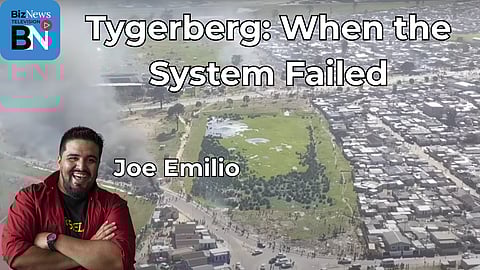
Filmmaker and YouTuber Joe Emilio speaks to Alec Hogg about his viral documentary on the Tygerberg Raceway land invasion. He says a 1998 law meant to protect the vulnerable has instead eroded property rights and fuelled a nationwide wave of land grabs.Sign up for your early morning brew of the BizNews Insider to keep you up to speed with the content that matters. The newsletter will land in your inbox at 5:30am weekdays. Register here.Support South Africa’s bastion of independent journalism, offering balanced insights on investments, business, and the political economy, by joining BizNews Premium. Register here.If you prefer WhatsApp for updates, sign up to the BizNews channel here..Watch here.Listen here.BizNews Reporter.When Joe Emilio uploaded his first full-length documentary to YouTube, he expected modest interest. Instead, his investigation into the Tygerberg Raceway land invasion has been watched by more than 180,000 people in just a few weeks.The film tells the story of a Cape Town raceway owner who lost his life’s work in a matter of days. Emilio argues it also reveals a far bigger problem: a piece of legislation passed in 1998 that he says has quietly stripped South Africans of meaningful property rights.From a community hub to rubbleTygerberg Raceway was once a thriving motorsport venue built up over two decades by owner Chris Liebenberg. In July 2020, during the height of the COVID-19 lockdown, more than a thousand people stormed the track.Within a week, the venue’s infrastructure was stripped and destroyed. Grandstands, VIP lounges and fencing were torn down or burned. Invaders began selling marked plots for shack construction.Lockdown regulations meant courts were not processing evictions. The City of Cape Town tried to secure an urgent interdict but the South African Human Rights Commission intervened to stop it. The legal system that should have protected the property owner failed at every turn.The PIE act: A law with unintended consequencesEmilio’s research led him to the Prevention of Illegal Eviction Act, known as the PIE Act. The law was intended to protect poor and vulnerable people from unlawful eviction. In practice, he says, it allows illegal occupiers to remain on private land for months or years while owners fight costly legal battles.There is no clear definition in the law of what constitutes a home. If someone erects a shack, a tent or even a makeshift tarp on your land, you cannot remove it without going to court. Owners are also required to find and pay for alternative accommodation before eviction.Many give up altogether. When land is abandoned, the Expropriation Act allows the state to take it, which Emilio says creates a dangerous incentive for organised land grabs.Not just a Western Cape problemWhile his first documentary focuses on Tygerberg, Emilio says the issue is nationwide. The PIE Act is a national law and overrides provincial rules. That means the same scenario could play out in any province, regardless of which party runs the local government.The Democratic Alliance has pushed for amendments to the law, but changes will not be presented until March 2026. Until then, Emilio says the hands of local authorities remain tied.Critics accuse the DA of legitimising invasions by providing infrastructure like water and sanitation to illegal settlements. Emilio points out that municipalities are constitutionally obliged to prevent humanitarian crises such as disease outbreaks.The hidden victimsThe property owner is not the only casualty of this system. Emilio notes that many invaded sites were earmarked for housing developments. When that land is taken, people on official waiting lists have to wait even longer for homes.“It is not those same people on the list who get the land,” Emilio says. “Often it is outsiders or people brought in by syndicates.”Why focus on the Western Cape firstSome question why Emilio has not gone straight to high-profile hotspots in Gauteng or KwaZulu-Natal. The answer is practical: funding. The Tygerberg film was made on no budget.“I live in the Western Cape, so it made sense to start here,” he says. His next projects will look at Grabouw, believed to be the largest land invasion in the country, and Hermanus, which saw one of the most violent. He hopes building a track record will open funding for investigations in other provinces.Public response and momentumThe Tygerberg film premiered to over 1,000 live viewers. Within 48 hours, it had 60,000 views. After one week, it hit 100,000. The audience has continued to grow, with about 1,000 people still watching daily.For a long-form documentary on YouTube, those numbers are exceptional. Emilio says the feedback has been overwhelmingly positive, with viewers praising its clarity and depth.The road aheadEmilio is now raising funds to produce more documentaries that dig deeper into the network of laws, politics and criminal activity behind South Africa’s land grab crisis.His hope is that a better-informed public will put pressure on lawmakers to reform the PIE Act. “The ANC has been undermining property rights since 1998,” he says. “Tygerberg is only one example. This is about the future of property ownership in South Africa.”For anyone who has not seen the documentary, a quick search for “Tygerberg Raceway” on YouTube will take you to Emilio’s film. It has already reached the equivalent of three packed Ellis Park stadiums. Emilio hopes some of those seats will be filled by policymakers - and that they will finally see the cost of leaving this crisis to grow.Joe Emilio’s viral Tygerberg Raceway film shows how the PIE Act has eroded property rights and fuelled land grabs across South Africa.