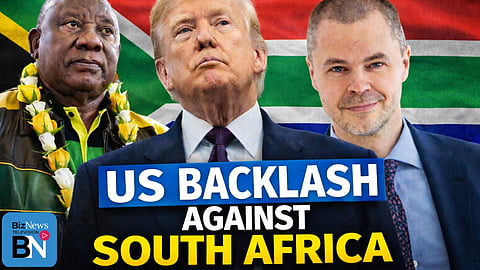
Joshua Meservey explains why South Africa is now seen as a willing accomplice to US adversaries and why consequences may finally be coming..Sign up for your early morning brew of the BizNews Insider to keep you up to speed with the content that matters. The newsletter will land in your inbox at 5:30am weekdays. Register here.Support South Africa’s bastion of independent journalism, offering balanced insights on investments, business, and the political economy, by joining BizNews Premium. Register here.If you prefer WhatsApp for updates, sign up to the BizNews channel here..Watch here.Listen here.BizNews Reporter.Relations between South Africa and the United States are now at their lowest point since the dawn of democracy in 1994. That is not hyperbole, and it is not simply the product of diplomatic misunderstandings or overheated rhetoric. According to Joshua Meservey of the Hudson Institute in Washington, the rupture is structural, ideological, and long in the making.Speaking to BizNews editor Alec Hogg, Meservey painted a stark picture of how South Africa is increasingly viewed in Washington. Not as a neutral or wayward partner, but as a willing accomplice to regimes that the US regards as hostile to its interests and values.At the centre of the latest flashpoint is Venezuela. South Africa has emerged as one of the loudest critics of the United States following the arrest and extradition of Venezuelan strongman Nicolás Maduro. In Washington, that response has landed badly.For most Americans, Meservey argues, Maduro is not seen as a legitimate head of state. He is viewed as the leader of what is effectively a narco state, accused of presiding over a criminal enterprise that deliberately funnels drugs into the United States, killing tens of thousands of Americans. From that perspective, the US action was not imperial overreach but law enforcement.South Africa’s decision to lead international criticism against Washington, including at the United Nations, has therefore reinforced a growing belief that Pretoria is no longer merely misaligned, but openly hostile to US foreign policy objectives.Meservey stops short of calling South Africa an adversary in the military sense. The country poses no physical threat to the US. Instead, he describes it as a diplomatic nuisance, one that consistently aligns itself with America’s enemies while claiming the language of principle and non-alignment.That pattern is not new. It extends from Venezuela to Iran, from Russia to China, and even to North Korea. The ANC, Meservey argues, has developed a worldview rooted in partisan loyalty rather than universal principles. Anti-imperialism, in this reading, is less about justice and more about tribalism.When ANC leaders invoke morality or international law, he says, it is often code for supporting regimes that share their anti-Western ideology or that backed the liberation movement during apartheid, regardless of those regimes’ conduct.This helps explain what many in Washington see as glaring double standards. South Africa condemns Israel while remaining silent on Iranian repression. It denounces Western intervention while defending regimes accused of election theft, ethnic cleansing, gulag systems, and mass corruption.In private, Meservey suggests, US policymakers are increasingly suspicious that South Africa’s posture may go beyond ideology. Venezuela’s narco economy, he notes, has historically moved drugs and money through South Africa. The deeper concern now is financial flows.South Africa has well-documented weaknesses in combating money laundering and illicit finance. In Washington, there is a growing belief that some senior figures within the South African political system may have benefited from these activities. That possibility is being taken seriously enough to prompt discussions around targeted sanctions.Congress is already involved. A bill introduced by Republican Congressman Ronnie Jackson would require the US State Department to identify South African officials eligible for sanctions and justify any decision not to act. While still far from becoming law, it has bipartisan support, including backing from several Democrats.Crucially, Meservey stresses that sanctions do not require new legislation. The US executive already has the authority to impose targeted measures through the Treasury or State Department. Those conversations, he says, are ongoing in Washington.Trade is another pressure point. The future of South Africa’s participation in AGOA, the African Growth and Opportunity Act, is increasingly uncertain. In Washington, there is a strong argument that South Africa no longer meets the criteria for preferential access, given its consistent alignment against US strategic interests.For South Africans hoping that a change in US political leadership might reset relations, Meservey offers a warning. Concern about South Africa is bipartisan. It was under a Democratic administration that the US first publicly rebuked Pretoria over the Lady R arms shipment controversy. The idea that Democrats will simply overlook ANC behaviour is, in his view, wishful thinking.What, then, would it take to repair the relationship?Meservey is pessimistic. The ANC, he argues, is so deeply invested in its self-image as a righteous anti-imperialist movement that genuine introspection would cause a political and psychological rupture. Acknowledging the nature of the regimes it defends would mean dismantling a core part of its identity.As a result, he sees little chance of meaningful change unless there is a significant shift in South Africa’s political landscape, particularly in control of foreign policy. Until then, the cycle is likely to continue, with regular provocations followed by growing consequences.For ordinary South Africans, the stakes are real. Sanctions, trade exclusions, and diplomatic isolation would hit jobs, exports, and investment. The geopolitical theatre may feel distant, but its effects will not be.The ball, as Meservey puts it, has been in Pretoria’s court for months. Washington has made its expectations clear. Whether South Africa chooses to act, or continues down its current path, will determine how much further this relationship deteriorates.