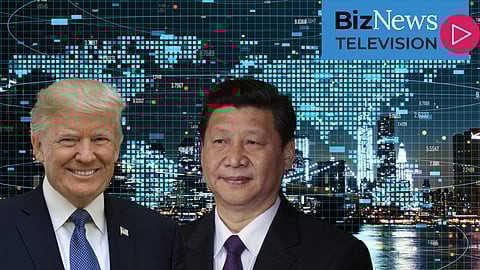
This is a must-watch interview for anyone trying to make sense of the chaos wrought by US President Donald Trump’s moves on tariffs. Johann Human spent his career in International Trade, including 17 years as an SA secondment to the Geneva-based World Trade Organisation. He provides a rare insider’s view of what is happening today - how the massive trade imbalances were always destined to end in the kind of explosion we are witnessing. He also shares some practical advice on how South Africa needs to position itself to avoid becoming collateral damage in a trade war caused by decades of Chinese outsmarting the Americans..Sign up for your early morning brew of the BizNews Insider to keep you up to speed with the content that matters. The newsletter will land in your inbox at 5:30am weekdays. Register here.Support South Africa’s bastion of independent journalism, offering balanced insights on investments, business, and the political economy, by joining BizNews Premium. Register here.If you prefer WhatsApp for updates, sign up to the BizNews channel here..Watch here.Listen here.Edited transcript of the interview .Alec Hogg Seems like everybody's got an opinion on just about everything nowadays. When you watch the business WhatsApp channels, there are all kinds of insights that are provided, suggested, recommended. But you've got to get to the people who actually know. And a member of our community who knows about what's going on with international trade is Johann Human. He's spent a career—a lifetime—in this field, working in the South African operation, the DTI, then in Geneva, and also for 17 years at the World Trade Organisation. So if anybody knows what Donald Trump’s up to, what South Africa should be doing—he’s the man.Alec Hogg Johann, thanks for joining us and for sharing your insights with us. I guess it's not unusual in this day and age, with so much information being available, for people to have opinions on pretty much everything. But from what you're hit with on a daily basis—which we all are—how much of this stuff is actually worth listening to, and how much is being driven by some kind of agenda?Johann Human Okay, thanks, Alec, for the opportunity. I hope I can assist you in trying to get a little bit more clarity on what's going on—well, at least from my perspective. Just before I start, a caveat: all my comments should be seen in the light that I'm not pro-Trump, I'm not anti-Trump. I'm not pro-China, I'm not anti-China. I'm not pro-WTO, I'm not anti-WTO. But what I am is unashamedly and unapologetically a supporter of a rules-based multilateral trading system, which can create a level playing field for all countries—big and small. That includes South Africa.There's a lot of speculation going around, and people use very inflammatory language, which I find not very useful. I think one needs to go back and try to analyse the Trump phenomenon. I'm not surprised that he's trying to do something—what surprises me is the way he's been doing it. Of course, we all know that his strategy is to create chaos and then to create something good out of that chaos. And that’s what he’s been saying. That’s all good and well—if you can manage the chaos. If you cannot manage the chaos, then it's a very risky game, particularly when you're dealing with something that affects the whole world. It’s not just a US issue.Now, of course, the US has its own concerns and ways of going about its business. But again, it affects the whole world—including us here in South Africa. And that makes it very, very problematic. So, there are lots of opinions going around, but you need to look a little into history and dig into what happened in the past. This is not something that...Alec Hogg Mm.Johann Human ...is new. It wasn't new in Trump 1, and it's no surprise that in Trump 2, he's really ratcheting up his efforts to set things right—the way he sees it.Alec Hogg Johann, let's just start then at the very beginning. You've been involved in this field since 1984. You've served at the highest level, listened to all the arguments. But I guess the place to start is 2001, when the Chinese were introduced into the World Trade Organisation. In other words, the intention then from the Western world was: if we bring China in and apply the rules, they will become part of the rules-based system around the world, and global trade will boom. I suppose that was the intention. At the time though, many people now look back and say, "Hang on, there were big mistakes made then." Just help us through them, because you were right in the middle of all of this.Johann Human Yes, you're right, Alec. It was around 2000–2001 when things started to develop. China was admitted as a member of the WTO in December 2001—that was the operational date. Now, of course, there were lots and lots of negotiations for many years before they were allowed to accede. Those negotiations were primarily conducted under the Clinton administration, when Charlene Barshefsky was the US Trade Representative.You also have to take into account that this was just a few years after the fall of the Berlin Wall—a totally new world. Some people even called it "the end of history." And also, 9/11 happened toward the end of the negotiations to allow China in. At that stage, there were high hopes. The Chinese system at the time wasn't fully compatible with what was required to become a member of the WTO, but the feeling among the bigger players was: "Okay, China is on the right track." They had made the right noises. They had started with some reforms. They emphasised the rule of law—which was a completely foreign concept in the Chinese legal system—and used that to bring some order into their system.Interestingly, the acronym WTO is not translated into Chinese; they use it as is—“WTO”—as a sort of shining light, a beacon. They followed the rules, not fully, but there were good hopes they'd continue on the path. And for the first couple of years, that's exactly what they did. But then...Johann Human ...what happened was 2008—the financial crisis. And of course, China was heavily affected. My Chinese friends often told me, “We looked at capitalism, we liked it—that’s why we went for a Chinese system with capitalistic characteristics." But after 2008, they said, “No, our system isn't that bad. Capitalism isn’t 100% okay. We need a mix.” And they pivoted back—particularly in the area of state-owned enterprises (SOEs).Before 2008, they had privatised a lot of their SOEs. But afterward, they strengthened the key ones—for very obvious reasons. Now, state-owned enterprises are allowed under WTO rules, and even before that, under the old GATT rules. But you need to act as a private company and follow free market principles. If not, you're in violation—and the rules address that.After 2008, China refocused on SOEs. And here's where it gets interesting—they are incredibly astute students of international law. They studied all the WTO rules very carefully. For example, the WTO consists of multiple agreements, including one on subsidies and countervailing measures (we call it the subsidies agreement). There were gaps in that agreement—negotiated during the Uruguay Round—that didn't really address SOEs on the scale of China.Johann Human So to say that the Chinese were just flouting the rules isn’t entirely accurate. They were very good at finding and exploiting the gaps in the system. Also, in the Protocol of Accession, there was no clear provision on transparency. So to this day, no one really knows the extent and depth of Chinese state subsidies. And that is the heart of the problem.Alec Hogg So let’s just understand it in simpler terms. It’s like having a competitor who’s supported and subsidised by the state—maybe through finance or other means. And it’s worked really well for China. They’ve flooded the world with products, generated massive exports. And the Americans perhaps played along by offshoring their manufacturing. Then Trump comes to power, backed by people who lost their jobs—jobs that might have remained if China hadn’t exploited the system. Is that a fair way to describe it?Johann Human Yes, very much so. It’s easy to be wise in hindsight, but that’s exactly what happened. Also, certain US companies pushed for specific outcomes in the accession negotiations—for their own benefit. Some sectors pushed harder than others. Sectors with high labor intensity weren’t as active, and their interests weren’t adequately protected. That created an imbalance.The idea was, “We open our markets to China, and they’ll open theirs in return”—a market of 1.3 billion people. So there was huge potential for US companies. But what resulted was not entirely two-way traffic. Some US firms made massive profits, but others suffered.Alec Hogg So it’s not just Trump—this is actually much broader. Would it be fair to say he’s more the symptom than the cause of this issue?Johann Human Absolutely, Alec. The US has been raising these concerns for many years, long before Trump. I remember back in 2010 already, at WTO meetings, the Americans were saying, "Look, this system isn’t working for us the way it’s supposed to." And it’s important to note—there’s a misconception that Trump is acting outside the rules. That’s not entirely accurate.He’s using the existing rules—but stretching them to the maximum. In some cases, he’s testing the boundaries, and in others, you could say he’s breaking the spirit of the rules rather than the letter. For instance, when Trump imposed tariffs on steel and aluminium using national security grounds—that was under Article XXI of the GATT. It’s a self-judging clause, meaning countries can decide for themselves what’s a national security concern. That’s very hard to challenge. So technically, he was within the rules, even though it upset a lot of people.Alec Hogg It sounds like the rules were never really designed for a player like China, and they weren’t expecting someone like Trump to come along and weaponise them.Johann Human Correct. The rules were written for a different time. They were designed in the 1990s, at the end of the Cold War, when there was a very different global order. The assumption was that countries would move toward liberalisation, openness, and integration. But China’s model is different. It’s state capitalism, and it’s been incredibly successful for them—but it challenges the assumptions baked into the WTO system.So, Trump comes in and says, “We’ve had enough. This system doesn’t serve our interests anymore.” He’s not the first to say it—but he’s the first to take such aggressive unilateral action. That’s the difference.Alec Hogg Let’s shift this to South Africa. What does this all mean for us? Are we just passengers here, or do we have some agency in how we respond?Johann Human Good question. We’re a small, open economy, so global rules and predictability are absolutely essential for us. If the system breaks down, we suffer—because we don’t have the economic muscle to throw our weight around like the US or China. So we need a rules-based system to protect us.And yes, we do have agency. We can align ourselves with like-minded countries and push for reforms in the WTO that level the playing field. But it requires strategic thinking. We can’t just sit back and watch. For example, the African Continental Free Trade Area (AfCFTA) is a huge opportunity. If we position ourselves correctly, we can become a gateway into Africa for investment and trade. But if we get caught in the crossfire between the US and China, we’ll just be collateral damage.Alec Hogg There’s been talk of the WTO becoming less relevant. Do you think it’s still fit for purpose?Johann Human It’s not fit for purpose in its current form. But that doesn’t mean it should be thrown away. The WTO is like an old car—it needs repairs, but the engine is still good. If we lose the WTO, we go back to a world where the strongest powers dictate the rules. That’s not a world that’s good for South Africa.Reform is necessary. The dispute settlement system is currently broken—mainly because the US blocked appointments to the Appellate Body. That’s serious, because the system only works if disputes can be resolved in a fair, impartial way. So now you’ve got cases being brought, and decisions being made, but if one party appeals, the whole thing is in limbo. That undermines trust.But the core idea—a global rules-based system—still has massive value.Alec Hogg And if Trump comes back into office—do you see things escalating?Johann Human I think so. Based on what he’s been saying publicly, his next term would be even more confrontational. He’s talked about imposing a universal 10% tariff on all imports into the US. That would be a clear violation of WTO rules. It would almost certainly provoke retaliation from other countries, and it could spiral into a global trade war.And for us in South Africa—that would be devastating. Our exports would be hit, our supply chains disrupted, and our currency would come under pressure. We’re not immune. That’s why we need to be proactive—strengthen regional ties, diversify trade partners, and push hard for WTO reform.Alec Hogg It sounds like we’re at a real crossroads. So what’s the way forward—for South Africa, and for the WTO?Johann Human Yeah, we are. The world is shifting, and we have to be clear-eyed about where our interests lie. For South Africa, we need to build resilience. That means strengthening trade ties in our region through the AfCFTA, improving our infrastructure, and creating an environment that attracts investment.At the WTO level, we have to be part of the reform conversation. Not just as passive observers, but as active participants. There’s a group of countries—including some developing ones—trying to come up with practical ways to fix the dispute settlement system, to make negotiations more inclusive, and to ensure the rules reflect modern realities like digital trade and climate change.We need to be part of those conversations—not just complain from the sidelines. And we have smart, capable negotiators. We’ve played constructive roles in the past. We can do it again.Alec Hogg You’ve been inside this system for decades. Are you optimistic about its future?Johann HumanLook - I’m cautiously optimistic. The WTO is under pressure, no doubt. But people often forget what the alternative is. Before the WTO, trade disputes were settled through power politics - the strongest countries imposed their will, and the smaller ones had no recourse.With all its flaws, the WTO has brought stability, predictability, and a voice to countries like ours. It’s worth fighting for. But it needs to evolve. The world has changed, and the rules must change with it.We’ve done it before. We can do it again.Alec Hogg That’s a good note to end on. Johann Human, thanks for sharing your insights - it’s been a real eye-opener.Read also:SA unveils bold 2025 immigration overhaul to woo global talent, turbocharge tourism, and fuel economic surgeGlobal strongmen seize power amid chaos, fueled by Trump’s unstable world orderBN Briefing - ANC: Trump is tormenting us everyday; Mbeki: ANC is inept; Trump pauses tariff