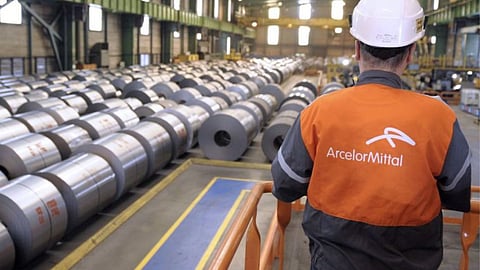
Key topics:ArcelorMittal slows losses but remains deeply indebted and fragile.Longs division closed; cash raised from scrap, Flats production rises.Survival hinges on IDC support, government tariffs, and parent backing..Sign up for your early morning brew of the BizNews Insider to keep you up to speed with the content that matters. The newsletter will land in your inbox at 5:30am weekdays. Register here.Support South Africa’s bastion of independent journalism, offering balanced insights on investments, business, and the political economy, by joining BizNews Premium. Register here.If you prefer WhatsApp for updates, sign up to the BizNews channel here..By Alec Hogg.There is a sombre inevitability about reading ArcelorMittal South Africa’s (AMSA) financial results these days, especially for some of my friends and family who still live in the Newcastle, town of my youth.For years, the once-mighty Iscor has been a proxy for South Africa’s de-industrialisation—a giant slowly shrinking into a shadow of its former self. This morning’s release of its financials for the year ended 31 December 2025 is no different. The headline numbers point to a company that has undergone radical surgery to survive, but one still very much in the recovery ward. At the risk of overworking the medical analogy, there’s a "Do Not Resuscitate" order hovering in the background as an accounting "material uncertainty" regarding the groups status as a going concern..The amputation is complete.The big news, of course, is that the deed is finally done. The Longs Business—the division responsible for the long steel used in construction and infrastructure—has been formally wound down into care and maintenance.For decades, the giant steelworks just north of Newcastle, heart of the group’s Longs operations, was the heartbeat of KwaZulu-Natal’s industrial economy. Today, we learn that production has ceased. Nothing is taking place there. Instead, management talks of converting the site into an "industrial park" and selling off scrap to generate cash. It is a polite way of saying the vultures are circling the carcass of what was once a national strategic asset.The financial impact of this amputation is stark. The company took a massive 16% haircut to R32.3 billion. Sales volumes crashed 12% to just 2 million tonnes. In its heyday, the company moved multiples of that volume. We are witnessing the shrinking of a giant in real-time..Less red ink, but still red.CEO Kobus Verster and his team will argue, with some justification, that the medicine is working. The bleeding has slowed. Financially, that is. The headline loss for the year was R3.35 billion. That is a horrific number in isolation, but it is an improvement on the R5.1 billion haemorrhage recorded in 2024. Similarly, the EBITDA loss fell 63% to R1.1 billion.Management attributes this to the "Value Plan"—corporate speak for aggressive cost-cutting—which saved R1.1 billion during the year. They also managed to neutralise the EBITDA bleed from the Longs business, which had cost them R1.6 billion the year prior.But let’s not pop the champagne just yet. The company’s net borrowings have ballooned to R6.4 billion, up from R5.1 billion a year ago. When you are losing money at an operating level and your debt pile is growing, you are walking a tightrope..The "Material Uncertainty".Notably, Arcelor Mittal’s auditors, Ernst & Young, have once again flagged a "material uncertainty related to going concern". This is the auditor’s way of saying: “Anyone doing business with this company should proceed with extreme caution."The company’s survival is now heavily dependent on three things, none of which are guaranteed:The IDC: The Industrial Development Corporation is effectively the life support machine. Discussions regarding a R1 billion working capital facility are ongoing, and the "Borrowing Base Facility" needs to be refinanced or deferred.The Parent: The multinational ArcelorMittal Group, based in Luxembourg, has provided a subordinated loan of R5.5 billion. Without "Big Daddy" backing the local operation, the lights would have gone out long ago.Protectionism: Management is banking on the Department of Trade, Industry and Competition to implement fair trade policies and tariffs in Q1 2026. They are betting the farm that the government will finally block the flood of cheap Chinese steel, which hit a record export level in 2025..Green shoots in the rubble?.Is there an investment case here? For the brave contrarian, perhaps.With the bleeding Longs business cauterised, the remaining "Flats" business (Vanderbijlpark) is technically capable of making money. Crude steel production at the Flats division actually rose 8%, and the company claims to have "substantial available capacity" to replace imports.Furthermore, they have managed to squeeze R1.2 billion in cash from the sale of "surplus metallics" (scrap). Free cash flow, while still negative, is expected to improve as the heavy restructuring costs fall out of the base..The Verdict.However, the risks are terrifying. The Rand has strengthened, which is actually bad news for AMSA as it makes imports cheaper and lowers the local steel price. The Chinese are exporting deflation to the world, and AMSA is in the firing line.What we have left is a smaller, leaner, but deeply indebted company that is entirely at the mercy of government policy and a state-owned financier (the IDC).Kobus Verster has done the hard work of cutting off the gangrenous limb. The question for 2026 is whether the patient's remaining blood is enough to survive the recovery. Until the IDC signs on the dotted line and the DTIC gazettes those tariffs, AMSA remains a speculative punt, not an investment.