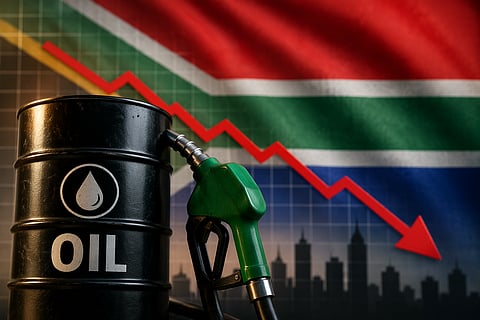
Key topics:IMF downgrades South Africa’s growth outlook more sharply than the global average.Heavy reliance on imported oil and shrinking refining capacity deepen SA’s vulnerability.Higher energy costs, inflation and rising public debt could further weaken growth.Sign up for your early morning brew of the BizNews Insider to keep you up to speed with the content that matters. The newsletter will land in your inbox every morning on weekdays. Register here.Support South Africa's bastion of independent journalism, offering balanced insights on investments, business, and the political economy, by joining BizNews Premium. Register here.If you prefer WhatsApp for updates, sign up to the BizNews channel here..By Dr Azar Jammine*.Downward revision of growth forecasts for SA.Why does this matter to me?.Unsurprisingly, given the surge in inflation expectations in recent months in the wake of the Iran war, the IMF has revised its base-case growth forecast for the world economy in 2026 downwards to 3.1% from 3.3% in January. The 2027 forecast is left unchanged at 3.2%. The disturbing feature, however, is that the downward revision for growth of the South African economy is even greater, at -0.4%, with a forecast growth rate for 2026 now put at 1.0%, rising to 1.3% in 2027 compared with an earlier forecast of 1.5%.In other words, forecast growth for South Africa has been revised downwards by more than the average for the rest of the world, reflecting the country's vulnerability in not being able to insulate itself from dependence upon oil, refined fuel and gas imports, with a significant rundown of domestic refining capacity over the past decade having increased this import dependency. And these are the best-case scenarios. The IMF also paints two further scenarios, which are more negative. The most negative scenario is based on oil prices rising to $100 per barrel in 2026 and $125 per barrel in 2027, with world economic growth coming in at just 2.0% in 2026, driven by the absence of a short-term settlement of the war..Reference scenario based on $82 oil price for 2026.Amid great uncertainty about how the global economy is likely to play out this year, with few willing to bet on the duration of the Iran war, the IMF has presented three alternative scenarios in its April outlook. Its base case, with an assumption of oil prices averaging $82 per barrel for the year, sees growth being revised downwards modestly for the world economy, by -0.2% in 2026, to 3.1%, from the 3.4% growth rate forecast at the time of its last forecasting exercise in January, prior to the outbreak of the war in Iran. In this scenario, inflation averages around 4.4% for this year..The picture is somewhat more optimistic for 2027, with the growth rate for the world economy being left unchanged at 3.2%. Inflation falls back to 3.7%. There is a marginal downward revision to forecast growth for the US economy in 2026, of -0.1%, to 2.3%, but an improvement of 0.1% in 2027 compared with the previous forecast. For the Eurozone, the forecast growth has been reduced by -0.2% for both 2026 and 2027. .In some instances, where countries are endowed with oil and can benefit from higher oil prices, such as in Russia and Brazil, the forecast growth has been revised upwards by 0.3% in 2026. All of these more optimistic forecasts are based on the assumption that the war does not last beyond another month or so, allowing oil prices to drop back to an average of $82 per barrel for the year..Salutary bigger downward revision for SA growth.Sadly, the downward revisions of economic growth for South Africa are greater than those for the rest of the world. For 2026, growth is now revised downwards to just 1.0%, from 1.4% previously, i.e. by -0.4%. Even for 2027, forecast growth is now -0.2% lower, at 1.3%, down from the 1.5% forecast in January. One reason for the relatively worse outcome for South Africa's economic growth is the fact that the outlook for emerging markets as a whole is much more sensitive to the rise in oil prices and inflation expectations than that of advanced economies. Specifically, such emerging markets are vulnerable to a considerable increase in food prices and to currency depreciation, leading to economic growth that is, on average, 0.5% lower than predicted three months ago. South Africa is part of this grouping. Secondly, it is classified as a significantly negative net importer of oil. One suspects in this regard that the IMF is significantly more bearish about South Africa's ability to undertake structural reforms to reduce its dependence on imported oil and refined fuels. It is a tragedy that only two out of six erstwhile refining plants in the country are still operating..The country's dependence on energy imports has therefore increased proportionately in recent years. This has been an integral function of the economy’s increased deindustrialisation over the past decade or two. Although the IMF alludes to increased optimism for 2027 based on the introduction of more structural reforms, we know from a report a month ago by the organisation that it sees significant constraints on economic growth in South Africa emanating from an environment of overregulation that is stifling the creation of new businesses and investment more generally. Sadly, in a table of forecast growth for leading economies worldwide, South Africa ranks among the five slowest-growing..Mind boggles if the worst-case scenario materialises.This relatively sober outlook for economic growth in South Africa compared with the rest of the world is arrived at based on the “best case” “reference” scenario adopted by the IMF, presumably as its "official" forecast. The institution, however, has also included two alternative forecasts based on significantly higher oil prices on this occasion. The first is what is called an "adverse" scenario that assumes oil prices averaging $100 per barrel this year and $75 in 2027, compared with the base-case optimistic assumption of $82 per barrel.Effectively, oil prices are assumed to be 80% higher this year than last year and 2027 prices, although on a downward path, are assumed to be a further 20% higher than one year earlier. In this scenario, global economic growth is considerably lower in 2026 at 2.5%, -0.6% below the growth forecast in the reference scenario. Inflation rises to an average of 5.4% this year and 3.8% next year, eroding disposable incomes and causing growth to come out much lower. Worse still, the IMF assumes a "severe" scenario based on average prices of $110 per barrel in 2026 and $125 in 2027, with gas prices rising by 200%. World economic growth plunges to no more than 2.0%, which, based on historical precedent, constitutes a global recession. The mind boggles as to what such an outcome would do to South Africa's economic growth. If it were to decline in line with the downward revision for the world economy, it would plunge the country's economic growth to zero for this year and barely positive for next year. If one assumes that emerging markets would suffer proportionately more, then the South African economy would naturally end up with negative growth. Fortunately, recent evidence suggests that settlement talks are preventing the materialisation of such a "severe" scenario. In such a scenario, inflation rockets to nearly 7% worldwide before dropping back to a still-high level of more than 4% in 2027. If there is one bright spot in the IMF narrative, it is that it foresees precious and base metal prices maintaining the gains achieved in 2025. This being the case, one is left to ponder whether the view of South Africa's economic growth prospects might be overly pessimistic. They are nonetheless barely more negative than our own most recent official forecast sent to clients yesterday morning..Worrisome increases in public debt levels.There are further reasons for concern emanating from the latest IMF World Economic Outlook. This relates to the fiscal situation in the world's leading economies. The IMF sees the US budget deficit rising to 7.5% of GDP in the coming year from 6.8% last year, and its public debt-to-GDP ratio increasing from 124% in 2025 to 142% by 2031. The institution alludes to the fiscally expansionary "Big Beautiful Bill" introduced by the Trump administration last year, as well as assumptions about increased defence spending specifically.The situation is not as negative in the case of the Eurozone, with the public debt-to-GDP ratio forecast to rise from a still-high 87% of GDP in 2025 to 90% by 2031.Ominously, the corresponding increase in public indebtedness for emerging markets over the next six years is from 74% to 86% of GDP. Given the negative perception of emerging markets’ indebtedness, it is no wonder the organisation is so pessimistic about the South African economic outlook. The country carries many of the debt constraints prevalent in the rest of the continent. The only saving grace is that fiscal policy appears to have become somewhat more responsible under the Government of National Unity. From a monetary policy perspective, the IMF alludes to the desire of the US to reduce interest rates, citing a terminal fed funds rate of 3.1%. In contrast, it foresees the European Central Bank's policy rate rising by 0.5% over this year and next. This combination of higher public debt and a penchant for lower interest rates in the US would ordinarily be interpreted as weighing on the Dollar's prospects over the coming year. It has been interesting to note that the US currency has stopped gaining ground in recent days, notwithstanding the ongoing Iran war, which traditionally ought to have driven safe-haven buying of the greenback. It has nonetheless contributed to the Rand regaining much of its lost ground in recent days, which ought to help, at the margin, in restraining the rise in inflation. Even so, the potential for domestic interest rates to increase by at least 0.5% in coming months remains..*Dr Azar Jammine is the Director and Chief Economist of Econometrix