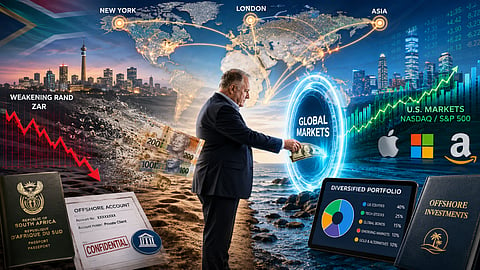
Key topics:Offshore investing trend driven by SA’s long-term underperformanceRand weakness, weak growth, and political risk eroding local returnsDiversification abroad seen as protection against policy and capital controls.Sign up for your early morning brew of the BizNews Insider to keep you up to speed with the content that matters. The newsletter will land in your inbox every morning on weekdays. Register here.Support South Africa's bastion of independent journalism, offering balanced insights on investments, business, and the political economy, by joining BizNews Premium. Register here.If you prefer WhatsApp for updates, sign up to the BizNews channel here..By Magnus Heystek*.Dear Piet, Your article on BizNews earlier this week, "The case for investing in SA keeps growing........" refers.As Mark Twain once remarked: "Pardon the long letter, as I didn't have the time to write a short one."It's no secret that I have been recommending offshore investing, especially equity investing, to my clients for many years, almost 29 years to be exact.Why 29 years, you might ask?Well, that was when the doors to the forbidden fruits of offshore investing were opened a teeny-weeny bit, an almighty R100 000 under Trevor Manuel in 1997.You might recall that in the 37 years from 1960, under the Nats' regime, offshore investing was verboten.People went to jail and had their assets confiscated if they were caught trying to build an offshore nest egg, for whatever reason.As a financial journalist/editor, I was fortunate to attend many global conferences, such as the IMF/World Bank conference in Bangkok in 1986.I sat there as a South African, listening to talks about the raging bull market on Wall Street at the time (the bull market lasted from 1980 to 1987 and was one of the most spectacular ever), realising that it was a crime for a South African investor to be invested in that market..Read more:.Externalising capital: The evolving framework for offshore investment by SA residents.The absurdity was this: I was allowed to report on this market, but anyone who acted on it and invested money in it (or any other global market) was guilty of a crime. I also realised that SA was a very small player in the global financial system, even more so today. The SA economy today accounts for less than 0,5% of the world economy and about 0,37% of emerging markets.In 1980, the rand was trading at $1,40. No, that's not a mistake. Over time, I witnessed a currency that, with the exception of the 2022-2007 period (when commodities were running hot), declined by about 6% per annum. In USD terms, a rand is worth 0,058c today.Those events had a great influence on me, so when it became legal to recommend offshore investing to my clients, I did so.At first, there was no great appetite, and the outflow of money was a trickle, not the rush that it is today.Fast forward to the 2002-2008 bull market in global commodities, when China joined the World Trade Organisation and began buying commodities on an enormous scale.During that time, the rand strengthened from around R13 to R5.70, and the JSE, together with other commodity-producing countries such as Australia and Canada, was a world-beater in terms of performance.WORLD CUP BOOM At the same time, the World Cup was heading our way, and for several years, the country looked like one massive building site. Even the turbulence of the Great Financial Crash of 2008 could not shake our exuberance.Who can forget those vuvuzela-filled days in South Africa? I still have my vuvuzela in my bar at home, and I fondly think about the SWC matches I happened to attend.But post 2010, something started happening. The USA economy was first out of the blocks in terms of economic recovery, and it also started showing up in the GDP numbers.Growth in South Africa started drifting sideways, and to any watcher of economic data, as was my occupation, it soon became very obvious that SA’s growth was faltering. SA has now underperformed global growth rates for almost 15 years, not only against the developed world but also against emerging markets.Our growth rate has been stuck at around 1% per annum since then, compared to an average growth rate of 3,4% worldwide.The US stock market started to pull away from the rest of the world, driven especially by technology companies such as Amazon, Apple, Microsoft, and, later, Facebook, as well as a clutch of other companies that have since become world-beaters.I was fortunate to attend a lecture by US financial commentator John Mauldin in 2011, discussing the coming technology revolution and the great opportunities on offer to the whole world, except for South African investors.At the same time, we witnessed the first signs of what would become known as the Gupta years. Under former president Jacob Zuma, the state was systematically looted, which affected consumer confidence and investment performance.The most visible effects were a sharp drop in the currency and the JSE's underperformance against world markets..Read more:.SA’s Shyft towards offshore investing.The period from 2010 to 2020 was particularly poor for SA investors, as shown by the accompanying performance figures. What was I supposed to do? Ignore the data and advise investors to invest in under-performing assets? The answer is no..During this time, I had a weekly radio show on RSG and a column in several newspapers, and I started writing about this trend... while also recommending offshore investments.Boy oh boy. It was like I was committing heresy or promoting paedophilia, such was the reaction from the local investment community. Invites to golf days and lunches dried up. RSG ended my weekly slot on the radio as my observations weren't considered "patriotic" enough. In comments on X and my Moneyweb articles at the time, I was openly called an "idiot" or even worse.But the markets (and the investment returns) didn't lie. I saw how clients with offshore investments were outpacing the returns on local markets.Over this period, the Treasury gradually increased the offshore allowance, first to R4 million and then, from 2015, to R10 million per taxpayer. In this year's budget, the single discretionary allowance was doubled to R2m per taxpayer.Since 2015, an estimated R1,2 trillion has legally left SA in this manner to offshore pastures. According to figures supplied by Currency Direct, more than R160bn was legally sent abroad by SA investors in 2025, about the same amount as the year before.If I am to be labelled as one of the "helpers", as you described it, advising and assisting local investors to take money offshore, then be it.I can assure you that there is not a single large financial institution in SA today that does not promote offshore investing. Only last night I saw an advert on national TV by Standard Bank advertising the merits of global wealth creation.All our large investment companies have formed alliances, one way or the other, with well-known offshore investment companies. All of Sanlam's considerable offshore assets are now managed by Ninety One.At the Biznews conference earlier this year, during my talk, I asked how many investors present did NOT have offshore investments, and not a single hand went up. THE FIRST RULE OF INVESTING: DIVERSIFICATIONSo, Piet, offshore investment is now mainstream in SA.It's not only the superior long-term returns that make this compelling, but also the need for diversification and risk spread. It's therefore no surprise that funds that focus on the local market are not attracting any material inflows.These two points are my main concerns about your article. You lament that SA entrepreneurs—when they sell their businesses in SA—take most, if not all, of the capital offshore.And by implication, not investing their money in your fund, which concentrates on the SA equity market.It would be unwise—and against all the rules of investing—to recommend that investors have all their assets in one country, and in one stock market. "Don't have all your eggs in one basket". Isn't that the first rule of investing?It most certainly is.Already, the other assets of the typical high-net-worth client (HNWC) are exposed to local conditions: property (with the exception of the Western Cape), farms, commercial buildings, pension funds (which are restricted by Reg 28), and other businesses and investments.All of these assets have undergone extreme value destruction under ANC rule.Any advisor NOT recommending greater offshore diversification is not acting in the best interest of his/her client and probably has a vested interest in not doing so.You overlook the political risk by investing all your money in an SA-focused fund or by recommending only local investments. The political risk, in my view, is HUGE. TREASURY MOVES SHOCK INVESTORS We have already seen the plans by the Treasury/SARB to try and control ownership of cryptocurrency, gold and foreign currency.What stops the Treasury from extending these draconian controls to other areas of investments, to offshore investments, for instance?And remember, the R2m/R10m foreign investment allowances, respectively, are just that: allowances. They can be repealed overnight by a simple regulation published in the Government Gazette.The collapse of the GNU is another political risk you cannot ignore.An ANC/EFF/MK alliance cannot be discounted, and there are often rumours about greater toenadering between these left-wing political groupings.And if that happens, the first thing to go will be the permission to invest capital offshore. Julius Malem and other firebrand socialist political leaders are on record as saying that these regulations are only benefiting the "rich whites" and must be scrapped.So while I can still "help" my clients take money offshore, I will. Despite your comments that the offshore returns "have not been great", I can assure you that over 10- and 15-year offshore returns have vastly outpaced local markets' returns.Last year was a good year for the JSE, no doubt, driven by a surging gold price, stellar returns from Naspers and Prosus, and even good 5-year numbers. But it could still not keep pace with the Nasdaq and S&P500, now a firm favourite amongst SA investors..Last year was a fantastic market for the JSE. Gold and commodity shares, plus Naspers/Prosus boosted the returns to around 50% for the year..These returns are unlikely to be repeated, as we can already see in the returns over the past 4 months.And even if the bull run on the JSE continues, one can use offshore instruments to provide exposure to the local market.Nothing stops investors with offshore money from investing in the JSE via an international platform by using a low-cost ETF such as the iShares MSCI JSE ETF (EZA). The returns have been great, and at a much lower fee (0,55%) than most local active fund managers, who charge between 1,5% and 2%..Read more:.Magnus Heystek reports from Europe: SA has fallen off the global investing radar.As an investor with offshore money, therefore, you can invest in the JSE without having to bring your money back into the South African capital controls net. ANC PROOF YOUR MONEY My investment strategy over the last 15 years has been to ANC-proof your money. This has been achieved by taking money offshore and selling any "investment" properties in SA, except in the Western Cape. Nothing has changed. The ANC will go down as the greatest destroyer of wealth the world has ever witnessed. This destruction of wealth is playing out on national television every night: the collapse of Johannesburg, the collapse of all towns and cities and SA (except WC again, the collapse of the railways, ports and almost every previously functioning institution in the country.I don't want my money (and that of my clients ) to be on board that sinking ship. And I suspect many others will agree with that..*Magnus Heystek is chairman of the Brenthurst Group of companies.