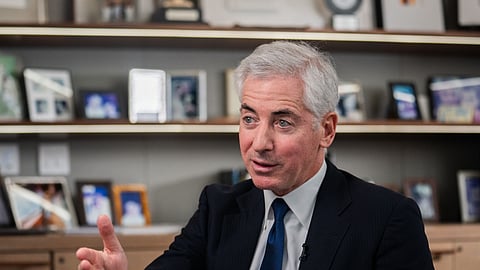
In the world of hedge funds, public listings are rare for a reason: investors are wary. The unpredictable nature of these financial juggernauts, driven by individual leadership and volatile earnings, often fails to inspire confidence. Yet, against the odds, Bill Ackman of Pershing Square Capital Management pursues this path, selling a 10% stake at a staggering valuation. But with a lean team and a history of mixed returns, can Pershing Square defy the odds and sustain its lofty ambitions?.Sign up for your early morning brew of the BizNews Insider to keep you up to speed with the content that matters. The newsletter will land in your inbox at 5:30am weekdays. Register here..By Marc Rubinstein.There's a reason so few hedge fund firms seek a stock market listing: Investors don't like them. .___STEADY_PAYWALL___.So it's a surprise Bill Ackman, founder of Pershing Square Capital Management, wants to go down the route — and that he found buyers for 10% of the common equity interest in his firm's parent company at a lofty valuation..As firms go, his looks far from ready for an initial public offering. Regulatory filings explicitly refer to key-person risk: "The Investment Manager is dependent on William Ackman to provide its investment advisory services…as he has ultimate discretion with respect to all investment decisions." For sure, he has a team behind him, with whom he shares the mic on investor calls, but they comprise only eight investment professionals among total staff of 40 – hardly the institutional heft of an enduring firm. And if anything should happen to him, the vehicle that provides over three-quarters of his firm's funds becomes subject to restrictive covenants..Read more: 🔒 Financial Times perspective: Bill Ackman sells entire Netflix stake at roughly $400m loss .Such a lean workforce partly reflects Pershing Square's investment strategy – to acquire and hold significant positions in a concentrated number of large-capitalization companies. The firm's $16.7 billion of assets is invested in just 12 stocks — two which have yet to be disclosed. No sophisticated algorithms, esoteric asset classes or even short sales here ; in theory, it's a portfolio you could replicate at home. But in order to justify its fees, the firm does have to offer something else, so it opportunistically puts on hedges with asymmetric payoffs — for example, to protect against macroeconomic risks and capitalize on market volatility. In 2020, these famously delivered; last year was the first since the pandemic they haven't contributed to performance..Although recent returns have been strong, that hasn't always been the case. Were the company already public, shareholders would have accrued performance fees in only five of the past 10 years. Most of the firm's assets are in a London-listed fund vehicle, Pershing Square Holdings Ltd., which has historically traded at a steep discount to net asset value, reflecting investor dissatisfaction. A more operationally leveraged management firm sitting on top would have fared worse. Although the fund paid the manager $1.7 billion in performance fees and $935 million in management fees over the 10-year period, its lumpiness would have made that hard to project..What Pershing Square does have going for it, though, is permanent capital. Indeed, Ackman cites this as a competitive advantage. The $13 billion of equity sitting in Pershing Square Holdings Ltd. isn't going anywhere – investors in a closed-end fund can sell to each other but they cannot redeem. Ackman wants to raise a similar closed-end fund domiciled in the US, with a target size of $25 billion. So attractive is it to hold permanent capital that he is prepared to forego performance fees..Read more: 🔒 Billionaire Bill Ackman's ambitious activist agenda: Reshaping America's institutions.The structure means that management fees – at 1.5% on the London-listed fund and 2% on the New York fund – are locked in as long as asset values remain stable, irrespective of customer flows. Together with around $3.7 billion of capital in traditional fund structures, these assets could yield around $730 million in annual management fees by my calculations. With only 40 staff to pay, there should be enough left over for outside investors. Ackman has promised to reduce performance fees on the London-listed fund depending on how much he raises in New York. A $25 billion raise would knock off $100 million from what the firm could collect, but if the fund returns 10%, that still leaves over $100 million of performance fees to share out. .If it achieves its $25 billion raise, over 90% of Pershing Square's assets would comprise permanent capital, putting it on a par with Blue Owl Capital Inc. which listed in 2021. Blue Owl currently trades on around 12 times fee-related revenue, which is probably the anchor for the $10.5 billion valuation Pershing Square's new strategic investors gave it in the recent sale. But Blue Owl is a lot more diversified, so its earnings volatility is likely to be lower. Holding on to the valuation requires Pershing Square to launch new strategies as well as continue to outperform..Ackman will be keenly aware of the fate of Sculptor Capital Management – he was part of a consortium that tried to buy it last year. When it listed as Och-Ziff Capital Management in 2007, it touted its competitive strengths: leading firm, team-based culture, research-driven investment process, record of positive returns. But shareholders were left disappointed as value was diverted to insiders. It's hard enough managing clients, investment positions and team members, without throwing in a whole new cohort of stakeholders as well..Read also:.Anthea Jeffery: ANC's blind pursuit of Soviet-era NDR pushing SA into death spiral🔒 Institutional investors flee Tesla amid growth concerns: What next for the electric car giant?Bacher: SA's high-stakes political game unnerves investors – big moves coming.© 2024 Bloomberg L.P.