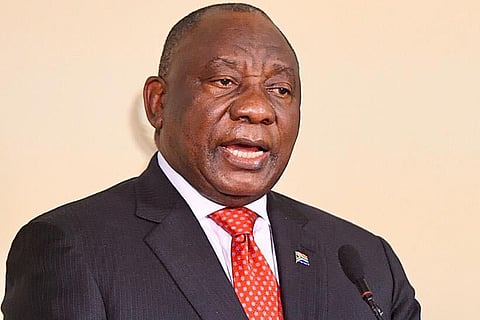
Key topics:Ramaphosa says local ownership rules align with global practices.Equity equivalence offers alternative to 30% ownership transfer.Draft rules to allow public comment before final approval..Sign up for your early morning brew of the BizNews Insider to keep you up to speed with the content that matters. The newsletter will land in your inbox at 5:30am weekdays. Register here.Support South Africa’s bastion of independent journalism, offering balanced insights on investments, business, and the political economy, by joining BizNews Premium. Register here.If you prefer WhatsApp for updates, sign up to the BizNews channel here.The auditorium doors will open for BNIC#2 on 10 September 2025 in Hermanus. For more information and tickets, click here..By Kerry Lanaghan.In a report by EWN, President Cyril Ramaphosa has reaffirmed his support for South Africa’s transformation policies, asserting that local ownership requirements for foreign companies are not unique to the country. Speaking in the National Council of Provinces (NCOP) on Wednesday, 25 June 2025, Ramaphosa addressed concerns about the balance between economic transformation and foreign investment, particularly in light of new equity equivalence regulations introduced by the Department of Communications.Responding to questions from NCOP members, Ramaphosa emphasised that international companies operating in South Africa should not be surprised by local ownership expectations. “We are not the only country in the world that requires local ownership,” he said, pointing out that such measures are part of broader global efforts to ensure inclusive economic development.However, the president also welcomed a shift in approach, highlighting the government's move to allow for “equity equivalence” as an alternative to direct ownership transfers. Under this framework, companies unable or unwilling to cede equity may contribute through investments supporting empowerment objectives, such as skills development or infrastructure projects.The new regulations, spearheaded by Communications Minister Solly Malatsi, mark a significant development in South Africa’s transformation strategy, particularly for high-tech global companies like Elon Musk’s Starlink, which has previously expressed reluctance to part with equity. The updated policy would allow such firms to operate without surrendering 30% ownership, provided they meet equity equivalence requirements.Ramaphosa defended this policy shift, calling it a pragmatic balance between promoting economic inclusion and attracting much-needed foreign investment. “If you’re not able to have joint ownership, we want equity equivalence that will help to address the injustices of the past,” he said.This stance, however, places the president at odds with some members of his party. ANC representatives in the parliamentary communications committee have previously pushed for strict adherence to the 30% ownership rule, particularly for historically disadvantaged groups. Despite this internal opposition, Ramaphosa insisted the policy does not dilute transformation goals but instead modernises their implementation.He also assured the public that the draft regulations would undergo a consultation process before becoming final. “South Africans will have an opportunity to make public submissions before they’re finalised,” he said, underlining the democratic nature of the policy-making process.Ultimately, Ramaphosa positioned the reforms as a step forward in reconciling the country’s transformational imperatives with global investment realities.