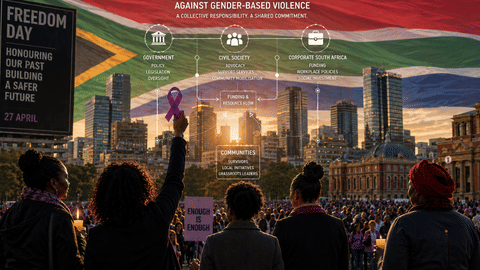
Key topics:GBVF crisis persists in South Africa despite democratic freedomsCall for corporate funding via GBVF Response Fund at scaleNeed coordinated action, governance, and measurable impact urgently.Sign up for your early morning brew of the BizNews Insider to keep you up to speed with the content that matters. The newsletter will land in your inbox every morning on weekdays. Register here.Support South Africa's bastion of independent journalism, offering balanced insights on investments, business, and the political economy, by joining BizNews Premium. Register here.If you prefer WhatsApp for updates, sign up to the BizNews channel here..By Dot Field*.More than three decades into democracy, South Africa marked another Freedom Day, celebrated with speeches, reflection, and resolve.Yet, gender-based violence and femicide (GBVF) remain a national disaster. And for millions of women and girls, freedom remains incomplete, constrained by fear, trauma, violence, and insecurity in homes, workplaces, schools, and communities.The question that must now be asked is, what are we actually going to do differently between today and 27 April 2027?A credible, well-governed funding vehicle to combat this scourge already exists. What is required now is sustained commitment, coordination, and action at scale. It is time for corporate South Africa to be fully engaged.The scale of the crisis is stark. Research by the Human Sciences Research Council (HSRC) indicates that more than one in three South African women have experienced physical or sexual violence in their lifetime, most often at the hands of an intimate partner, family member, or someone known to them. This is not an abstract statistic. It is a lived reality across every community in our country..Read more:.The Economist: The crisis of South Africa’s missing dads.Recent South African Police Service (SAPS) quarterly crime statistics continue to underscore the severity of the crisis, with thousands of sexual offences and hundreds of women murdered in a single quarter, many in domestic or intimate partner contexts. This is not episodic. It is persistent.While GBVF disproportionately affects women and girls, men and boys are also victims of sexual and gender-based violence. The impact is therefore broader than often acknowledged, reinforcing the need for a coordinated, society-wide response.GBVF cuts across income levels, professions, and geographies. No segment of society is immune. And so, while South Africa celebrates political freedom, too many men and women continue to live without the most fundamental freedom of all: freedom from violence.It is for this reason that President Cyril Ramaphosa described GBVF as a “second pandemic” at the height of Covid-19. In 2021, recognising the scale and urgency of the crisis, the Presidency requested the establishment of the Gender-Based Violence and Femicide (GBVF) Response Fund, with the International Women’s Forum South Africa (IWFSA) convening a coordinated private sector-led response.Now, as the Fund enters its fifth year, the urgency has not diminished. Unlike COVID-19, GBVF has not receded. It remains systemic and deeply damaging, weakening communities and eroding the country’s social fabric.It is also an economic issue. The World Bank estimated that gender-based violence can cost countries up to 3.7% of GDP - more than many governments spend on education. In South Africa, the costs are borne across healthcare, policing, lost productivity, and reduced participation in the economy.The Fund was established to address a critical gap: the absence of coordinated, well-governed funding at scale to support the national response. It provides a structured vehicle for directing financial and non-financial contributions towards high-impact interventions aligned with South Africa’s National Strategic Plan (NSP) on GBVF.Since its inception, the Fund has supported community-based organisations working directly with survivors, strengthened programme delivery, and contributed to a more coordinated, multi-sectoral response. It has become an important bridge between government, civil society, and the private sector, recognising that no single actor can address GBVF alone.Central to the Fund’s credibility is its governance model.The Fund is a registered non-profit company overseen by an independent board, chaired by Ms Faith Khanyile, comprising experienced leaders from business and civil society. It operates under stringent governance and due diligence protocols, designed to ensure fairness, integrity, accountability, and measurable impact.Leading professional services firms also support the Fund on a pro bono basis across legal, banking, administration, accounting, and audit functions. This ensures that resources are managed responsibly, transparently, and with appropriate oversight.The board’s independence is deliberate. It ensures that decisions are evidence-based, that capital is deployed effectively, and that the Fund remains focused on impact - free from undue influence while aligned with national priorities.For corporate South Africa, this should matter.Capital allocation depends on trust in governance, accountability, and delivery. The Fund has been structured to meet these requirements. It offers a credible, disciplined mechanism through which the private sector can contribute meaningfully and at scale.And yet, the national response to GBVF remains materially under-resourced relative to the magnitude of the crisis. This is where corporate South Africa must step forward.GBVF is not separate from business. It affects employees, customers, supply chains, and communities. It has direct implications for productivity, retention, and long-term sustainability. Addressing it is fundamental.The call to action is therefore clear.Corporate South Africa should commit funding at scale to the Fund as a central, well-governed mechanism for impact.Beyond financial support, businesses can deploy their capabilities, including data, technology, logistics, skills, and networks, to strengthen implementation and expand reach. At the same time, organisations should embed GBVF response within their own environments through workplace policies, support structures, and responsible value chain practices.South Africa has demonstrated, in times of genuine crisis, that it can mobilise collective effort with urgency and resolve. GBVF demands exactly that, sustained and at scale..Read more:.SA’s 30 years of democracy: Celebrating freedom despite challenges – Ivo Vegter.We have a national strategy. We have a functioning, credible vehicle in the GBVF Response Fund.What is required now is renewed and sustained commitment at scale.If we are serious about building a truly free society, then freedom from violence is non-negotiable.The time for acknowledgement has passed. What matters now is action and ultimately, accountability. So that when Freedom Day 2027 arrives, we are not repeating the same rhetoric and asking the same questions..*By Dot Field, Non-Executive Board Member, GBVF Response Fund and Chair of the Advocacy, Behaviour Change and Communications (ABC) Committee