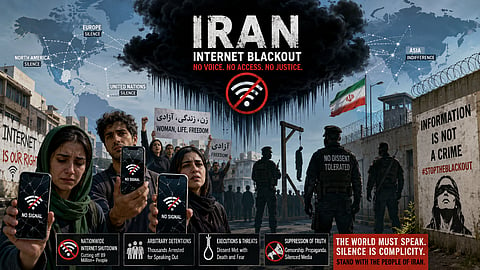
Key topics:Iran executions, repression, internet blackouts ongoingCriticism of South African platforming of Iranian envoyCalls for moral clarity and action on human rights abuses.Sign up for your early morning brew of the BizNews Insider to keep you up to speed with the content that matters. The newsletter will land in your inbox every morning on weekdays. Register here.Support South Africa's bastion of independent journalism, offering balanced insights on investments, business, and the political economy, by joining BizNews Premium. Register here.If you prefer WhatsApp for updates, sign up to the BizNews channel here..By Shervin Ghorbani*.We are not watching events in Iran from a distance. We are living them - through broken phone calls, vanished internet signals, and the growing list of names we fear to say out loud.In Iran today, executions are not a relic of the past. They are happening right now. Protesters are being hanged. Detainees are being tortured into confessions. The Islamic Revolutionary Guard Corps (IRGC) continues to brutalise civilians and, increasingly, to draw children into its machinery, enlisting and exploiting minors in its ranks and operations.When entire regions are plunged into internet blackouts, it is a deliberate act to hide what is being done: to silence victims, erase evidence, and prevent the world from witnessing the scale of repression. And yet, where are the urgent calls from human rights organisations? Where is the outcry from the international community? Where is the sustained pressure to stop it? The silence is as telling as the shutdown itself..Read more:.Iran’s deadly record: 1,639 executions in 2025, an absurd increase in its history.Over the past several years tens of thousands have been killed in state crackdowns. Children are among the dead. Families are left searching for answers that never come. For many of us in South Africa, that suffering is immediate and personal. We are not reading headlines, we are trying to reach loved ones who may already be gone..And yet, here in South Africa, the response has been silence - and beyond that, a deeply troubling willingness to look the other way.The National Association of Democratic Lawyers (NADEL) has formally invited the Ambassador of the Islamic Republic of Iran to address a South African audience on “International Law Under Siege” . This is not a neutral act. It is the granting of legitimacy, a platform, and moral cover to a regime that is actively executing its own people, suppressing basic freedoms, and weaponising the law against its citizens.This is not theoretical. The ambassador himself oversees the Iranian embassy’s X account, which routinely amplifies hostility, inflammatory rhetoric, and messaging aligned with a regime that thrives on intimidation. At the same time, the embassy forms part of a broader pattern of pressure and fear directed at diaspora communities who dare to speak out.Across the world, Iranian activists in exile report threats, surveillance, and retaliation against their families back home - a tactic widely documented as part of the regime’s effort to silence dissent beyond its borders. Families are harassed, relatives detained, and voices abroad are targeted precisely because they refuse to stay silent.We know this reality firsthand.The event is being officiated by Judge Siraj Desai, who has himself drawn controversy for stepping into highly charged political terrain. He was widely criticised for reportedly comparing Ayatollah Khomeini to Nelson Mandela, and in 2023 the Judicial Conduct Committee cautioned him to avoid political controversies. His continued defiance in the face of that warning only deepens concerns about the judgment and credibility of this platform.For those of us in the Iranian-South African community, speaking out is not without consequence. There is a real and growing fear that criticism here can carry a price for loved ones in Iran - that even from thousands of kilometres away, the regime’s reach does not end. And yet, in that context, a representative of that same system is being handed a microphone in South Africa - not to answer for these abuses, but to speak about law.At a moment when Iranians are being denied even the right to speak, this is not just tone- deaf. It is a betrayal of the very principles that the platform claims to defend.For those of us who have buried family members, who live with the fear of a phone that will never ring again, this is not just offensive. It is indefensible.We note with alarm a failure of leadership. There has been no public condemnation from the South African government of the executions, the killings, or the systemic repression unfolding in Iran. At the same time, there has been a refusal to acknowledge the grief of Iranian-South Africans - no recognition, no outreach, no expression of solidarity for a community carrying real and immediate loss. This is compounded by diplomatic inaction, with no visible effort to hold the Iranian state to account, even symbolically. Instead, we are witnessing something even more troubling: the gradual normalisation of a regime whose abuses are well documented, as civil society platforms in South Africa host its representatives as though these realities do not exist.South Africa knows what state brutality looks like. It knows what it means when a government turns its power against its own people, and what it costs when the world looks away. That is why this moment matters. Because what we are witnessing now is not just silence - it is the quiet normalisation of a system built on fear, violence, and control.We are proud Iranian South Africans. We believe in this country’s moral voice. But that voice loses its meaning if it is only used when it is convenient.We are asking, plainly and urgently, for the truth to be acknowledged. That means a clear public recognition of the executions, the killing of protesters, the use of childsoldiers, and the systematic repression taking place in Iran. It also meansacknowledging us - the Iranian-South African community - and the very real grief and fear we are carrying every day..Read more:.TCS Politics Desk: Mbalula’s Sharpeville rhetoric collides with ANC’s Iran silence.We are calling for engagement with integrity. Meet with our community beforeextending platforms to representatives of the regime responsible for these abuses.Apply South Africa’s human rights principles consistently, because they cannot beselective. They either matter everywhere, or they mean nothing. And ensure that South Africans who speak out against these violations can do so without intimidation.We are not asking for geopolitics. We are asking for moral clarity. Because right now, while people are being executed, while children are being drawn into violence, and while the internet goes dark to hide it all, South Africa is being tested.And silence, in moments like this, is not neutral..*Shervin Ghorbani Member of the Iranian Community in South Africa