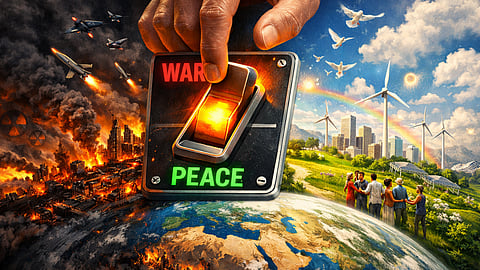
Key topics:World shifting toward permanent war and normalized escalationNo military victory solves global crises; risk of catastrophe risesUrgent call for de-escalation, reform, and shift to life economies.Sign up for your early morning brew of the BizNews Insider to keep you up to speed with the content that matters. The newsletter will land in your inbox every morning on weekdays. Register here.Support South Africa's bastion of independent journalism, offering balanced insights on investments, business, and the political economy, by joining BizNews Premium. Register here.If you prefer WhatsApp for updates, sign up to the BizNews channel here..By Jay Naidoo*.We are living through a dangerous moment in human history.Not only because wars are spreading across regions, or because tensions between great powers are rising again. But because something deeper is breaking: the idea that humanity can govern its own power with wisdom, restraint, and responsibility.We are drifting into a world of permanent war readiness.An endless cycle of conflict, rearmament, and technological escalation.And this descent is not abstract. It is being shaped by words as much as weapons.When leaders speak of overwhelming force as policy, when public discourse normalises the idea that peace can be secured through destruction, we cross a threshold.Recent rhetoric from senior figures, including escalatory language around total military force and the framing of war as a legitimate tool of negotiation, reflects a deeper shift in thinking. Donald Trump has repeatedly used language that leans toward maximal force, ‘bomb Iran into the stone age.’ Figures such as Pete Hegseth have been associated in public discourse with the notion that strength is demonstrated through force rather than restraint, “we negotiate with bombs.”These are not isolated phrases.They are signals.Signals of a world in which war is no longer the last resort.But a first language..Read more:.The Economist: Iran War about to escalate - Gulf States may join in.Military budgets are rising at record levels. Nuclear arsenals are being modernised. Artificial intelligence, one of humanity’s greatest breakthroughs, is being rapidly integrated into systems designed not to sustain life, but to end it more efficiently.This is not a strategy.This is a failure of imagination.And it brings us to a defining moment:A political chokepoint that will determine the fate of humanity. Beyond VictoryThe first truth is this: there is no military victory that will resolve the crises we face.No country can bomb its way to long-term security.No alliance can dominate its way to global stability.No technological superiority can substitute for legitimacy.The wars of our time are not isolated. They are symptoms of a system that has normalised insecurity as a permanent condition.If we continue down this path, the destination is clear:a world where conflict is constant, trust is absent, and the risk of catastrophic escalation, nuclear or otherwise, becomes a matter of time, not probability.The off-ramp must begin by rejecting the illusion that war can deliver peace. The Chokepoint This is not just another geopolitical moment.It is a narrowing passage in history.A point at which the accumulated weight of:• militarisation• technological acceleration• ecological breakdown• and political arroganceconverges into a single question: Do we continue down the path of domination, or do we change course?At this chokepoint, there are no neutral actors.Silence is complicity.Escalation is a choice.And leadership, true leadership, means stepping back from the edge. A Ceasefire with the Future The off-ramp the world needs is not owned by any bloc, any ideology, or any nation.It is a shared necessity.It begins with an immediate principle:No new wars. No expanded wars. No normalization of escalation.This requires ceasefires where conflicts are active, and a global commitment to de-escalation over dominance.Not as a moral gesture, but as a survival strategy.Because in an interconnected world, every war is now a global event, impacting energy systems, food security, migration, and the fragile ecological balance we all depend on. What the West Must Do NowIf this is a global chokepoint, then those who have held the greatest concentration of power carry a particular responsibility.The West must step away from a trajectory that increasingly resembles a dystopian future, one shaped by permanent war readiness, technological domination, and moral inconsistency.This is not about blame.It is about responsibility. It requires five decisive shifts: 1. Abandon the Doctrine of Permanent WarEnd the idea that security can be sustained through endless intervention, proxy wars, and military expansion. 2. Recommit to International Law Without ExceptionNo selective application. No exemptions. The same rules must apply to all nations. 3. Dismantle the War Economy BiasRedirect public investment away from military-industrial expansion toward climate resilience, food systems, and human wellbeing. 4. Lead Global Restraint on AI and Nuclear RiskSet binding limits on autonomous weapons and recommit to genuine nuclear disarmament. 5. Restore Moral Credibility Through ConsistencyHuman rights cannot be invoked selectively. Legitimacy depends on coherence between values and actions. Without these shifts, power will continue to erode into mistrust, fragmentation, and resistance. Reclaiming Law Over Power The United Nations system, designed in the aftermath of global catastrophe, is no longer fit for purpose in its current form. Its legitimacy is questioned, its structures outdated, and its authority often bypassed.We need a serious, time-bound process to:• Expand and democratise the Security Council• Limit the use of veto power in situations of mass violence• Strengthen the role of the General Assembly when the Council is paralysedLet us debate where in fact the United Nations should be based? This is not institutional reform for its own sake.It is about restoring a basic principle:That no nation, however powerful, stands above the law. Drawing the Line on AI and Nuclear Escalation We are entering a new frontier where the tools of war are evolving faster than our ability to regulate them.Artificial intelligence is already being integrated into targeting systems, surveillance architectures, and autonomous weapons platforms. At the same time, nuclear doctrines are being updated, arsenals modernised, and thresholds blurred.This convergence is unprecedented.The off-ramp must include:• A global treaty banning fully autonomous lethal weapons• Renewed commitments to nuclear disarmament, not expansion• Transparency and verification mechanisms for emerging military technologiesHumanity cannot accept a future where machines decide who lives and dies. From War Economies to Life EconomiesPerhaps the most urgent shift is economic.We are investing trillions in systems designed to manage conflict, while underinvesting in the systems required to sustain life.Climate breakdown accelerates.Food systems remain fragile.Inequality deepens.Communities fracture.The off-ramp requires a redirection of resources:From militarisation to regeneration.From extraction to restoration.From competition to cooperation.This is not idealism. It is the only rational allocation of resources in a century defined by ecological limits and technological disruption. Africa’s OfferingAt this chokepoint, Africa must step forward—not in opposition, but in offering.From the Cradle of Humankind to the Rift Valley, this continent holds the memory of our shared beginnings.And with it, a different proposition:That life is relational.That dignity is shared.That peace is cultivated, not imposed.Ubuntu is not a slogan.It is a civilisational alternative.Africa does not need to become the next centre of power.It can become a centre of balance. The Role of HumanityThe off-ramp will not come from power alone.History shows that systems rarely reform themselves without pressure from below.Movements for peace, justice, and dignity have always preceded political change.We are once again at such a moment.A new global peace movement is neededone that understands the complexity of this era, and insists that technology, economics, and governance be aligned with life, not destruction. A Choice at the EdgeWe stand at a threshold.One path leads to deeper militarisation, permanent instability, and the normalisation of technologies that could end human civilization as we know it.The other leads to a difficult but necessary transformation: of institutions, priorities, and values.The off-ramp is not a single agreement or a single summit.It is a direction.A decision to step away from the logic of endless warand toward a future grounded in cooperation, restraint, and shared survival..Read more:.Jay Naidoo: An illegal war, a broken trust — the questions the world cannot avoid.This is the chokepoint.And history will remember what we chose.The question is not whether we can afford to take that path.It is whether we can afford not to..*Jay Naidoo: Elder | Sacred Activist | Founder, Calabash International Regeneration Centre