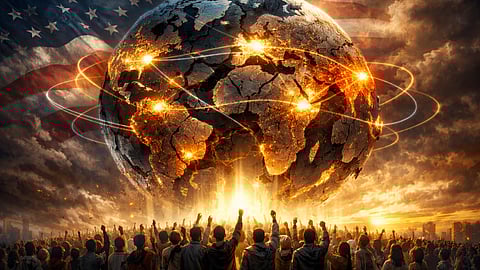
Key topics:US-led order shifting as multipolar world emerges after US-Iran ceasefireAsia/Europe realign: Japan, South Korea, India, China, Spain shift autonomyCitizen agency rises; decentralisation, ethics, Earth focus in global transition.Sign up for your early morning brew of the BizNews Insider to keep you up to speed with the content that matters. The newsletter will land in your inbox every morning on weekdays. Register here.Support South Africa's bastion of independent journalism, offering balanced insights on investments, business, and the political economy, by joining BizNews Premium. Register here.If you prefer WhatsApp for updates, sign up to the BizNews channel here..By Jay Naidoo.We are living through a quiet turning of the tide.Not with the drama of a single event. Not with the fall of a wall or the collapse of a tower. But through a series of small, deliberate decisions by nations that are beginning to step out of the shadow of a single centre of power.This is what the end of an era looks like.For decades, the United States stood at the centre of the global order. Its currency, its military alliances, and its political influence shaped the architecture of our world. Whether one agreed or disagreed with that dominance, it defined the rules of engagement.But today, something is shifting.The ceasefire between the United States and Iran was meant to create space for diplomacy. Instead, it has revealed a deeper truth: the rest of the world is no longer waiting. Across Asia and parts of Europe, nations are quietly recalibrating their relationships, their dependencies, and their sense of agency. This is not rebellion. It is realignment.Take Japan, long considered one of Washington’s most loyal allies. Its oil tankers now move with a new confidence, navigating the Strait of Hormuz not as an extension of American policy, but in pursuit of its own national interest.South Korea is choosing dialogue over confrontation, sending envoys directly to Tehran. This is not merely diplomacy. It is a signal that regional stability can no longer be outsourced to distant powers..Read more:. FT: A world divided – ‘rules-based’ order vs ‘multipolar’ vision.In Europe, Spain has reopened its embassy in Tehran, stepping away from a policy of isolation that no longer serves its interests. One senses that others may follow, not in defiance, but in quiet recognition that the world has changed.Then there is India, a civilisation that has always understood the importance of strategic autonomy. By allowing Iranian cargo under sanctions to enter its ports, India is not making a dramatic statement. It is simply acting in alignment with its own economic and geopolitical realities.China, meanwhile, is reshaping the very grammar of global trade. The movement towards yuan-denominated transactions in critical waterways like the Strait of Hormuz is more than a technical adjustment. It is a quiet but decisive step away from a dollar-centred world.Turkey positions itself as both mediator and energy corridor, while Pakistan refuses to be drawn into a conflict that would destabilise its region. None of these actions, taken alone, would signal a tectonic shift. But together, they form a pattern.The world is decentralising.We must be careful not to romanticise this moment. The decline of a dominant power does not automatically give rise to justice, peace, or wisdom. History teaches us that transitions between orders can be dangerous, even chaotic.But there is also a possibility here.For the first time in generations, we are witnessing the emergence of a truly multipolar world, a world where power is distributed, where nations assert their agency, and where no single voice can unilaterally dictate the course of history.And yet, we must ask a deeper question.Will this new world be guided by a higher consciousness, or will it simply reproduce the same patterns of domination in different forms? Because the crisis we face is not only geopolitical.It is civilisational.We have built systems that extract from the Earth without replenishing her. We have normalised war as an instrument of policy. We have allowed fear to shape our identities and divide humanity into competing camps of “us” and “them”.If the post-American era simply replaces one centre of power with several competing centres, then we will have learned nothing.But if this moment becomes an invitation to rethink our relationship with power itself, then something new can emerge: a world rooted not in dominance, but in interdependence; a world that recognises that security cannot be built on the insecurity of others; a world where economic systems serve life, rather than consume it.This is where the deeper work begins.Because the future will not be shaped by states alone. It should be shaped by citizens.History shows us that every moment of awakening carries within it the risk of capture. Empires fall, systems shift, language changes. But if consciousness does not deepen at the level of people, the same patterns return wearing new clothes.So the question before us is not only what nations will do.It is what we will do.The first task is to reclaim the agency. For too long, we have been conditioned to believe that power lies somewhere else, in governments, in markets, in institutions. But every system is sustained by participation. Transformation begins when citizens withdraw unconscious consent; when we refuse to be mobilised by fear; when we stop outsourcing our moral compass.A multipolar world without conscious citizens simply becomes a multiheaded empire.The second task is to rebuild the community. Elites thrive in fragmentation. Digital outrage is not power. Relational trust is power. Communities that can feed themselves, share resources, resolve conflict, and protect one another with dignity become the foundation of real sovereignty.This is not a retreat from the world. It is the regeneration of it.The third task is to re-anchor the economy in life. The dominant system today is extractive. If we do nothing, extraction will continue under new management. Every rand we spend is a political act. Supporting local food systems, cooperative ownership, and regenerative practices is not idealism. It is the construction of an alternative.The fourth task is inner sovereignty. Without inner work, external change collapses into old patterns. We must cultivate stillness in a world of noise. We must understand how fear and anger are triggered and manipulated. We must learn to respond rather than react. A person who is internally stable cannot easily be weaponised.The fifth task is to protect the truth. In times of transition, misinformation becomes a battlefield. Citizens must become guardians of discernment, holding complexity rather than collapsing into slogans, resisting the reduction of entire peoples into enemies.Truth without compassion becomes another weapon. Compassion without truth becomes complicity.The sixth task is to insist on ethical leadership, but not wait for it. Leadership must be rooted in service, but the future will not be delivered from above. It will be grown from below and between us, through councils, collectives, and communities of practice.And finally, we must root everything in our relationship with the Earth. Any system disconnected from the Earth will become extractive again.The Earth is calling us back, back to balance, back to relationship, back to truth.As an Elder, I do not see this moment simply as the decline of one nation and the rise of others. I see it as a threshold, a test of whether humanity can mature. Each nation will make its choices. Each leader will follow their own path. But ultimately, this moment will be decided in the small, daily choices of ordinary people..Read more:.US–Iran talks break down, fragile ceasefire in jeopardy.In how we live. In how we relate. In how we build. Will we replace one empire with many? Or will we co-create a world rooted in dignity, interdependence, and life?The post-American era is not just a geopolitical transition. It is an invitation: to step out of illusion and into the deeper truth of interbeing, human and non-human.To restore our frequency before we disturb the greater whole.And to remember that the new world will not arrive fully formed. It will be lived into being, one community, one relationship, one conscious act at a time.