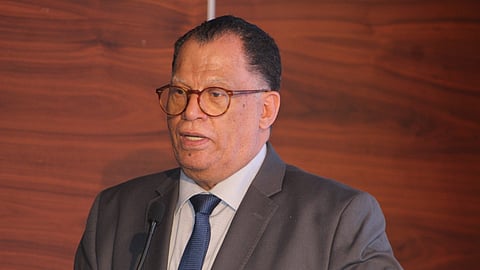
Key topics:SAFA’s executive size defies FIFA’s long-standing recommendation.Jordaan defends costly travel amid financial instability.CFO admits liabilities exceed assets, plans turnaround strategy..Sign up for your early morning brew of the BizNews Insider to keep you up to speed with the content that matters. The newsletter will land in your inbox at 5:30am weekdays. Register here.Support South Africa’s bastion of independent journalism, offering balanced insights on investments, business, and the political economy, by joining BizNews Premium. Register here.If you prefer WhatsApp for updates, sign up to the BizNews channel here.The auditorium doors will open for BNIC#2 on 10 September 2025 in Hermanus. For more information and tickets, click here..By Kerry Lanaghan.Listen to this story instead:.South African Football Association (SAFA) President Dr. Danny Jordaan faced scathing criticism from Parliament’s Sports, Arts and Culture Portfolio Committee on Tuesday. Lawmakers questioned the organisation’s dire financial state, excessive travel costs, and what they called a “bloated” executive structure. The oversight hearing, held on 4 June 2025, revealed deep concerns over SAFA’s governance and fiscal responsibility when the body struggles to meet its obligations.Committee member Liam Jacobs led the charge, pointing to a $ 500,000 FIFA loan being repaid between 2023 and 2025 - equivalent to R8.9 million - that has drained SAFA’s coffers. “You say you’re in a bad financial position, yet you are repaying millions and spending excessively on leadership perks,” Jacobs said, before confronting Jordaan on the size of SAFA’s National Executive Committee (NEC).According to Jacobs, in 2013, FIFA recommended that SAFA reduce its NEC to approximately 18 members. Over a decade later, that number has ballooned to 47, with escalating costs: SAFA paid R2.5 million in honorary allowances in 2023 and R6.1 million in 2024. This equates to R130,000 per NEC member last year, over six times what it would have cost with a leaner committee.“Had this recommendation been implemented,” Jacobs argued, “SAFA could have saved millions-almost the same amount the Department of Sports had to bail you out with.”Jordaan pushed back, arguing that the NEC's structure is enshrined in SAFA’s statutes and approved by its members. “It is not a matter of personal preference,” he said. “The composition of the NEC is determined by our constitution and is reflective of provincial representation.”However, criticism intensified when Jordaan was confronted with documentation showing his travel expenses, totalling hundreds of thousands of rands. These included trips to Qatar, London, Morocco, Cameroon, and Vietnam for the Oceania Football Confederation Congress. Jacobs questioned why SAFA representatives attended an Oceania meeting when it is “thousands of kilometres away and has no relevance to South Africa.”Jordaan defended the trips, claiming they were part of a campaign to secure South Africa’s bid to host the FIFA Women’s World Cup. “I had no business to go to Vietnam otherwise,” he said. “It was part of the lobbying process. You are part of that campaign now.”Jacobs, undeterred, continued: “SAFA is not in a strong financial position. You are burdened by debt, yet the leadership acts like a business. Who holds you accountable?”Under pressure, SAFA’s Chief Financial Officer admitted the organisation was fragile. “We are not in a strong financial position,” he said. “Our liabilities exceed our assets. We are addressing this, but it’s clear past budgeting errors and performance assumptions led us here.”He added that SAFA owns R250 million worth of unencumbered property assets, which could be used as collateral for loans, but only with a robust turnaround strategy. “We are working on a payment strategy and tightening our budgeting processes.”Despite accepting responsibility, SAFA leadership offered few specifics on cost-cutting or structural reform. As the hearing closed, MPs expressed concern over the lack of accountability and slow response to years-old financial warnings.The session underscored a critical juncture for South African football: without reform, even its most loyal government backers may lose faith in SAFA’s ability to manage the beautiful game.