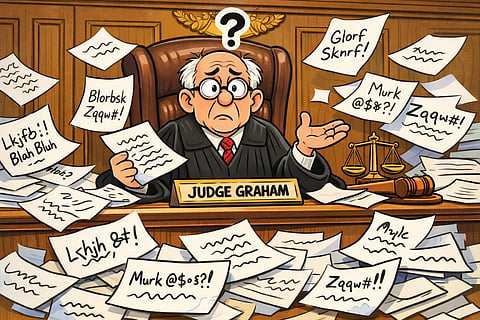
Key topics:Bad Writing Contest honoured confusing academic writing from 1995–1998.Judge Moshoana’s PHSG ruling shows ornate yet unclear legal language.Chief Justice praised his writing despite misreadings of law and cases..Sign up for your early morning brew of the BizNews Insider to keep you up to speed with the content that matters. The newsletter will land in your inbox at 5:30am weekdays. Register here.Support South Africa’s bastion of independent journalism, offering balanced insights on investments, business, and the political economy, by joining BizNews Premium. Register here.If you prefer WhatsApp for updates, sign up to the BizNews channel here..By Satire with Johan van den Berg.The Bad Writing Contest (BWC) was the brainchild of editors of the academic journal Philosophy and Literature. The contest was inaugurated in 1995, but sadly, only ran for four years with its last ceremony in 1998. In the final year of its existence, and before announcing the contest winners, the judges had this to say by way of background: ‘The Bad Writing Contest celebrates the most stylistically lamentable passages found in scholarly books and articles published in the last few years. Ordinary journalism, fiction, departmental memos, etc. are not eligible, nor are parodies: entries must be non-ironic, from serious, published academic journals or books. Deliberate parody cannot be allowed in a field where unintended self-parody is so widespread.’It is a great pity that the BWC is no more. If it had still been in existence would it have considered submissions extracted from South African court judgements, say, I wonder? I certainly hope so, for these do, after all, meet the requirement of being ‘serious’ although in many cases, only in the eyes of those who penned them, or the small number of believers claiming to comprehend. .Read more:.PHSG School Capture Part 10: Join the counter-offensive - Richard Wilkinson.If the BWC did still exist and regarded court judgements as ‘scholarly’ work, then surely the following passage from Gauteng High Court Judge Graham Moshoana’s finding in the recent Gauteng Education Department (GDE) versus Pretoria High School for Girls (PHSG) matter, would be a serious contender:‘Given the limited bases upon which the present interlocutory application oscillates, it shall be obsolete for the Court to punctiliously provide a full rendition of the factual matrix appertaining the dispute involving the parties before me.’Odd then that the writing skills of Judge Moshoana appear to have been singled out for praise by high-ranking colleagues in the judiciary. Indeed, no less a person than our Chief Justice Mandisa Maya, someone with a sharp eye for talent when she sees it, waxed lyrical about our judge and his writing skills, after she (and others on the JSC) interviewed him for a position on the Gauteng Bench in October 2024. A synopsis of the interview, as reported on the website Judges Matter (a deeply ironic name if ever there were one) records the following: ‘A talking point once again was his writing abilities. Not only has he written more than 340 judgements in his judicial career, Chief Justice Maya was particularly impressed with his extrajudicial writing of articles and books. She described him as a “prolific writer” and pointed out how well he has done in being able to co-author a book while being a sitting judge. When quizzed on where he finds the time to write all these things he explained that it is rooted in his enjoyment of reading’.In the GDE versus PHSG case over which he presided, Judge Moshoana was able, once more, to display this ‘writing ability’ in his judgement. A pity though that it was replete with misreadings of both the law and of legal precedence – in one place he quotes case history thinking this supports his finding when in fact it does the opposite (a proper critique of his judgement by the indomitable Richard Wilkinson may be found here https://www.school-capture.com/phsg-part-12). All this being so, the Judge might want to consider supplementing his ‘enjoyment of reading’ with a short course on ‘reading with comprehension’.His 340 written judgements are, perhaps, a reminder that practice does not always make perfect.But back to his submission for a BWC award. Despite its compelling status – it’s a veritable tour de force in pretentious verbal gymnastics - I do have this worry that his court judgement might fall into the category of ‘fiction’ and thus fail to meet one of the award’s preconditions. What a shame that would be.