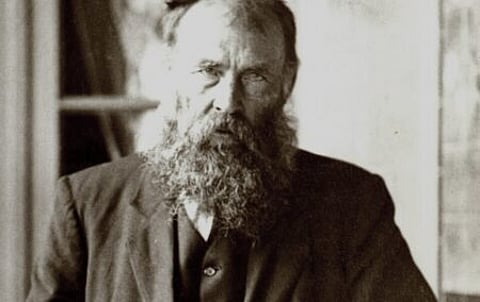
Key topics:Geopolitics tense: US–SA clash, conflicts persist, no major peace dealsANC declines; DA poised for gains in key metros like JohannesburgAI doubts rise as prophecy, politics, and uncertainty collide.Sign up for your early morning brew of the BizNews Insider to keep you up to speed with the content that matters. The newsletter will land in your inbox at 5:30am weekdays. Register here.Support South Africa’s bastion of independent journalism, offering balanced insights on investments, business, and the political economy, by joining BizNews Premium. Register here.If you prefer WhatsApp for updates, sign up to the BizNews channel here..By Jonathan Katzenellenbogen*.A few nights ago, the ghost of Siener van Rensburg paid me a visit, and I asked if he had any prophecies for the next year. He said he saw dark clouds and fires, but he then spoke of the sun breaking through the clouds.“What do you mean,” I demanded. I told him that Biblical riddles and his visions of symbols were all confusing and open to wide interpretation.Much has changed since the “prophet of the Boers” lived, but Siener’s ghost insisted that the nature of war and politics remain the same, so his powers of prophecy remain intact.He then turned on me and asked how I thought he might be remembered next year on the centenary of his death. “Well,” I said, “We often could not really tell what you were predicting.”“What about your ‘black bull versus white bull’ vision, apparently predicting racial war,” I asked. Polling of voters now shows that whites and blacks now have similar concerns and are increasingly abandoning voting on racial lines, I pointed out.The ghost insisted his visions about the surrender of the Boers at Vereeniging in 1902, the death of Boer General Koos de la Rey who was shot by police in 1914, Germany’s defeat in World War I, and the Russian Revolution were all correct. And he went on, “I said we would have heavy rains and the sun would shine. And that’s what you have had for the past few weeks, in die ou Zuid-Afrikaanse Republiek.”.Read more:.The coming reckoning: AI’s rise and the chaos it leaves behind - Ivo Vegter.I then asked him to please come up with predictions, “just for next year,” on the following issues, with names, places, and dates, but with no scenarios and probabilities, and nothing based on mathematical models. I then rattled off my questions. “What will be the big geopolitical event next year? Is there any epidemic, like Covid or wars, like the invasion of Iraq and Afghanistan or Ukraine, or an October 7th that nobody expected the previous year that might happen in 2026? For us, I wanted to know where US-SA tensions would lead, and whether the DA mayoral candidate in Johannesburg, Helen Zille, would manage to get the party over the 50 percent mark in Council in the upcoming local government elections. “Will the Gaza ceasefire hold, will there be peace between Ukraine and Russia, and will China invade Taiwan?” Then I asked if artificial intelligence (AI) was really the great game-changer, as the constant hype made it out to be.“My jirre, jy is prop-vol k–vrae,” the ghost replied.“One thing I can tell you is that nobody can predict what Trump will do.”“You doubt my prophecies, but remember AI hallucinates and it gives your data to the Chinese, and the Americans, who then give it to ‘die donnerse Engels.”As I needed answers to meet my deadline, I jumped out of bed, tapped my ChatGPT and Claude apps, and went into deep thinking mode.To obtain a global overview, I asked ChatGPT what the big geopolitical trends next year would be. This was the reply:“Expect continued geopolitical fragmentation and policy uncertainty: slower global growth, persistent inflation risks in some economies, and a world more oriented toward regional blocs and competition among great powers. Big risks lie ahead.”Then I tried my own deep thinking on our prospects next year. We are headed for a big clash with the US, which both the ANC and Trump seem to want. President Cyril Ramaphosa has declared, “we won’t be bullied”, and is prepared to see out the pain from the three years left in Trump’s term. But even if the European countries that attended the G20 are now our good friends, it is doubtful whether they will stand up for us in Washington. And there is not much that the ANC’s friends, Russia and China, will do for us on trade with the US.What might help ease our position with the US is that the ANC’s dominant role in SA politics is fast on the wane. Playing the G20 and foreign policy cards just won’t work for the ANC in an election. There are no photos of Ramaphosa with Trump, Xi Jinping and Putin, which would have shown him as a world statesman in one picture. Anyway, the local government elections are all about service deliveryThe overall direction of travel for the ANC shows a steep descent in recent polls. And with the starting-gun having sounded for the race to succeed Ramaphosa, division in the ANC and its weakness are evident.ChatGPT was more forthcoming than the prophet about the DA’s chances in Johannesburg and said, “Good question. I don’t think it is plausible (with our current knowledge) to confidently say that Helen Zille — or more precisely the party under her leadership — will obtain above 50% of the vote in the upcoming Johannesburg local government election.” But the DA will be the largest party in council, it predicted.And Cilliers Brink, the DA candidate, stands a good chance of becoming Mayor. But in Johannesburg and Tshwane, the DA will have to be sure to get out the vote, and see that much of the vote does not get split between the proportional representation ballot and the one for councillors. But Siener van Rensburg might well be correct in saying, “The sun will shine.”Among the oracles I asked, none saw peace settlements to Africa’s conflicts: Sudan’s civil war, the conflict in Somalia, instability in the eastern Democratic Republic of Congo, and Islamic insurgency in the Sahel. Conflicts spread, and that poses a problem, the oracles said. They also said that South Africa’s military weakness presents a deep long-term problem.And on Gaza, my oracles told me that with the ceasefire accord and Sharm el Sheikh agreement, the region’s peace prospects are much improved. Israel is doing as much as it can to destroy Hamas within the lines it occupies under the deal. Worryingly, there are no signs of the dismantling of Hamas and the rebuilding of Gaza. Importantly, Iran, in the wake of the US and Israeli damage inflicted on its nuclear facilities and its air defence system, is signalling that it is prepared to talk to the US. But Hamas, Hezbollah, and the Houthis might yet continue to show that they can still inflict damage on Israel. And as for a longer durable solution, that is a long way off.A wider and more dangerous conflict could yet emerge from Ukraine. In February next year, it will be four years since the Russian invasion. Ukraine continues to put up serious resistance along a front line that is essentially frozen. Ukraine is taking strain, and so is Russia, as its shadow fleet used to ship oil is hit. Kyiv seems to be under no pressure to agree to the sort of deal that Trump and Russia may want, and it seems able to hold on.A crowd-forecasting exercise conducted by Glimt, developed by the Swedish Defence Research agency to identify strategic changes, indicates that most of those polled do not expect a ceasefire, or a Trump-Putin meeting or a Zelensky-Putin meeting. So, as things stand, there is little chance of a deal..Read more:.RW Johnson: Why the ANC’s decline now looks inevitable.And then I pondered whether China would invade Taiwan, and what might be the US response. In short, China is rapidly building up the capacity to conduct amphibious operations, with a combination of aircraft carriers, large assault ships, submarines, drones, missiles, and cyber-attack capabilities. But it still needs adequate sea lift and logistics to sustain a force. The Taiwanese government has said it expects Beijing to be ready to invade in 2027, with the possibility increasing toward the 2030s. While next year seems unlikely, whether or not this ultimately happens will depend on what the US and its Pacific allies indicate in the way of response.Siener van Rensburg’s ghost woke me early this morning to shout in my ear that AI’s problems of hallucinations, lack of understanding of the data, and misinterpretation can’t be solved.“The productivity statistics have not even risen, despite its promises. And don’t worry, you will still have a job. We need commentators who can suck their thumbs and pull things out of thin air.”.*Jonathan Katzenellenbogen is a Johannesburg-based freelance journalist. His articles have appeared on DefenceWeb, Politicsweb, as well as in a number of overseas publications. Katzenellenbogen has also worked on Business Day and as a TV and radio reporter and newsreader. He has a Master's degree in International Relations from the Fletcher School of Law and Diplomacy at Tufts University and an MBA from the MIT Sloan School of Management..This article was first published by Daily Friend and is republished with permission