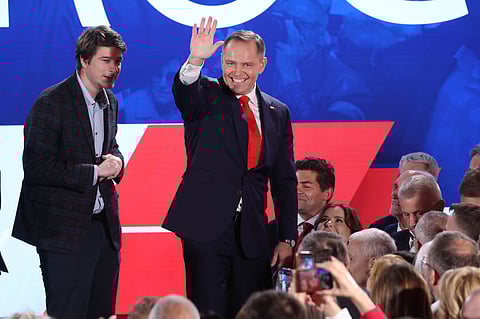
Key topics:Poland’s new president Nawrocki embodies the right’s macho, strongman idealTrump, Putin, Modi and others feed a global cult of authoritarian physicalityRight-wing populists equate liberalism with weakness and undermine democracy.Sign up for your early morning brew of the BizNews Insider to keep you up to speed with the content that matters. The newsletter will land in your inbox at 5:30am weekdays. Register here.Support South Africa’s bastion of independent journalism, offering balanced insights on investments, business, and the political economy, by joining BizNews Premium. Register here.If you prefer WhatsApp for updates, sign up to the BizNews channel here.The auditorium doors will open for BNIC#2 on 10 September 2025 in Hermanus. For more information and tickets, click here..By Adrian Wooldridge.Liberals have wasted no time in pointing to Karol Nawrocki’s lack of qualifications for his new job as president of Poland. He has never previously held political office. He won by the narrowest of margins with 50.9% of the vote. But Nawrocki possesses the one qualification that many national populists value above all other: a taste for physical strength laced with violence.Nawrocki is a former boxer who still likes to go a few rounds. He is also such an enthusiastic football supporter that he reportedly got the logos of his two favorite teams — Chelsea and Lechia Gdansk — tattooed on his chest. During the campaign, he admitted to taking part in 2009 in a 70-a-side-punch-up with fans of rival clubs, alongside scores of convicted criminals armed with clubs and brass-knuckles. He denied other violence-related accusations such as that he moonlighted as a pimp during a stint working as a security guard at a hotel and that he has extensive contacts with the Polish underworld. His come-from-behind campaign featured videos of the candidate in the boxing ring and shooting range and a pledge to “make Poland great again.”This emphasis on physical prowess laced with violence is commonplace on the nationalist right. The master of the genre is, of course, Vladimir Putin. Russia’s president likes to pose doing macho things, such as hunting, shooting, fishing and ice-pool diving, often stripping down to his waist to reveal his rippling biceps and bare chest. He claims that he once stunned a Siberian tiger that was supposedly menacing a female journalist. In January 2007, Putin brought his black Labrador into a meeting with then German Chancellor, Angela Merkel, a well-known canophobe, saying “I’m sure it will behave.” The mini-Putins in Russia’s sphere of influence all cultivate the same macho style. The head of the Chechnya Republic, Ramzan Kadyrov, frequently dresses in military garb and brandishes guns. He once kept a pet tiger, threatening to set it on journalists who wrote disobliging things about him. The president of Belarus, Alexander Lukashenko, presents himself as a virile farmer, with his fluffy white dog giving him the air of a James Bond villain.India’s President Narendra Modi boasts about his “56-inch chest” and claims that, as a boy, he went wild swimming among crocodiles. He also maintains a band of uniformed supporters, the Rashtriya Swayamsevak Sangh (RSS), who perform calisthenics dressed in skimpy shorts and march through the streets burning mosques.Meanwhile, the Chinese propaganda machine claims that, during the Cultural Revolution, Xi Jinping regularly carried 220 pounds of wheat over three miles without switching shoulders, and likens his long ascent to power to “the training of a Kung-Fu master.” The Turkish president Recep Tayyip Erdogan once christened the opening of a new stadium in Istanbul by playing himself and scoring a hat trick — all on live TV. And Donald Trump is such a devoted wrestling fan that the World Wrestling Entertainment has made him a “hall of famer.” He loves a physical display of power: He has been agitating for a military parade in Washington, DC, since first coming to power. His solutions to the problem of illegal immigrants during his first term included shooting to kill, shooting in the kneecaps, roasting with heat rays, or digging a moat and filling it with alligators. He proudly hung a portrait of himself in his Mar-a-Lago estate fashioned out of bullet casings — a present from the self-declared “Trump of the tropics,” former Brazilian President Jair Bolsonaro.Trump’s infatuation with Putin is the subject of all sorts of conspiracy theories. But the simplest explanation is that Putin is the world’s leading exemplar of the quality Trump most admires. Other members of the strongmen club fascinated him for the same reason. He nicknamed Erdogan “the Sultan,” and told everybody how much he admired his “seemingly endless ability to get his own way at home.” He was much impressed by the fact that North Korean leader Kim Jong-Un’s bodyguards ran alongside his limousine. Kristi Noem, Trump’s homeland security secretary, endorsed Nawrocki’s candidacy on May 27 with the words: “Donald Trump is a strong leader for us, but you have the opportunity to have just as strong a leader in Karol.” The right’s cult of physical strength is not incidental. It is a metaphor for a much broader argument: that liberalism is synonymous with weakness and that the only way to escape from such weakness is to embrace headstrong, authoritarian leaders. Liberalism’s preoccupation with rules and consensus leads to paralysis, the argument goes, and its concern for society’s casualties leads to self-paralysis. Therefore, what the world needs, especially in periods of uncertainty, are strong leaders who can cut through the nonsense and uphold their nation’s traditions.This cult of strength helps to explain the growing support for right-wing parties among young men. Trump won young men (aged 18-29) by 14 points, while Kamala Harris won young women by 18 points. Both Nigel Farage’s Reform Party and Germany’s AfD also do well among young men. It also helps to explain the right’s broader appeal to people who are fed up with political paralysis. Across the world, right-wing parties demonize the bureaucratic blob that protects the status quo and human rights lawyers who make it difficult to stem the flow of refugees.This obsession with strength also dictates the right’s governing style. Everywhere they gain power, national populists undermine independent institutions and gather power to the executive — most obviously in countries with weak or non-existent democratic traditions such as Russia but also in the West. Trump is systematically weakening the “checks and balances” that were supposed to limit the president’s power, including the courts, the civil service, the press and Congress. He likes to assure friendly audiences that “I have the right to do whatever I want as president,” quoting Napoleon by saying “he who saves his country does not violate the law.”Yet the equation of liberalism with weakness and autocracy with strength is a serious error. The liberal order stood up to the threat of Communism after the Second World War though a combination of internal consensus building and external relentlessness. Authoritarian rule tends to be marred by faction fighting and brittleness, making democracies far more durable than strongmen regimes.And this is an error that could have rapid consequences in Poland. The country has been a model of strength under centrist rule, with annual average growth of 4% and the largest army in Europe after Russia, Ukraine and Turkey. The election of a supposed strongman to the presidency will inevitably make Poland weaker..2025 Bloomberg L.P.