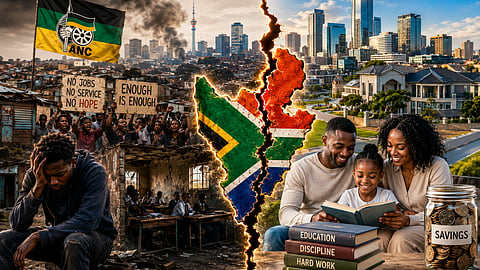
Key topics:Culture vs history debate reignites SA inequality discussionFamily breakdown and poor schooling deepen poverty crisisANC policies and dependency culture blamed for decline.Sign up for your early morning brew of the BizNews Insider to keep you up to speed with the content that matters. The newsletter will land in your inbox every morning on weekdays. Register here.Support South Africa's bastion of independent journalism, offering balanced insights on investments, business, and the political economy, by joining BizNews Premium. Register here.If you prefer WhatsApp for updates, sign up to the BizNews channel here..By Rob Hersov*.The most dangerous question in South Africa is not whether apartheid did terrible damage. It did. The dangerous question is whether, thirty years after democracy, some habits defended as “culture” are helping to keep millions of black South Africans poor, badly educated, unhealthy and politically trapped. The answer is uncomfortable: race is not destiny, but culture matters enormously. Not skin colour. Not biology. Culture: the habits, incentives, family structures, expectations, taboos and institutions that shape behaviour.The evidence is brutal. Statistics South Africa’s 2022/23 Income & Expenditure Survey found that white-headed households had average annual income of R676,375, compared with R143,632 for black African-headed households. They also spent almost four times more, at R409,520 versus R108,461.1 This cannot be waved away as merely “white privilege”, although inherited assets obviously matter. It also cannot honestly be discussed without asking which cultural habits build wealth and which destroy it..Read more:.RW Johnson: Why the ANC’s decline now looks inevitable.The real divide is not only income. It is assets. An LSE Inequalities analysis reports that roughly half of white adults in South Africa own wealth of at least R250,000, while only 3% of black adults do.2 Assets compound. Houses, businesses, pension funds, professional networks, private schooling and inherited expectations produce confidence and optionality. Poverty also compounds: bad schools, broken families, debt, transport costs, crime, food insecurity and weak networks lock people into survival mode.So, is “black culture” the problem? The phrase itself is too crude. There is no single black culture. Zulu, Xhosa, Sotho, Tswana, Venda and other traditions differ deeply. Urban township culture is not rural traditional culture. Middle-class black professional culture is not the same as patronage politics or gang culture. The better question is this: which cultural patterns now dominant in parts of black South Africa are holding people back?Start with family. Research using South Africa’s National Income Dynamics Study found that young people in disrupted or non-resident-parent family structures were up to 50% less likely to complete high school than those in undisrupted co-resident-parent families.3 That is not a moral footnote. It is a national emergency. If fathers are absent, if mothers carry the burden, if grandmothers become the welfare state, if boys grow up without disciplined male responsibility, the country should not be shocked when schools, streets and prisons fill with the consequences.This is where the debate becomes taboo. South Africa is comfortable blaming apartheid, colonialism, capitalism and “the system”. It is much less comfortable asking why fatherhood, school discipline, reading at home, punctuality, sobriety, savings, sexual responsibility and respect for property are not treated as revolutionary duties. Too often, “respect for elders” becomes protection for failed leaders. “Ubuntu” becomes a demand that successful people subsidise irresponsibility. “Tradition” becomes cover for patriarchy, machismo and deference. “Transformation” becomes a jobs programme for connected insiders rather than a competence revolution for the poor.The point is not that white South African cultures are morally pure. They are not. Afrikaner culture produced formidable institutions, language pride, family solidarity, savings discipline and self-help networks; it also produced racial nationalism and apartheid. Anglo-South African culture produced commercial literacy, global networks and institutional fluency; it also produced detachment, class arrogance and a habit of exit rather than repair. Jewish South African culture has over-performed through education, literacy, entrepreneurship, family cohesion and international networks; it too benefited from being inside systems that excluded others. The lesson is not racial superiority. The lesson is that high-functioning cultures transmit human capital, social capital and financial capital across generations..Read more:.Ramaphosa presses ANC on policy delivery as internal power struggles intensify.Education proves the point. Stats SA reports real progress among black Africans aged 25 and older: those with primary education or less fell from 57.9% in 1996 to 22.2% in 2022, while secondary attainment rose from 9.4% to 34.7%.4 That is genuine achievement. But the same economy still pays massively for skills. Stats SA found households headed by someone with tertiary education averaged R577,415 income, compared with R84,185 for those with no schooling.1 If education is that powerful, then tolerating dysfunctional schools is not compassion. It is betrayal.Health tells the same story. A study on post-apartheid medical access found that 40.8% of black respondents and 22.9% of coloured respondents reported going without medical care at some point in the previous year, compared with 10.9% of whites and 6.9% of Asians.5 Healthcare inequality follows money, geography and infrastructure, but it also follows family stability, education, nutrition, crime, transport and trust in institutions.Zimbabweans in South Africa expose another uncomfortable truth. Many arrive poor and vulnerable, yet are often perceived as disciplined, entrepreneurial and willing to work. That perception is not universal fact, and xenophobia is disgusting, but the comparison rattles South Africans because it challenges the claim that opportunity alone explains outcomes. If migrants with fewer rights can hustle, save and build, what exactly is blocking locals: lack of opportunity, broken incentives, poor education, entitlement, or all of the above?South Africa needs a new cultural contract. No serious person should deny history. But no serious country can live forever inside history’s excuses. The question is not whether black people are the problem. They are not. The question is whether some norms defended in the name of blackness are anti-child, anti-merit, anti-family, anti-business and anti-truth. If so, they must be confronted.The future belongs to cultures that do five things relentlessly: keep fathers or functional substitutes close to children; make reading and numeracy non-negotiable; socially punish crime, corruption and disorder; admire builders more than politicians; and transmit assets, discipline and expectations across generations.So, is “black culture” holding South Africa back? Not blackness. Not ancestry. Not identity. But any culture that excuses broken families, failed schools, corrupt leaders, male irresponsibility, tribal patronage and dependency is holding South Africa back. And if South Africans cannot say that aloud, they are choosing politeness over the future..Read more:.Growth, not redistribution, key to reducing global inequality: Katzenellenbogen.And, as you would expect from me: as it is patently obvious from every single fact and statistic that the ANC and its deranged policies have set us on a backwards trajectory, why does “Jabu’s Mum” still vote for failure….?.*Rob Hersov, South African businessman and patriot