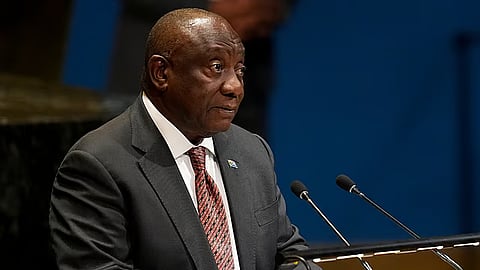
Key topics:Ramaphosa pushes R1tn infrastructure plan, boosting private sector role.Mining labeled “sunrise industry”; SA ore reserves valued at R40tn.Water crisis and crime tackled via new committees, accountability enforced..Sign up for your early morning brew of the BizNews Insider to keep you up to speed with the content that matters. The newsletter will land in your inbox at 5:30am weekdays. Register here.Support South Africa’s bastion of independent journalism, offering balanced insights on investments, business, and the political economy, by joining BizNews Premium. Register here.If you prefer WhatsApp for updates, sign up to the BizNews channel here..By Alec Hogg.If you were looking for a sign that the Government of National Unity (GNU) has emboldened President Cyril Ramaphosa, last night’s State of the Nation Address (SONA) at the Cape Town City Hall was it. Gone was the hesitant, consensus-seeking head of state we’ve become accustomed to. In his place stood a President ready to bet the farm on a massive infrastructure drive and — music to the ears of the BizNews tribe — and recognising the country's mineral endowment is a path to prosperity.For years, the mining sector has felt like the unwanted stepchild of the South African economy, battered by regulatory uncertainty and logistical nightmares. Yet, in a pivot that will get resources bulls excited, Ramaphosa explicitly branded mining a "sunrise industry". He backed this bullish sentiment with a staggering figure: he said SA ore reserves are worth over R40 trillion -10x its current GDP.This isn't just rhetoric. The President pointed to the "Mining Indaba" confidence, noting that new gold, copper, platinum, and coal mines are opening - while small and tentative, even the weakest pulse is a welcome sign of life for a long moribund sector. It seems the penny has finally dropped in the Union Buildings: you cannot grow an economy by strangling your primary revenue generator..Read more:.SONA 25: Ramaphosa states that South Africa won’t be bullied by Trump.But the headline-grabber for the night was the sheer scale of the promised spending. Ramaphosa is committing to a public investment drive of over R1 trillion over the next three years to build and maintain infrastructure. He calls it the "largest allocation of its kind in our country's history". We’ve heard similar promises to turn South Africa into a "construction site" before, specifically during the chaotic Zuma years. However, the difference this time — if we are to believe JZ’s successor — lies in the mechanism. The use of the "Infrastructure Fund" and new public-private partnership regulations suggests a heavy reliance on the private sector to actually get the job done.The economic backdrop Ramaphosa painted was surprisingly sunny. He cited four consecutive quarters of GDP growth, two consecutive annual primary budget surpluses, and the strengthening of the Rand against the dollar. He even claimed that the Johannesburg Stock Exchange has performed "exceptionally well" over the past year. For investors who have been riding the volatility wave, this stability is welcome, though one wonders if the "Ramaphoria" is returning or if this is simply a cyclical bounce.However, no South African reality check is complete without addressing the crises that affect daily life. Ramaphosa admitted what every ratepayer in Joburg and Durban already knows: water has replaced electricity as the country’s primary headache. He termed it the "single most important issue" for many.The President’s solution comes straight from the Eskom playbook. Just as the National Energy Crisis Committee helped end load shedding, Ramaphosa announced the formation of a "National Water Crisis Committee," which he will chair. The strategy involves a R156 billion commitment to water infrastructure and a "zero tolerance" approach to municipal failure. In a move that suggests the gloves are finally off, he revealed that criminal charges have already been laid against 56 municipalities, with municipal managers now facing charges in their personal capacities. Accountability, it seems, is making a comeback.On the crime front, the President didn't mince words, identifying "organised crime" as the most immediate threat to SA’s democracy. He referenced the Madlanga Commission of Inquiry, which exposed "rampant corruption" within the SAPS. His response? A "hard-hitting new criminal justice reform initiative" modelled on Operation Vulindlela, and the deployment of the SANDF to Gauteng and the Western Cape to tackle illegal miners and gangs (and, hopefully, the rampant poaching of national marine and flora assets).Perhaps the most intriguing geopolitical signal was Ramaphosa’s assertion of sovereignty. "We will not be bullied by any other country," he declared, emphasising that while South Africa respects others, it demands the same in return. It’s a clear message to both East and West as the country navigates an increasingly volatile global landscape.So, where does this leave us? The speech was a "game of two halves." On the macro side, the numbers look better than they have in years: inflation is down, debt is stabilising, and the FATF grey list exit has been achieved (bravo Momo and Treasury). On the micro side — the lived experience of water outages, construction mafias, and gang violence — is real and acknowledged..Read more:.Lesotho Highlands Water Project faces fresh opposition as communities demand accountability.Ramaphosa concluded by saying the nation has reached a "turning point," leaving behind an "era of decline". If, unlike Zuma’s empty promises, his administration can actually deploy that R1 trillion effectively and turn the "sunrise" mining sector into a realised boom, he might just be right. But as always in South Africa, the gap between the podium and where the takkie hits the tar is where the real story unfolds. For now, the "Buy" signal is flickering, but keep a close eye on those water levels.