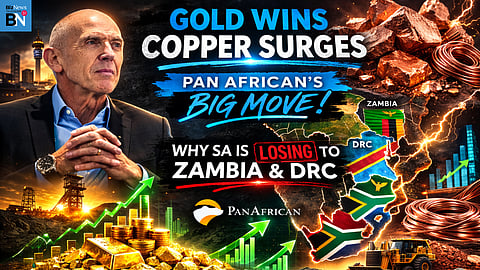
Two mining giants pass. Gold stocks surge. Copper becomes the new AI trade. Peter Major unpacks Pan-African’s breakout, Jubilee’s Zambian bet, Kumba’s iron ore warning - and why Zambia and the DRC are pulling ahead while South Africa stalls..Sign up for your early morning brew of the BizNews Insider to keep you up to speed with the content that matters. The newsletter will land in your inbox at 5:30am weekdays. Register here.Support South Africa’s bastion of independent journalism, offering balanced insights on investments, business, and the political economy, by joining BizNews Premium. Register here.If you prefer WhatsApp for updates, sign up to the BizNews channel here..Watch here.Listen here.BizNews Reporter.It has been one of those weeks in mining where everything seemed to happen at once.Results poured in from Glencore, BHP, Gold Fields, DRD, Pan African, Kumba and Jubilee. Two giants of the industry passed away. And quietly, beneath the headlines, a bigger shift continued to gather momentum. Copper is becoming the new obsession, Zambia and the DRC are attracting billions, and South Africa risks watching from the sidelines.Peter Major, veteran mining analyst at Modern Corporate Solutions, did not hesitate when asked what stood out.Pan African.The company founded by the late Jan Nelson has outperformed every gold share this year. Up 4.7 times. AngloGold about four times. Newmont roughly three. The difference, according to Major, is simple. Production growth.Pan African is not just riding the gold price. It still has “cylinders” left to fire. Tailings projects, recovery circuits, incremental expansions. Even if the gold price flattens, output can rise. That is what the market rewards.It is a reminder that not all gold shares are equal. Gold Fields, Harmony and AngloGold are producing millions of ounces, but keeping production steady at those levels is hard work. Growth is incremental. Costs are rising in double digits. If gold merely stabilises instead of climbing, margins will be squeezed.Pan African, by contrast, still has visible runway.DRD, too, earned a nod. Measured management. Steady execution. Few surprises. In a volatile commodity cycle, that counts.But the bigger story may not be gold at all.It is copper.Glencore and BHP both showed it in their results. The strategic pivot is unmistakable. Copper is now front and centre in capital allocation, exploration spend and mergers. It has moved from prince to king.Major compares it to artificial intelligence on the tech side. Everyone wants exposure. It is seen as the metal of electrification, data centres, AI infrastructure and grid expansion. And it is true that copper underpins all of that.But there is a note of caution.Copper is cyclical. It is trading well above long-term averages. It is outside standard deviation. That does not mean it collapses tomorrow. It does mean investors should be selective.Jubilee is an interesting case. It exited chrome and pivoted toward copper in Zambia. Major describes it as a V8 engine that is only firing on two or three cylinders. Tailings dams, recovery circuits, dumps and new projects are all being built out. If execution follows through, production could step up meaningfully.And Zambia matters.By Major’s rough calculation, the Democratic Republic of Congo now produces more metal in dollar terms than South Africa. Around 52 or 53 billion dollars. South Africa sits near 50 billion. For decades South Africa was the continent’s leviathan. Gold, platinum, manganese, diamonds, heavy minerals. The full spectrum.Now growth capital is flowing north.Zambia’s president has positioned the country as stable and business friendly. No royalty surprises. No sudden empowerment overhauls. Stability. Predictability. That message resonates. Billions are flowing into rail, power and mining.The DRC, despite conflict in its east, continues to attract enormous copper investment. The West, the Gulf states and others are committing real money.Meanwhile, South Africa debates legislation and wrestles with factional politics. Major worries that policy signals remain negative rather than encouraging. Investors notice.Back home, Kumba tells another story. Its results were resilient. Production improved. Dividends are strong. Yet the share price lags badly behind gold stocks.Why?Iron ore.The price has drifted lower and hovers around the psychologically important 100 dollar mark. If it breaks below, the market fears a slide toward 90. China’s steel demand has plateaued. New supply is ramping up elsewhere. The market looks six to twelve months ahead and does not see sustained upside.Kumba becomes a recovery story, not a growth story. If Transnet improves rail volumes and the rand weakens, that helps. But structurally, iron ore no longer has the glamour.Which raises the obvious question. Could copper eventually follow iron ore’s path? Today’s most fashionable girl at the dance eventually faces competition.Major acknowledges the risk. Copper bulls argue demand from electrification and AI will overwhelm supply for years. There is truth in that. Building new mines takes time and capital. But no commodity defies gravity forever.The key is valuation. Buying copper exposure blindly at peak enthusiasm is different from backing companies whose growth is not yet fully priced in.For now, the momentum is clear. Gold has created enormous shareholder value, particularly for those with production growth. Copper is drawing global capital. Zambia and the DRC are benefiting from policy certainty and resource endowment.South Africa still has extraordinary geology. South Deep is a marvel of engineering, three kilometres underground, producing around 300,000 ounces a year. But geology alone is not enough. Capital flows where it feels welcome.This week’s results were more than numbers. They were signals.Gold rewards growth. Copper commands attention. Iron ore cools. And Africa’s mining centre of gravity is shifting.The market has already started adjusting.The question is whether policymakers have.