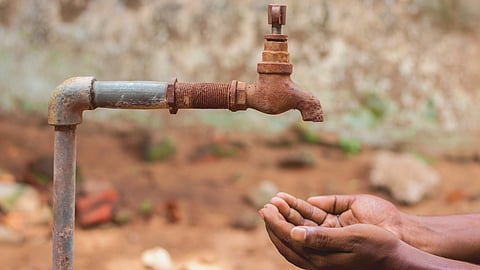
Key topics.South Africa faces worsening water shortages due to poor infrastructure.Corruption and mismanagement have led to failing municipal water systems.The government seeks private sector help to fix the water crisis..Sign up for your early morning brew of the BizNews Insider to keep you up to speed with the content that matters. The newsletter will land in your inbox at 5:30am weekdays. Register here..Support South Africa's bastion of independent journalism, offering balanced insights on investments, business, and the political economy, by joining BizNews Premium. Register here..If you prefer WhatsApp for updates, sign up to the BizNews channel here..By David Pilling___STEADY_PAYWALL___.Reservoirs may be full but poor maintenance, lack of investment and criminality are disrupting supplies.Justice Malala, one of South Africa's leading journalists, was visiting his mother a couple of years ago in Hammanskraal on the outskirts of Pretoria, Gauteng province. Stopping at a supermarket to buy provisions, he was appalled to find all the shopping trolleys were missing — the result, he assumed, of petty theft..But arriving at his mother's home, he understood what was really happening — the neighbourhood was in the middle of a cholera outbreak, in which 20 people had died thanks to poorly treated water. The trolleys were missing because, in the absence of government help, people were buying large canisters of water and wheeling them home..If anything, South Africa's water crisis has worsened since then. In Johannesburg, where years of rolling electricity blackouts have finally been brought under control, residents are getting used to another problem: cuts to water supplies that can last up to 86 hours..As well as affecting people's lives, lack of water poses a huge challenge for already struggling industries, from car manufacturing to food processing..John Steenhuisen, leader of the Democratic Alliance, a pro-market party that is now part of the government of national unity alongside the African National Congress, says these damaging shortages follow years of mismanagement and under-investment.."The system has started to reach a tipping point where it's failing massively," he says. "In Gauteng, there's no drought, the dams are full, the reservoirs are full, but the taps are dry," he explains, referring to the country's most populous province and home to Johannesburg..Read more: 🔒 Jo'burg water crisis: R27 billion infrastructure upgrading and renewal backlog.Steenhuisen says that much of the problem lies with shortsighted municipalities, which have neglected to invest in maintaining pipes and other infrastructure. "You have water, electricity and sanitation services that are invisible because they're all underground," he explains. "So it's very tempting when budget time comes around to say, 'We'd much rather have a community hall than actually replace the 2km of piping.'"."The system has started to reach a tipping point where it's failing massively"John Steenhuisen, Democratic Alliance party.South Africans use a lot of water, consuming about 237 litres per person per day, compared with a global average of about 173 litres, according to Ntombifuthi Nala, a researcher at the government's information service. But not enough is treated or recycled, and South Africa has failed to build dams to store water to meet rising demand..To make matters worse, the ageing infrastructure means much of the water is lost to leaks. In Gauteng, leakage rates are 35 per cent, according to Senzo Muchunu, former minister of water and sanitation.."We have allowed things to deteriorate," he said at the launch of four new water catchment management agencies in Durban last year. "We are a water-scarce country, but we still have just enough water, provided that municipalities stop leaking water the way they are doing now.".A part of the difficulties is that South Africa's post-apartheid constitution devolved many powers to municipal level. That has made it hard for the national government to interfere in local decisions about spending. Many of the 257 municipalities are near bankruptcy..The challenge has been compounded, alleges one finance ministry official, speaking on condition of anonymity, by Black empowerment rules that mean local authorities often give limited maintenance contracts to Black-owned businesses that are not always qualified..Widespread corruption, known as state capture, under former president Jacob Zuma between 2009 and 2018, meant money was sometimes allocated to phantom tenders..Eskom, the state electricity provider, was infiltrated by criminal gangs during this period, worsening the energy crisis. The same has happened with water, says one businessman who works with the presidency as part of a programme to tackle problems by drafting in private sector expertise and resources. "There's a water 'mafia'. They cut the line and then they come around with tankers of water," he says. "Water is another area crying out for private sector help.".'People want water now'.Co-operation between the government and the private sector played a role in turning around the energy sector. The aim is to involve the private sector in providing services such as the operation and maintenance of water treatment plants, distributing water or building and maintaining pipe networks.."The idea now is to bring in private sector players and ensure that municipalities ringfence revenues," says Steenhuisen. "A certain proportion must go to maintenance.".As part of its reforms, the government last year set up the National Water Resources Infrastructure agency to impose order on a fragmented system and establish a framework in which private investors can participate. As Muchunu, then minister of water and sanitation, said: "People want water now.".Read also:.The Hammanskraal water crisis: How political unity achieved the impossible – Jordan GriffithsJoburg's water crisis deepens as delays to Lesotho Highlands Project surgeWater shortages in SA risk increased infections in healthcare facilities: how to combat these risks.© 2025 The Financial Times Ltd.