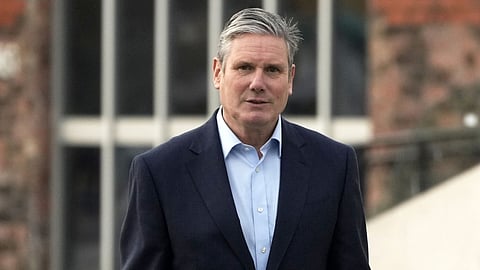
In the aftermath of a surprising British election, Labour's narrow victory belies deep-seated challenges. With a fragile mandate and internal leadership struggles, Starmer faces a stark reality: a disillusioned electorate and unresolved economic woes. Farage's Reform UK emerges as a potent disruptor, fracturing Tory support and complicating Labour's hold. Meanwhile, the Tories' tumultuous evolution from Brexit zealots to leadership crises prompts existential questions. As political tensions mount, the future hinges on whether Labour can consolidate power or if Farage's populist surge reshapes the conservative landscape..Sign up for your early morning brew of the BizNews Insider to keep you up to speed with the content that matters. The newsletter will land in your inbox at 5:30am weekdays. Register here..Join us for BizNews' first investment-focused conference on Thursday, 12 September, in Hermanus, featuring top experts like Frans Cronje, Piet Viljoen, and more. Get insights on electricity and exploiting SA's gas bounty from new and familiar faces. Register here..By R.W. Johnson .___STEADY_PAYWALL___.In the run-up to the British election the polls repeatedly gave Labour a lead of 20% over the Conservatives. In fact this turned out to be quite wrong. In the event Labour got 33.7% and the Tories 23.7%, a lead of exactly 10% – only half what the polls had predicted. Yet, as we know, Labour won by a landslide – 411 seats to the Tories' 121. Rishi Sunak has resigned as Tory leader, Sir Keir Starmer has moved into 10 Downing Street and there is Labour euphoria, echoed throughout the media..This is unlikely to last, not least because the British electorate is far too experienced, not to say jaded, to give politicians the benefit of the doubt for very long. Secondly, the country faces many deep-seated problems and can't afford to borrow more money, so the only way to make positive changes will either be to levy a lot more taxes (which Starmer has ruled out) or to somehow get the country to grow a whole lot faster, a difficult task and one that, at the best, takes time. .Moreover, Labour's position is a great deal weaker than it looks. Starmer himself still has a negative popularity rating. His front bench is low on talent. And while his parliamentary majority is large, there was no big popular tide pushing Labour into power. Electoral turnout, at 59.9%, was the second lowest ever recorded and Labour only won a third of the vote. .Read more: The Tories have waged the worst election campaign in living memory: Martin Ivens.In fact Labour's victory is wholly owed to Nigel Farage's right-wing Reform UK party which came from nowhere to take 14.3% of the vote, at least two-thirds of which came from the Tories. Although Reform won only 5 seats it is already the third biggest party in terms of mass support and Farage makes no secret of his ambition to displace the Tories as the main conservative opponent of Labour. In this election there were no less than 171 seats in which the Reform vote was larger than the margin of votes by which sitting Tory MPs lost their seats. Had there been no Reform, the Tories could have won up to 292 seats and there would have been no Labour majority. Moreover, Starmer's pro-Israel stance has alienated many Muslim voters who were previously strong Labour supporters. In constituencies with large Muslim communities on average the Labour vote fell from 62% to 39%..What this really boils down to is that the big story is really the almost suicidal evolution of the Tory party. The Tories are both the oldest and the most successful political party in the world. But as the British Empire melted away Harold Macmillan and Ted Heath decided that it was essential to replace Empire with British entry to what is now the EU. They pursued this objective in the face of strong Labour opposition (and the bitter opposition of the Tory tribune, Enoch Powell) but in 1973 Britain finally entered Europe. .By 2000, however, a growing Tory fringe decided that Powell had been right after all. Gradually this anti-EU group gathered strength and ultimately it forced David Cameron to promise a referendum on EU membership. When the No vote won in 2016 it gradually took over the whole of the Tory party so that its successive leaders – Theresa May, Boris Johnson, Liz Truss and finally Rishi Sunak, have all either claimed to be Brexiteers or at least said that Brexit must be respected. Yet no Tory has offered an explanation as to why it was the Tories who pushed first for EU entry and then for exit, rather like the Grand Old Duke of York who marched his men up to the top of the hill and then marched them down again..This bizarre reversal almost tore the Tories apart and this, the traditional party of the ruling class and the byword for capitalist stability, behaved as if it was having a protracted nervous breakdown. It was mad enough to elect Theresa May and then, very soon after, decide that that was a mistake, but it was madder still to elect Boris Johnson. I have to be careful here since I know Boris a bit. He's clever, a very engaging and amusing lunch companion but not really serious. In particular he has always played fast and loose with the truth, partly as an amusing journalistic style, rather as Auberon Waugh did. All one can say is that the traditional Tory party of Churchill, Eden and Macmillan would never have elected Boris as leader. And sure enough, as leader Boris was soon caught out telling one untruth after another. He got away with quite a few fibs but when it was discovered that he had been holding a whole succession of alcoholic parties in Downing Street at the same time that all such gatherings were forbidden due to Covid, the public was outraged..Then came madwoman Truss. Anyone who had followed her career knew she was bold, outspoken to a fault, flirtatious and rash. It was all jolly entertainment for the elderly pensioners who make up the Tory faithful, but again, the traditional Tory party would never have touched her with a bargepole. Within a few weeks she had thrown away the Tory reputation for economic stability, caused a major market crash, had to sack her Chancellor and discard her whole programme. Naturally, she continues to insist that she was right and everyone else was wrong. She has now lost her seat and may find it difficult to get another one..The damage was then completed by Nigel Farage, a saloon bar cheeky chappie with a populist flair. His great cause is hostility to mass immigration – the number one issue for the Tory faithful – and the Tories have laid themselves open by promising to cut back on immigration for 14 years but never quite doing it. .In the whole history of the Tory party there has been no other period like this. It's as if the old ruling class has got dementia and committed one glaring error after another. A great deal now depends on who the Tories choose to replace Sunak. Again, it runs contrary to all Tory tradition that the three leading contenders are all people of colour, two of them women: James Cleverly, Suella Braverman and Kemi Badenoch, all of them on the right of the party. .If the Tories were to revert to traditional type they would choose Jeremy Hunt, the former Chancellor, who just held his seat against all predictions to the contrary. Again, I have to be careful because Jeremy was my pupil at Oxford. He is a highly intelligent and a very decent and honourable man. He was head boy of Charterhouse, a major private school, his father an Admiral and he was distantly related to the late Queen. I had other former pupils, some of them very brilliant, who play leading roles in other parties, but if I were choosing simply on the basis of character I'd probably choose Jeremy. But I'm not sure he will even stand for the leadership and given the state of the Tories they might well not elect him. .A great deal depends on this. Farage is putting together a working class and lower middle class coalition of far right anti-immigration zealots and it is highly predictable that Starmer will fail to deal adequately with the immigration issue. As Labour loses popularity Farage will lead a passionate right-wing crusade which could destabilise the political scene just as Brexit did. And Labour will run scared. Labour regards Farage as a fascist or at least a proto-fascist but they know that Reform UK already runs second to Labour in 97 seats and could easily make further inroads in Labour areas. .But the question is whether the Tories can re-establish themselves as the dominant party of the centre-right. To do that they need to pick a moderate but capable leader. If that leader can revive the Tories, Farage will campaign in vain. But if the Tories decide they have to move further right to compete with Farage they will avoid moderates like Hunt, who is too liberal minded for that. The situation is pregnant with a considerable variety of possibilities..Read also:.🔒 Sunak's election gamble backfires, Labour gains ground: Wooldridge🔒 Sunak's struggle: UK PM's frustration mounts ahead of electionPolitics and the pound: UK election could make or break sterling's run