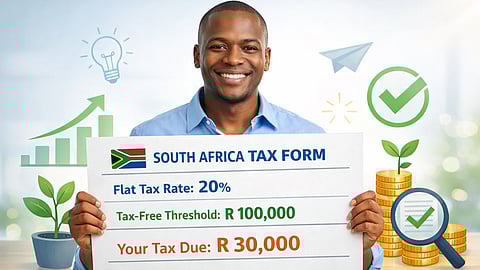
Key topics:Flat tax simplifies SA system, boosts transparency, compliance, and growth.Current tax favours complexity; flat rate broadens base and aligns corporate-personal rates.Global examples show flat taxes increase revenue, investment, and reduce avoidance..Sign up for your early morning brew of the BizNews Insider to keep you up to speed with the content that matters. The newsletter will land in your inbox every morning on weekdays. Register here.Support South Africa's bastion of independent journalism, offering balanced insights on investments, business, and the political economy, by joining BizNews Premium. Register here.If you prefer WhatsApp for updates, sign up to the BizNews channel here..By Dr Brian Benfield*.Imagine a tax return that fits on the back of a postcard. No schedules, no annexures, no interpretive disputes, no army of advisers. Just income, a minimum threshold, a rate and a Tax Due result.That simple vision captures not merely quick public understanding and administrative convenience; it represents a profound and vitally necessary structural reform. The case for a flat tax extends far beyond simplification. It speaks to administrative efficiency and transparency, greater compliance, stimulated investment and associated growth impetus.Our current tax system, ostensibly progressive, has evolved into a dense and convoluted construct. It does not merely collect revenue; it significantly distorts behaviour. It diverts capital and talent away from productive activity and into tax planning, arbitrage and deferral. The result is not equity, but opacity.Statutory personal income tax rates presently range from 18% to 45%. Yet these headline figures obscure a more revealing truth. The effective burden on high income earners typically settles far lower, often in the region of 25% to 30% of gross income. This divergence is not incidental. It is the product of a tax code riddled with deductions, exemptions and preferential treatments that systematically narrow the base..Read more:.Stagnant tax thresholds are reducing South Africans disposable income.Allowable deductions and the partial inclusion of capital gains dilute the apparent progressivity of the system. Dividends are taxed separately through a withholding mechanism, disconnected from the personal income framework. The result is fragmentation masquerading as sophistication.This complexity does not fall evenly. Those with access to expert advice can materially reduce their liabilities - others cannot. The system therefore penalises simplicity and rewards complex structuring. At the same time, compliance costs escalate, administrative burdens multiply and scarce economic energy is diverted away from innovation and growth.A flat tax dispenses with this architecture of complication. The latter replaces the former with a single, coherent principle. It levies a single, unified rate on all income above a clearly defined tax-free threshold.The flat rate formula renders calculations immediately transparent and straightforward: T = r x (Y – t) where T is tax payable, r is the flat rate of tax, Y is income and t is the tax-free threshold.The critical question is of course, revenue. South Africa currently raises roughly R835 billion from personal income tax, R330 billion from corporate income tax and R75 billion from dividend withholding tax. A viable reform must preserve this fiscal capacity. The flat tax achieves this not through higher rates, but through a broader base and sturdier compliance. With a tax-free threshold of R250,000 and a flat rate of approximately 27%, it has been suggested that the structure would remain progressive and yet largely revenue neutral, particularly when anticipated taxpayer and investor behavioural changes occur. An individual earning R800,000 for example, pays an effective rate of 18.56%, while one earning R5 million pays approximately 25.65%. Higher earners contribute substantially more, yet the calculation is transparent and immediate.The present system taxes corporate income twice, first at the company level and again upon dividend distribution, producing a combined burden exceeding 40 % on distributed profits. This encourages retention, restructuring and profit shifting. Under a unified flat tax, corporate profits are taxed once and distributed without further levy. Aligning corporate and personal rates removes arbitrage and restores neutrality.Base broadening is central. The elimination of most deductions expands the taxable pool, while all forms of income are treated consistently. Capital gains are adjusted for inflation, ensuring only real gains are taxed. When set against current effective rates, the proposed flat rate is not radical. It reflects what many already pay, stripped of distortion. Behavioural effects reinforce the arithmetic. Simpler systems reduce avoidance, increase compliance and encourage participation in the formal economy by many who presently choose to remain beyond it. This is critical in South Africa where fewer than eight million individuals carry the personal income tax burden in a population officially exceeding sixty-five million. The load is concentrated among a small and mobile cohort, an arrangement that is neither equitable nor sustainable.Russia’s adoption of a 13% flat tax in 2001 was followed by a sharp rise in revenues. Its later reintroduction of a slightly higher flat rate nevertheless underscores that tax systems remain political constructs. Georgia’s 20% flat tax, introduced alongside sweeping institutional reform, delivered sustained increases in revenue and compliance. Bulgaria’s 10% rate attracted investment and broadened the base sufficiently to sustain revenues despite initial IMF scepticism. Experience in several other flat-tax jurisdictions including Estonia, Latvia and Lithuania provide similarly compelling evidence that behavioural effects alone can materially expand the taxable base, increasing compliance and swelling revenue.The implications for growth are strongly positive. Flat tax systems improve investment certainty, reduce compliance costs and are almost irresistible capital lures. The impact on inequality becomes evident. Naturally, outcomes depend on design and the strength of complementary social spending. Where thresholds are meaningful, compliance improves and inequality moderates appreciably.Administrative gains are almost immediate. For most taxpayers, liability is determined virtually instantly. Income is declared, the threshold applied and the tax calculated. For salaried employees, the process can be fully integrated into payroll systems. The annual return then becomes a formality rather than the present ordeal.At a deeper level, the case for a flat tax is philosophical. Taxation is an unavoidable intrusion by the state into one’s private life. Its legitimacy rests on intelligibility. Citizens should be able to easily understand what they owe and how it is calculated. The current system fails that test. It cloaks the true burden in technicality and exception.A flat tax restores clarity, transparency and predictability. It protects lower income households while ensuring that higher earners contribute more to absolute terms. It aligns taxation with economic reality.The question is how to move from here to there.A rapid transition is both possible and desirable, provided it is executed pragmatically. Rather than a single disruptive overhaul, the system can be made to function like a flat tax almost immediately. This begins with collapsing the existing rate structure into a narrow band, effectively creating a single rate above the threshold. Dividend withholding tax can be removed early and corporate and personal rates aligned, eliminating double taxation and arbitrage. Deductions can be phased out over a short, defined period, broadening the base without a protracted political contest..Read more:.Nicholas Woode-Smith: How SARS can raise tax revenue.A parallel optional flat tax regime would accelerate the desired behavioural change, allowing taxpayers to elect simplicity in exchange for the loss of deductions. At the same time, expanded withholding at source would ensure that, for most individuals, tax is effectively final at the point of earning. With a clear legislative timetable signalling full unification, the system would converge rapidly in practice, even before formal consolidation is complete.Such an approach preserves revenue, reduces political resistance and allows the benefits of reform to materialise quickly. It recognises that tax systems change not when they are announced, but when incentives change.The result is a fiscal architecture that is simpler, broader and more durable. Revenue is preserved, compliance is strengthened and economic incentives are improved. Most importantly, the relationship between citizen and state is rendered more honest and harmonious.And for most taxpayers, the annual return does indeed fit on a postcard!.*Dr Brian Benfield, retired professor, Department of Economics, University of the Witwatersrand, is a Senior Associate and Board member of the Free Market Foundation.