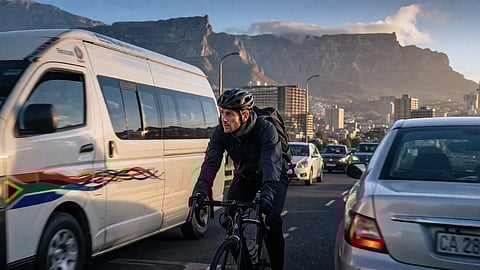
Key topics:Cyclist deaths highlight unsafe SA roads and weak enforcementPoor road culture: taxis, drivers, and low accountabilityCalls for empathy, reform, and shared road responsibility.Sign up for your early morning brew of the BizNews Insider to keep you up to speed with the content that matters. The newsletter will land in your inbox every morning on weekdays. Register here.Support South Africa's bastion of independent journalism, offering balanced insights on investments, business, and the political economy, by joining BizNews Premium. Register here.If you prefer WhatsApp for updates, sign up to the BizNews channel here..By Solly Moeng.Every few weeks, another headline announces the loss or serious injury of a cyclist somewhere along Cape Town’s coastal roads or elsewhere in our urban sprawl. The most recent tragedy involved veteran cyclist, Landon Lagrange, a 61-year-old rider who was struck by a minibus taxi in Camps Bay – a story that has become heartbreakingly familiar to South Africans who cycle regularly. As a fellow road user, citizen, and regular cyclist who is deeply concerned with how we coexist in shared spaces, I can’t help but ask: why is it still so dangerous to ride a bicycle in South Africa?The answer lies not only in poor enforcement and cycling infrastructure inadequacies, but deeper – in our collective understanding of what it means to share the road responsibly.Here's a Tale of Two CulturesIn places like Switzerland, roads operate on a beautifully simple social contract that distinguishes between “strong road users” (motorists, truck drivers, bus drivers, etc.) and “vulnerable road users" (pedestrians and cyclists). The burden of care falls heaviest on those controlling vehicles that can inflict greater harm. In essence, strength comes with responsibility. A Swiss motorist who disobeys road rules or injures a cyclist faces real consequences – including temporary or permanent withdrawal or driver’s permit, which, importantly, is a state property. Driving there is a privilege, not an entitlement. In South Africa, by contrast, a driver’s licence is treated like personal property – a mark of independence and dominance rather than of public trust. Enforcement is selective, corruption thrives, and accountability is rare. Our most vulnerable – pedestrians and cyclists – too often pay for that impunity with limbs and lives.The Taxi Factor and the Broader Culture of ChaosNo discussion about road safety in South Africa can exclude the minibus taxi sector. It is both indispensable and anarchic – a law unto itself. We know it, taxi drivers operate under brutal pressure: daily financial targets, aggressive competition, and a race against time mentality that too often turns our roads into danger zones. But they’re not alone. Drunk drivers, speeding luxury cars, and careless lane changes all contribute to the culture of risk. In Cape Town – where recreational cycling is popular – cyclists are still seen by some motorists as intruders on “their” roads. The hostility plays itself out daily in hooting, close passes, or outright aggression.Our Roads are Mirrors of SocietyRoads are not just concrete and paint – they reflect how we see one another as citizens and how we organise shared spaces. In Switzerland and Germany, road sharing rests on mutual trust and predictability. Drivers slow down because they assume responsibility for the safety of others. The law also requires them to do that. In South Africa, that sense of duty often collapses under impatience, ego, and mistrust. Many motorists operate under what behavioural economists refer to as ‘moral hazard’ – they know that nothing serious is likely to happen to them if they offend. When consequences are inconsistent, behaviour follows suit.Cape Town has made gestures towards cycling infrastructure, but paint on asphalt isn’t protection. Cyclists still face abrupt lane endings and changes, parked cars in bike lanes, broken glass from bottles thrown out of moving cars onto bike lanes, and dangerous intersections. What is missing is continuity, enforcement, and design integrity – all shaped by the assumption that vulnerable users deserve priority. Switzerland gets this right not just through infrastructure but through education - including learner driver training – signage, and constant enforcement visibility. As long as empathy and respect remain absent, no number of painted bike symbols will fix the problem. Accountability Must Be Redefined. Imagine if South Africa adopted a model where driving privileges belong to a state led by ethical leaders and administrators and are easily withdrawn for reckless behaviour. I argue that respect for the rules would become self-preservation.Equally, our driver education system should evolve from test-based memorisation to ethics-based awareness. Drivers need to understand that a cyclist taking a full lane isn’t doing this to be difficult – they’re probably doing this to avoid obstacles and hazards in the bike lanes to stay alive. Cyclists should also learn proper signalling and adopt road sharing behaviour that acknowledges the right of other road users to also be on the road. Moral responsibility should replace mechanical compliance for all. A Call for Shared Leadership As citizens, we must renew our moral contract on the road. Civil society, municipalities, and corporate actors all have a role to play. Cycling bodies like the Pedal Power Association (PPA), for instance, must continue to champion campaigns that humanise vulnerable road users – reminding motorists that behind every helmet is a real person, a parent, a professional, a friend of a friend, a loved one of a friend, a work colleague, a business client, an employer, or a neighbour. Brands that sponsor cycling events could easily co-fund “Respect on the Road” campaigns. Schools could integrate empathy and pedestrian safety into life orientation classes. Small nudges like these can shift behaviour and attitudes faster than harsh penalties alone. But enforcement also matters, even though culture matters more. A respectful road culture is the symptom of a respectful society. Every car, truck, bus, or minibus taxi driver who looks out for vulnerable road users and indicates before merging, every pedestrian who crosses responsibly, and every cyclist who plays his or her part in the social contract, contributes to a social fabric of mutual care.Landon Lagrange should still be with usThe deaths of Landon Lagrange and other cyclists must not fade into passive outrage. They should honour their memory by inspiring reform and change of road use culture in all of us. The most powerful road users must learn to shoulder the greatest responsibility towards the most vulnerable road users. Until respect becomes the reflex, tragedy will remain routine. There will be no improvement to the status quo if we do not agree to redefine what it means to drive well. It is not just technical skill – it is the act of caring for life. Our roads could be safer, calmer, and more humane - if only we learn again how to share them.