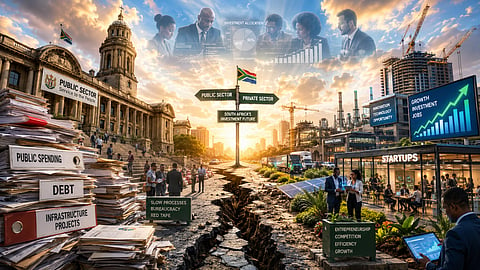
Key topics:SA’s GFCF low; focus on productive investment, not just more spendingPrivate investment incentives beat state-led projects; China caution exampleCapital from savings; skilled capitalists/entrepreneurs + reform needed.Sign up for your early morning brew of the BizNews Insider to keep you up to speed with the content that matters. The newsletter will land in your inbox every morning on weekdays. Register here.Support South Africa's bastion of independent journalism, offering balanced insights on investments, business, and the political economy, by joining BizNews Premium. Register here.If you prefer WhatsApp for updates, sign up to the BizNews channel here..By Mpiyakhe Dhlamini*.South Africa has an investment problem: as of 2024, our Gross Fixed Capital Formation (GFCF) was at 15% as a percentage of GDP. This number tells you how much of the spending represented by GDP is going into fixed investment: factories, roads, buildings etc. Investment is a leading indicator for growth and growth is needed to create jobs, therefore our highest priority should be to increase investment but more importantly, to get skilled capitalists to deploy this investment productively.By limiting our analysis to an aggregate number like GFCF, there is a risk that we miss the importance of getting the right kind of investment. The right kind of investment increases productivity and therefore makes everyone wealthier. If we just increase investment - something that could be done trivially by the government building buildings all over the country - we do not actually make anyone better off and we are just as likely to make everyone worse off..Read more:.All ‘staff riders’, in the Capitalist economy of SA, just recuse yourselves – Plaatjie Mashego.Legions of economists keep telling our government to increase GFCF, even if this is done through government spending, In 2008, just before the World Cup, South African GFCF peaked at 22% of GDP (it was not an all-time peak, that occurred in 1976 at 29%), yet this heralded the current period of long-term economic decline. It is therefore important to understand how to increase the right kind of investment, investment that leads to employment growth, rising incomes and just better living standards in general. 1.Private Investment is better than government investmentThe first thing to note is that private investment is what we need. This is because governments are centralised entities and operate under incentives that are likely to make their investments wasteful.South Africa’s government collects taxes from the entire country and spends that money on behalf of the country. That means that when it makes investments it does not have the bottom-up view of some small business that sees local prices and local needs. And by local we do not mean just the municipal level, although decentralising government investment that way would help; we mean also at the street or block level.It’s important to understand how businesses start and grow. They often start by solving problems faced only by a few people e.g. at a specific workplace. Then the business refines the solution for this small group and expands to the next bigger group. It is an iterative, bottom-up process.This is the opposite of how the government works. This means that as a business grows, it has encoded information about the needs of numerous small groups and so as it invests at a large scale, it is able to do so productively, by focusing the investments towards serving those needs. Additionally, even if a business grows so large that it starts to lose touch with those it serves, it still has the incentive to maximise profit.You cannot fake incentives; you can approximate them imperfectly as China does through decentralisation and holding SOE managers to standards as if they were private company managers. But even there, with the extraordinary discipline of the Chinese people, you still get political incentives seeping in. China has one of the largest debt burdens of any government if you factor in local government debt, national government debt and SOE debt, by some estimates this debt exceeds 300% of GDP.This is one of the largest in the world and is one of the causes of China’s slowdown since the 2008 financial crisis. China bet big on government investment, and this has produced ghost cities, uneconomical high-speed trains (when most people needed the cheaper and longer distance traditional trains), the destruction of whole villages etc.Even today, we are told China is a model. These people are failing to see the forest and are focusing on the trees. China’s collapse promises to be as spectacular as its rise. Its growth is anything but sustainable.One of the problems is that local governments were incentivised to spend more on infrastructure even if the infrastructure was no longer productive. And the specific problem is due to public sector incentives because long-term infrastructure takes time to be profitable. It is easy to build something that ensures your advancement in the CCP today because you know that you will be in the central committee by the time it fails to yield the expected return.Contrast this with the private sector, where people must spend their own money. No matter if an investment takes 20 or 30 years, it must still make a profit otherwise someone will lose their own money. It is not like the state where no one feels the pain when the state takes a massive loss on a ghost city built by some local government where the people who built it have long retired or been promoted to higher levels of government.2.Capital comes from savings not taxes or inflationCapital is necessary for production, but capital itself is born out of accumulated production in the form of savings. Again, these must be privately generated for the same reasons why private investments are better than government investments. Taxes simply take capital out of the hands of those who are incentivised to use it most productively and put it in the hands of those who pay no price for deploying them unproductively.That is the story of South Africa’s decline post-2008; the government tried to escape the 2008 financial crisis by spending money we did not have. This simply took away future productive capital from the private sector because those people are now paying for the debt the government took on “to save the economy”. As we speak, we are now spending 5% of GDP just on debt servicing costs, up from 2% in 2008.Keep in mind that debt-servicing costs must come directly from government revenue mostly in the form of taxes. So, 5% of GDP that could be used to invest in the economy is going towards paying the costs of the government's failed attempts to invest in the economy. This is not to say private sector investments always succeed; that is a strawman. The argument is about incentives, information and accumulated production.Incentives because spending your own, limited funds where losing those funds would leave you worse off, results in better decisions. Patrice Motsepe must be very careful when he invests money; unlike the government, if he is reckless, he can lose the money he has. So, he can’t just deploy his capital on any idea that sounds good; he could even lose it all and become poor, and the same goes for all private investors.The government does not have any such incentive. No matter how bad their investment decisions are, the taxes will keep flowing. If the tax revenue declines because the productive capacity of the country declines, they can keep spending by taking on debt (paid for by future taxes, with interest) or simply printing money, which is paid for by reducing the purchasing power of the accumulated production of savers.3.Skilled investors/capitalists are needed to direct capital to productive usesIn this country, some members of leftist political parties and those who hold to the ideologies that these parties promote, regularly attack people they call capitalists. But what is a capitalist? If we take our cue from the definition of capital, as being assets that are used in the process of production, then capitalists are simply those who provide this capital, and we know from above that these people are simply savers.That means everyone who consumes less than what they make is potentially a capitalist. Of course, capitalists are not equal. I, with my modest cash and stock portfolio, am technically a capitalist. But I simply do not have the skill of someone like Warren Buffett. Some capitalists are better at identifying productive uses of capital than others, and so a society does not just need the capital itself, it needs the skilled capitalist to deploy it.Yes, incentives make it more likely, if for no other reason than trial and error, that the private deployer of capital would put it to productive use compared to the government investor. It is also important to note that over time, due to the same incentives, it is possible to identify private deployers of capital that just do it better than anyone else..Read more:.Mailbox: A capitalist South Africa is not the solution for us all - Hassen Lorgat.These should not be confused with entrepreneurs, the people who organise production, although they are frequently the same person. The deployer of capital specialises in identifying skilled entrepreneurs and worthwhile projects to invest in. We can imperfectly approximate the private incentives for deploying capital by introducing meaningful accountability in the public service (China’s case shows the limit of this), or we can try to mimic private sector decentralisation through public sector decentralisation. But there is no way the public sector can produce a Buffett or a Johann Rupert, Dr Allan Gray or Jannie Mouton.This is why a government that is serious about increasing production in the country, employment, wealth and ultimately tax revenue, must care about keeping and attracting more skilled capitalists. Of course, some of these skilled capitalists don’t have any capital right now and they will get it once they get jobs and start saving (with these savings growing at high and compounding rates for the most skilled), but the government must get out of their way.4.Entrepreneurs are required to see opportunities no one else can seeThe defining attribute of the entrepreneur is to see opportunities no one else can see, and act on them. An entrepreneur who is also a capitalist because of the overlap between both roles, is common. Think of Patrice Motsepe deciding to buy distressed gold mining assets in the late 90s because he could see an opportunity no one else could see. He had to get funding for this from people who could see that he could profitably execute on his idea.Think of Adrian Gore in the early 90s seeing an opportunity in health insurance. The entrepreneur often creates new industries, such as the automatic pool-cleaning industry created in South Africa by Ferdinand Chauvier in 1974. The software industry was created after WWII by pioneers such as Grace Hopper, John Von Neumann, Alan Turing etc and has now revolutionised the modern world, being one of the few industries that is extremely capital-light.Similarly, pioneers like Jensen Huang, Sam Altman, are driving the current generative AI revolution, built on the more fundamental deep neural network revolution brought to us by people like Geofrey Hinton. This was enabled by a computer hardware revolution, much of which was due to entrepreneurs like Jeff Bezos, through advances in cloud computing.The point is, you need entrepreneurs to organise production and identify opportunities no one else can see. But you also need capitalists to identify the entrepreneurs themselves. The government cannot do this. If it sees that entrepreneurs and capitalists are not deploying capital and creating the opportunities, the only thing the government can do is to figure out which of its own policies are causing a problem and remove those policies..Read more:.Ramaphosa’s ‘National Dialogue’ is just more talk while SA burns - Ivo Vegter.The government must realise that it cannot take on the roles of capitalists, entrepreneurs or even consumers. All it can do is provide incentives, through its control of legislation and law enforcement, to make the outcomes it wants more likely. The government itself doesn’t decide how much of an incentive is enough, if you want investors and entrepreneurs, you must create an environment that can create them: eliminate regulations, lower taxes and reduce government spending..*Mpiyakhe Dhlamini is a libertarian, writer, programmer and an Associate of the Free Market Foundation.