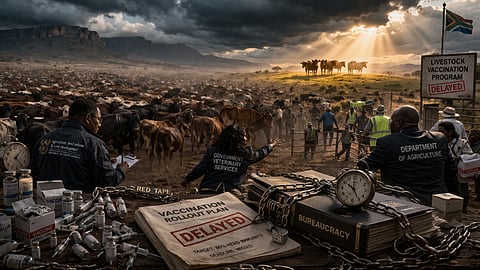
Key topics:National FMD vaccination programme lags, 90% unvaccinated.Vaccine supply exists, but distribution system creates delays.Leadership failures, not logistics, drive ongoing crisis..Sign up for your early morning brew of the BizNews Insider to keep you up to speed with the content that matters. The newsletter will land in your inbox every morning on weekdays. Register here.Support South Africa's bastion of independent journalism, offering balanced insights on investments, business, and the political economy, by joining BizNews Premium. Register here.If you prefer WhatsApp for updates, sign up to the BizNews channel here..By Andrew Morphew.THE COMMITMENTOn 26 November 2025, Minister of Agriculture John Steenhuisen made a clear announcement."I can therefore announce today that the Ministry of Agriculture has made a policy change. We will be moving to vaccinate the entire national herd in South Africa against foot-and-mouth disease. This is going to be essential if we are to get on top of the disease."That was the commitment. Vaccinate the entire national herd. It set a clear objective and a clear measure of success.It is now possible to measure what has been delivered against what was promised. THE SYSTEMFMD control comes down to two things: speed and coverage.Speed matters because delay allows the virus to stay ahead. Coverage matters because gaps allow it to spread.You need both, at scale. In countries where the disease has been brought under control, vaccination has been delivered in tightly coordinated windows measured in weeks, not months.The only thing that makes that possible is vaccine — in sufficient quantity and being administered fast enough to matter. THE OUTCOMEAccording to ICC figures dated 26 March 2026, approximately 1.1 million animals have received a first dose. The national cattle herd is approximately 12.5 million..Read more:.FMD: A crisis defined by no vaccine - Andrew Morphew .Three months after the national vaccination programme was announced, more than 90% of the national herd remains unvaccinated.But there is a second failure sitting inside the first, and it matters just as much.Of the 2.3 million doses received in the country, fewer than half have been administered. The vaccine exists. It is here. The system has not converted supply into protection fast enough.The scale makes the point. The two companies selected to supply South Africa with FMD vaccines have a combined monthly production capacity of 40 million doses. South Africa has received 2.3 million doses in total. The constraint was never global manufacturing capacity. It was the system through which vaccine was procured, approved, and released.Three months in. No speed. No coverage.The mathematics do not improve with time. The animals vaccinated first are approaching the point where they need a booster. A second round begins on top of an unfinished first round, in a system that has already shown it cannot keep pace. The numbers compound. THE CONSTRAINTThe problem was built into the design.Government failed to secure vaccine at the scale required. That failure was compounded by a second decision: to maintain a state-controlled, single-channel system for access and distribution. For more than four months — between October and February — no vaccine entered the country.The position taken was that, under the Animal Diseases Act, farmers had no legal right to source or administer FMD vaccine independently — a position the Minister defended vigorously until litigation forced a change of course.One route in. One approval authority. Sequential sign-offs at each stage. No parallel pathways. No mechanism to accelerate when the situation demanded it.A state-controlled system can function when it is properly resourced and supply is assured. Neither condition applied here. The result was a bottleneck at every point where the state was the sole gatekeeper.Speed was structurally impossible. Coverage could not follow. WHAT THE RECORD SHOWSThe Department's public account of this response has described steady progress — difficulties acknowledged in general terms, institutions functioning, the system moving in the right direction.The internal record is different. It became visible only when Ministerial Task Team minutes were filed as part of court proceedings. Without the litigation, what follows would not be in the public domain.Field strain samples were not submitted to the International Reference Laboratory in time. When results came back, they showed a mismatch on the SAT1 component of the Biogénesis Bagó vaccine — the primary imported supply. Approximately 40% of doses already deployed carried this mismatch, leaving their effectiveness against the circulating strain uncertain. This was not disclosed publicly.The Agricultural Research Council — responsible for diagnostic support — was recorded in those minutes as unresponsive. It declined to engage directly with the Task Team, insisting all communication be routed through the Department. Provinces waited months for strain confirmation. By March, the diagnostic failure had overtaken vaccine supply as the primary operational bottleneck.No Section 21 import permits had been issued, despite the entire import programme depending on them. The minutes record that most progress on vaccine importation came from Task Team members working around the system — not through it. Dunevax would not begin manufacturing the next five million doses without Section 21 assurance. The manufacturing pipeline stalled because the regulatory pipeline had not moved. THE STANDARDNo one expects perfection in a crisis of this scale. Systems fail. Institutions underperform. Decisions that looked reasonable in November look different in March.The standard is not perfection. It is accountability.When something goes wrong — acknowledge it clearly. Adjust course. Fix what is broken. Tell the farmers carrying the consequences what is happening and why.What falls below that standard is making the minimum concession only when forced by a court date, then presenting it as forward movement while the underlying system stays unchanged. That is not managing a crisis. That is managing how the crisis looks. THE PUBLIC POSITIONMore than three months after the commitment to vaccinate the entire national herd, the public account has not meaningfully changed.Vaccines are arriving. Systems are functioning. Institutions are performing. Challenges have not been clearly acknowledged. The response remains, in official communications, a story of government working hard under difficult circumstances.No one in the Department — not the Minister, not the Director-General, not any official — has taken clear public responsibility for any identifiable failure, delay, or mistake.Not for the strain mismatch. Not for the diagnostic backlog. Not for the permit delays. Not for the 90% of animals still unvaccinated. THE PATTERNWhat makes this more than a catalogue of failures is that the response to each failure has followed the same shape.When the High Court heard the urgent application brought by Sakeliga, SAAI, and Free State Agriculture, it declined to grant the immediate relief sought — but it ordered the Minister to gazette a Section 10 scheme by 17 April and return to court on 28 April. The order carried costs against the Department. It was a court putting the Department on terms.Judge Van der Westhuizen reportedly remarked on the Minister’s sudden U-turn: "When death knocks on the door, then presto... suddenly, when the shoe pinches, all kinds of things are done."In a press statement, the Minister welcomed the ruling. “Minister John Steenhuisen welcomes today's outcome in the Gauteng Division of the High Court, which has affirmed the Department's lawful authority to regulate and manage South Africa's response to Foot-and-Mouth Disease.” A punitive order with a hard gazette deadline was framed as vindication. A legal challenge lost — reframed as a victory. Delays attributed to a single supplier — despite system constraints that predate that relationship, and supply numbers that made the shortfall predictable from the start. Failures identified inside the Task Team — recorded in minutes never intended for public release, entering the public domain only through litigation. Problems named internally — without correction.Those who raised concerns publicly were challenged or removed. Legal action brought by farming organisations was characterised as profiteering. Industry leaders were attacked by name. The energy went into the narrative, not the system..Read more:.The quiet change that may win the war on FMD.This is not a run of bad luck. It is a consistent set of choices — about what to disclose, who to engage, and where to direct effort when the pressure came. THE QUESTIONWhen a system fails this visibly, for this long — and when the response to that failure follows this consistent pattern — the question is no longer one of execution. Systems do not correct themselves. They reflect the decisions, priorities, and values of those who lead them. This system is producing exactly the outcomes it is designed to produce.The problem is leadership.