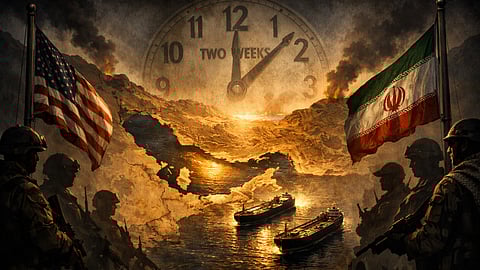
Key topics:US-Iran two-week ceasefire triggers 10% drop in Brent crude oil.Ceasefire is temporary; broader regional conflicts remain unresolved.Iran uses ceasefire to push 10-point negotiation framework for leverage..Sign up for your early morning brew of the BizNews Insider to keep you up to speed with the content that matters. The newsletter will land in your inbox every morning on weekdays. Register here.Support South Africa's bastion of independent journalism, offering balanced insights on investments, business, and the political economy, by joining BizNews Premium. Register here.If you prefer WhatsApp for updates, sign up to the BizNews channel here..By Dr Joan Swart.The announcement of a two-week ceasefire between the United States and Iran has already had a measurable global impact. Within hours, Brent crude fell by roughly 10%, reflecting a sharp reduction in the immediate risk of disruption to energy flows through the Gulf.Yet this market reaction risks being misinterpreted. The ceasefire is not a peace agreement, nor does it signal the end of hostilities. It is a temporary and conditional arrangement designed to create space for negotiations, reportedly to be held in Islamabad, with Pakistan acting as intermediary. Crucially, it applies unevenly across the conflict landscape. While direct US–Iran escalation has paused, violence linked to Israel, Lebanon, and other regional actors continues, underscoring that this is not a comprehensive settlement but a narrow de-escalation mechanism.At the centre of the diplomatic process is Iran’s proposed framework for negotiations, widely described as a 10-point plan. This includes demands for sanctions relief, recognition of Iran’s right to uranium enrichment, the withdrawal of US forces from the region, and compensation for war-related damage. It also extends beyond bilateral US–Iran issues to encompass broader regional conditions, including ceasefires across multiple fronts and a reconfiguration of security dynamics in key theatres..Read more:.The Economist: Why Arab states are silent about Iran’s unrest.What makes this moment unusual is not just the content of these demands, but the posture from which they are being advanced. There is little indication, at least publicly, that Iran is negotiating under immediate pressure to concede. Instead, the available signals suggest that Tehran views the ceasefire as an opportunity to convert what it perceives as military and psychological resilience into diplomatic leverage. Earlier US proposals were reportedly rejected, with Iran placing its own framework at the centre of discussions.This does not necessarily mean that Iran holds decisive advantage, but it does shape the dynamics of the negotiation. The ceasefire, in this sense, is not simply a pause—it is a transition from kinetic pressure to political bargaining. Whether that bargaining leads to compromise or deadlock remains uncertain.It is against this backdrop that the movement in oil markets should be understood. The sharp drop in Brent crude reflects a repricing of short-term risk, particularly the likelihood of sustained disruption in the Strait of Hormuz. As one of the most critical chokepoints in the global energy system, any threat to Hormuz has immediate implications for oil supply, shipping costs, and insurance premiums. The ceasefire has temporarily eased those concerns, allowing tanker flows and market expectations to stabilise.But the underlying vulnerability remains. The past weeks have demonstrated that even the possibility of disruption—rather than its full realisation—is sufficient to drive significant volatility. Hormuz is no longer treated by markets as a stable constant; it has become a variable shaped by geopolitical tension.This shift has broader consequences for the global economic system. Energy markets are built not only on physical supply and demand, but on assumptions about security and continuity. Once those assumptions are shaken, they are not easily restored. Investment decisions, strategic reserves, and trade patterns begin to reflect a more uncertain environment.At the same time, the diplomatic demands emerging from Iran raise questions about the future of sanctions as a tool of economic power. If negotiations result in even partial sanctions relief, or if enforcement weakens in practice, it could accelerate the ongoing development of parallel economic networks. These networks—already visible in trade involving Russia and Iran—operate alongside the formal global system, using alternative channels to bypass restrictions.The result is a gradual fragmentation of the global economy into overlapping systems: one governed by established rules and institutions, and another shaped by geopolitical contestation and adaptation. The current conflict has not created this trend, but it has exposed its significance.The volatility in oil markets also points to a deeper structural change. Prices are increasingly driven by geopolitical signals as much as by production data or macroeconomic trends. A ceasefire announcement can move markets as decisively as a shift in supply, while renewed escalation could reverse those gains just as quickly.For economies such as South Africa, this introduces a persistent layer of uncertainty. Fuel prices, inflation trajectories, and currency stability become more sensitive to events in distant regions. Policymakers must contend not only with economic variables, but with geopolitical developments that can alter conditions overnight.The ceasefire, then, should not be read as a return to normality, but as a moment of temporary relief within a more unstable system. Its durability will depend on whether negotiations produce tangible progress or simply delay further confrontation. If Iran maintains its current position without meaningful concessions, and if the United States proves unwilling to accommodate key elements of its framework, the risk of renewed escalation remains high.In that sense, the most important question is not whether oil prices have fallen, but why they fell—and how quickly that trend could reverse. The answer lies not in the ceasefire itself, but in the unresolved tensions it has merely postponed..Read more:.The Economist: Iran War about to escalate - Gulf States may join in.The global economy has been given a brief reprieve. Whether it marks the beginning of a more stable arrangement, or simply an interlude before further disruption, will depend on what happens next at the negotiating table.