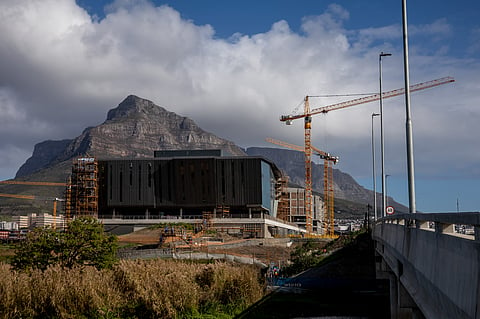
Writing for the Daily Friend, columnist Ivo Vegter takes aim at Daily Maverick's "Power Guzzlers" coverage and a Foxglove-backed objection to a Cape Town Equinix data centre, arguing that activists are conflating zoning applications with licensing processes to obstruct investment South Africa badly needs. He points to Actom, Hitachi Energy and Eskom's transmission build-out as evidence data centres anchor jobs and infrastructure, and notes SA's unusually cheap commercial power as a genuine competitive edge in the global AI infrastructure race. Blocking the Cape Town project, he argues, won't house a single family in the city's housing backlog, just send the jobs and rates revenue elsewhere..By Ivo Vegter*.Activists have discovered a new dragon to slay: the data centre. If they succeed, they will have protected poor South Africans from jobs, investment and infrastructure. Some victory.For once, there was a positive story in the papers. In May, the Daily Maverick reported that data centres in South Africa are not just energy consumers, but catalysts for economic growth, infrastructure development and job creation.So they are, whether or not you know (or like) what companies use them for.The article quoted executives from Hitachi Energy and Actom – the latter a South African original equipment manufacturer employing some 8,000 people – explaining how the data centre boom is driving demand for locally manufactured substations, transformers and battery storage.Data centres, one pointed out, are anchor clients for municipalities: guaranteed megawatts, guaranteed revenue. Actom is so confident of long-term demand that it runs maths and science tutoring programmes in schools to feed its artisan and engineering pipelines. Eskom’s long-term transmission planning – 14,000km of new lines by 2035, at a conservative estimate of R440 billion – has given global equipment suppliers the confidence to build supply chains in South Africa.This is what economic development looks like. Private investment anchors public infrastructure. Skills are trained because there are jobs to fill. Municipalities gain large, reliable, paying customers to cross-subsidise the poor.In a country with an unemployment rate that should keep every policymaker and every civil society activist awake at night, one would expect this to be greeted with enthusiasm.One would be wrong.The monster huntersThe very same publication has spent much of this year running a series of breathless exposés – filed under the tag “Power Guzzlers”, no less – fretting about the energy and water footprint of data centres.Veteran environmental journalist Tony Carnie has warned that data centre growth could threaten South Africa’s electricity and water supply, catalogued the “hidden impacts” of AI on water and climate, darkly hinted at “clouds of secrecy”, and described a proposed Durban facility as a “monster” and, most recently, an “AI data beast”. And that’s not even all of them.Monsters. Beasts. Guzzlers. This is not the vocabulary of journalism. It is the vocabulary of a horror film, deployed by activists to make readers afraid of buildings full of computers.And where fear is stoked by media exaggeration, lobbyists follow.In April, a UK-based NGO called Foxglove, together with the Housing Assembly and the Legal Resources Centre, lodged a formal objection to a land use application for a proposed Equinix hyperscale data centre at the King Air Industria development in Cape Town.Why exactly a British lobby group is lobbying against municipal zoning decisions in South Africa is anyone’s guess. Foxglove’s co-executive director declared a “global fightback” against data centres, which she called “power and water-guzzling monsters”.There are those scary words again.Resource constraintsI hold no brief for secrecy, and I do not dismiss resource constraints.Cape Town lived through the Day Zero crisis. Eskom subjected the country to sixteen years of load-shedding. Durban loses more than half its water to leaks and theft, and the rest of the country isn’t doing much better.Anyone proposing a facility that draws hundreds of megawatts and large volumes of cooling water should expect scrutiny, and South Africa’s licensing regime should – and does – provide it.The objectors’ central complaint is that Equinix’s rezoning application – a 24-page motivational letter, they say – contains little or nothing about water consumption, diesel generators, emissions or noise. If their argument were merely that developers should be forthcoming, and that municipalities should ask hard questions, I would agree.But that is not the argument. The argument is that the City of Cape Town should refuse even to consider the application until the developer has produced, at the zoning stage, the kind of detail that belongs to entirely different regulatory processes.That is not scrutiny. That is obstruction dressed up as civic concern.Zoning is not licensingA zoning application answers one question: is this land suitable for this category of use? In this case, is this land suitable for “general industry”?It does not answer, and is not designed to answer, how much water a facility will draw, where its electricity will come from, or what its generators will emit.Those questions are governed by their own statutory processes – water-use licences under the National Water Act, environmental authorisations under NEMA, atmospheric emission licences, electricity arrangements with the municipality or Eskom, or NERSA.Each comes with its own application, its own public participation, and its own opportunity for objection.Demanding that every one of these assessments be front-loaded into a rezoning application is to demand a full environmental impact report at every rung of the regulatory ladder, whether relevant to that rung or not.It multiplies cost, delay and legal risk at each step – which is, of course, precisely the point. The strategy is not to ensure that concerns are addressed at the appropriate stage; it is to ensure that there are as many stages as possible at which a project can be delayed or killed.Consider Durban’s proposed 400MW facility, the “monster” of Carnie’s headline, representing a potential fixed capital investment in South Africa of between $3 billion and $10 billion.When eThekwini approved a memorandum of agreement with a Korean consortium, it stated explicitly that this was an exploratory framework, that no infrastructure commitments or subsidies had been approved, and that any actual development would be subject to the full suite of environmental authorisations and water use approvals.In other words: the concerns will be assessed, at the stage at which the law requires assessing them.The project promises up to 5,000 construction jobs and 500 permanent ones. The critics’ response is to treat a feasibility study as a fait accompli and demand that all questions be answered before the regulatory process has even asked them.Foreign monsters and false dichotomiesIt is worth pausing on who is doing the objecting. Foxglove is a London-based lobby group that boasts of forcing the UK government to back down on data centre approvals, and cites, approvingly, the American state of Maine’s outright ban on data centres. Having campaigned against digital infrastructure in one of the richest countries on earth, it has now arrived to “protect” the communities of Cape Town.Protect them from what? From a multi-billion-rand investment in a city with a housing backlog, an unemployment crisis, and a municipal budget that must somehow fund the infrastructure the poor so desperately need?Rich countries can perhaps afford the luxury of banning industrial development. South Africa cannot. When first-world NGOs export their anxieties to the developing world, the result is not protection but privation.We have seen this movie before, when environmental lobbies helped keep shale gas exploration in regulatory purgatory for a decade and a half, and when green campaigns against modern agriculture exacerbated malnutrition and starvation among the world’s poorest people.Elitist rich-world fads, imposed on poor countries, cost the most vulnerable people dearly.The Housing Assembly, for its part, frames the matter as a choice: the City must “put people before profit”, because a data centre “is not a priority for the landless people of Cape Town”.This is a false dichotomy, and a destructive one. The landless people of Cape Town do not need only houses. They need jobs with which to pay for houses, and a city with the revenue to build water and electricity infrastructure. Houses do not generate municipal income; data centres do, handsomely. They cross-subsidise indigent households.This is not about a contest between the deserving poor and the profiteering rich. Industrial land, put to productive use, generates the growth that funds everything else, including housing.A golf course leased to an industrial developer was hardly going to become social housing in any event. Blocking the data centre will not house a single family. It will merely ensure that the jobs, the rates revenue and the infrastructure investment go elsewhere – to Nairobi, or Lagos, or Dublin, or Bangalore.“People before profit” is a slogan that mistakes profit for the enemy of people, when profit is precisely what pays for people’s wages, people’s infrastructure and people’s tax-funded services.A city that repels profitable enterprises does not thereby house its poor. It impoverishes them further, and then people riot when the housing budget shrinks.A rare competitive advantageThere are good reasons why hyperscalers are looking at South Africa: proximity to African customers, landing stations for submarine cables like the 45,000km 2Africa system, and – surprisingly, perhaps – price.For all the justified complaints about Eskom’s tariff trajectory, commercial electricity in South Africa is among the cheapest in the G20, at about $93 per megawatt-hour: on a par with Russia and China, and roughly a fifth of what commercial users pay in Britain.We are one of the few countries where commercial power is cheaper than household power.That is a genuine, if probably accidental, competitive advantage in the global scramble for AI infrastructure.President Ramaphosa boasted in his State of the Nation Address that more than 55 data centres have been built here, with a further R50-billion in digital infrastructure investment secured.Whether the worldwide AI investment boom ultimately pays off is a question for the investors risking their own capital; it is emphatically not a question for zoning tribunals, municipal councils or foreign lobby groups.If the boom fizzles, shareholders will bear the losses, and South Africa will still have the substations, the co-generation plants, the fibre, the skills and the grid upgrades.If it doesn’t, we will have caught a wave that waits for nobody, and that stagnant economies like ours rarely get offered twice.The only way to squander the opportunity is to smother it in process – to signal to every hyperscaler weighing Cape Town against Casablanca that in South Africa, a routine rezoning invites transnational lawfare.A civil society that can say yesNone of this requires abandoning environmental precaution. South African law amply provides for impact assessments, water licensing, emissions control and public participation..Read more:.'Toti is becoming a battleground for data centres.What it requires is a civil society that approaches development with a presumption in favour of “yes” – one that asks how impacts can be mitigated, how infrastructure can be co-developed, and how self-generation can relieve the grid, rather than one that reflexively turns to objection letters, exaggerated claims, media scare campaigns and astro-turfed protest marches.The test of a public interest campaign should be simple: does it seek to make development work, or to make development stop?Campaigns of the first kind deserve a seat at the table. Campaigns of the second kind – waged in the vocabulary of monsters and beasts, by foreign lobbyists – deserve to be recognised for what they are: obstructionism that would condemn South Africans to permanent poverty, in the name of protecting them.South Africa does not suffer from too much investment. It suffers from far too little.A country with over 30% unemployment cannot afford a civil society that treats every major investment as a dragon to be slain. If the monster hunters prevail, they will win nothing but stagnation – and the landless people of Cape Town will remain exactly as landless, angrily asking why liberation has not delivered a better life for all..*Ivo Vegter is a freelance journalist, columnist and speaker who loves debunking myths and misconceptions, and addresses topics from the perspective of individual liberty and free markets..This article was first published by Daily Friend and is republished with permission..Sign up for your early morning brew of the BizNews Insider to keep you up to speed with the content that matters. The newsletter will land in your inbox every morning on weekdays. Register here.Support South Africa's bastion of independent journalism, offering balanced insights on investments, business, and the political economy, by joining BizNews Premium. Register here.If you prefer WhatsApp for updates, sign up to the BizNews channel here.