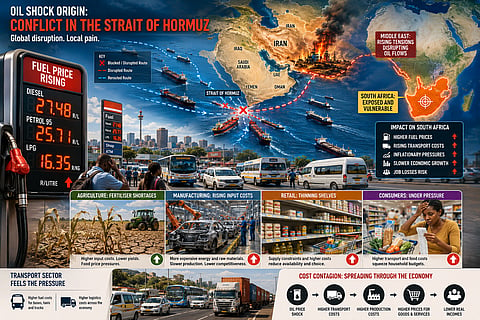
Key topics:Oil >$100 from Hormuz conflict drives sustained fuel price surgeHigher fuel costs push inflation via transport, food and farming inputsSA exposed: weak refining, fertiliser shortages, fiscal limits, reform needed.Sign up for your early morning brew of the BizNews Insider to keep you up to speed with the content that matters. The newsletter will land in your inbox every morning on weekdays. Register here.Support South Africa's bastion of independent journalism, offering balanced insights on investments, business, and the political economy, by joining BizNews Premium. Register here.If you prefer WhatsApp for updates, sign up to the BizNews channel here..By Dr Joan Swart*.More than 60 days after the outbreak of conflict involving Iran and the disruption of traffic through the Strait of Hormuz, the effects on South Africa are no longer theoretical. They are measurable, cumulative, and increasingly structural.The most immediate impact has been felt at the fuel pump.Global oil prices have remained elevated above $100 per barrel since the onset of the conflict, with recent weeks consistently exceeding $110 as both sides signal further escalation. Disruptions to shipping through the Strait of Hormuz, alongside direct attacks on infrastructure and vessels, have entrenched a sustained risk premium in global energy markets. There is little evidence that prices have peaked. For South African households, this is not a temporary spike, but the beginning of a prolonged period of elevated fuel costs likely to extend well into the third quarter..Read more:.Justice Malala: Africa’s energy vulnerability exposed as war shakes fuel markets.A commuter travelling 40–60 kilometres daily is likely to see fuel costs rise by roughly R400 to R600 per month based on recent price increases alone. When broader household driving is taken into account, this increase can approach R800 to R1,000, turning higher fuel prices into a substantial and recurring pressure on monthly budgets.Fuel, however, is not an isolated cost. It is an input into almost every sector of the economy.Transport costs rise first, followed by food prices, logistics, and retail margins. Agriculture is particularly exposed. Diesel powers planting, harvesting, and distribution, and recent increases of over R6–R7 per litre significantly raise costs across the sector. As input costs rise, margins compress, and these pressures move through the value chain. The result is a broad-based inflationary effect that extends beyond fuel itself and into the everyday cost of living.This is where the second-order effects begin to matter.South Africa imports approximately 80% of its fertiliser requirements, including key inputs such as urea and phosphates. Around 40% of these imports originate from Gulf producers, and with fertiliser shipments through the Strait of Hormuz effectively halted since the onset of the conflict, the impact is no longer confined to rising prices. It is contributing to a broader global supply constraint, with implications for availability as well as cost.If elevated energy prices persist, fertiliser costs will follow. More importantly, constrained availability introduces a further risk. Reduced application rates or delayed purchases—common responses under such conditions—can translate into lower yields in subsequent seasons. The effect is not immediate, but it is predictable. What begins as a geopolitical shock evolves into a domestic supply constraint with direct implications for food security.At the same time, South Africa’s structural exposure is being laid bare.The country’s refining capacity has diminished significantly over the past decade, leaving it increasingly dependent on imported refined products. This reduces flexibility in responding to external shocks. The government’s move to increase crude sourcing from Angola and Nigeria reflects a recognition of this vulnerability, but it addresses only part of the problem. Diversification of supply does not eliminate exposure to global pricing or shipping constraints.Nor does it resolve the strategic dimension.Energy security is not only an economic issue. It has direct implications for national security and military readiness. Modern armed forces are fuel-dependent, and sustained increases in fuel costs place pressure on operational budgets, training cycles, and deployment capacity. In a constrained fiscal environment, these trade-offs become more pronounced. More fundamentally, the broader state of the economy directly affects the funding available for defence. Slower growth, rising input costs, and fiscal pressure reduce the resources that can be allocated to military spending, placing further strain on a defence budget that is already significantly below international benchmarks as a percentage of GDP. At the same time, the state’s ability to cushion the immediate impact is limited. Temporary relief measures, such as fuel levy adjustments, are fiscally difficult to sustain and are likely to be withdrawn in the near term, reinforcing the persistence of the underlying cost pressure.Foreign policy is also affected. South Africa’s positioning in relation to Middle Eastern actors, as well as its engagement with African energy producers, is no longer purely diplomatic. It is increasingly shaped by material considerations: access, stability, and continuity of supply.The question, then, is not whether the impact of this conflict will be felt, but how it will propagate.Rising input costs, constrained supply chains, and reduced policy flexibility create conditions that extend beyond the economy. As household pressure increases, so too does the risk of social strain. South Africa has seen this pattern before: economic stress translating into heightened sensitivity around service delivery, cost of living, and employment.Mitigation, therefore, requires more than short-term relief measures.Temporary fuel levy adjustments provide immediate support, but they do not address underlying vulnerability—and, critically, they cannot be sustained in a fiscally constrained environment. More durable responses, such as restoring elements of domestic refining capacity, building strategic reserves, or securing diversified supply agreements, all require funding that is not readily available under current conditions.The question is therefore not only what should be done, but how it will be financed.At present, South Africa’s fiscal position leaves limited room for large-scale intervention. Debt servicing costs are rising, revenue growth is constrained, and competing social and infrastructure demands remain acute. Under these conditions, new spending without corresponding reform risks further weakening the state’s financial position.In the absence of fiscal space, reform is not optional—it is the only viable source of capacity.Improving efficiency and productivity within the public sector is not a long-term aspiration, but an immediate necessity. Reducing leakage through corruption and mismanagement, accelerating decision-making processes, and lowering the cost of doing business are among the few measures that can unlock capacity without requiring new funding. These are not abstract reforms—they directly affect the state’s ability to respond to external shocks.At the same time, economic growth is not peripheral to this discussion. It is the primary source of fiscal space. Without it, mitigation remains limited to redistribution rather than expansion. A more pragmatic, transaction-oriented foreign policy, particularly within Africa, can support this by securing supply relationships, expanding trade, and reducing exposure to external bottlenecks.In agriculture, supporting input resilience will require targeted, carefully structured interventions rather than broad subsidies. Ensuring access to fertiliser and maintaining production levels will be critical in preventing the current shock from translating into a longer-term food supply constraint. Here, public–private coordination may prove more effective than purely state-driven approaches.What becomes clear is that the challenge is not only external. It is internal..Read more:.Godongwana warns oil shock may hit South Africa’s inflation.South Africa’s exposure to global disruptions cannot be eliminated, but it can be reduced. Doing so does not require a wholesale transformation overnight. It requires a sequence of deliberate steps—improving governance, restoring operational efficiency, and enabling economic activity—that together create the conditions for resilience.The current moment leaves little room for hesitation. The constraints are already visible, and the margin for error is narrowing. The question is not whether the country has the potential to respond. It is whether it can act with sufficient clarity and urgency to realise it..*Dr Joan Swart is a forensic psychologist and military analyst specialising in security studies, geopolitics, and strategic affairs, with a particular focus on Africa. She is currently completing a PhD at the University of Stellenbosch Military Academy.