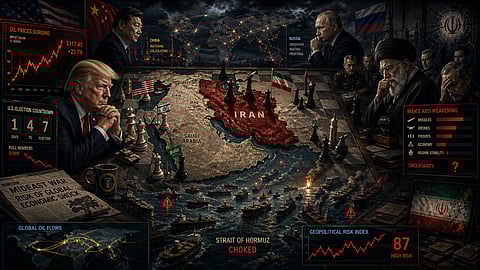
Key topics:US and Iran face pressure for a deal amid oil prices and war risksWar weakens Iran's military and regional proxies, containing its powerGlobal oil disruption impacts China, Russia; risk of frozen conflict.Sign up for your early morning brew of the BizNews Insider to keep you up to speed with the content that matters. The newsletter will land in your inbox every morning on weekdays. Register here.Support South Africa's bastion of independent journalism, offering balanced insights on investments, business, and the political economy, by joining BizNews Premium. Register here.If you prefer WhatsApp for updates, sign up to the BizNews channel here..By Jonathan Katzenellenbogen*.Whether or not US and Iranian negotiators meet in Islamabad today, it is unlikely that there will be a deal just yet. Although there is deep distrust between the two sides, both want a deal, but neither wants to be seen as the first to fold.There is an enormous amount that we do not know about the Iran war. We do not know what stock of ballistic missiles and drones the Iranian regime still holds. And we do not know what the “new cards” are that the Iranians say they hold.We also do not know about a crucial element — the internal politics of the Iranian regime since the killing of successive layers of its leadership.But we do know that both the US and Iran need a deal in which both sides can look good.Both President Donald Trump and the Iranians are under pressure to reach a deal. The mutual benefit of such a deal is that oil would flow. For Iran, this would allow it to earn export revenue; for the US and the world economy, it would pave the way to lower oil prices..Read more:.FT: Iran sets its price to end the war.But this mutual benefit does not guarantee that a deal to end the conflict will be reached.For Trump the pressures come from high oil prices and the prospects of a long war.If there is one political lesson to have emerged from the US wars in Afghanistan, Iraq and Vietnam, it is that the public tends to turn rapidly against involvement in what appear to be long wars. The US does not have boots on the ground in Iran, but the American public does not want US troops being deployed there at some stage. Trump wants to avoid higher oil prices going into the US midterm elections in November. The loss of the slim Republican majorities in the House and the Senate could mark the beginning of the end of the Trump wave.Last week, Trump’s former national security advisor, John Bolton, said on CNN that the President “does not really know where he is going with this” — referring to the war against Iran.The lack of a clear strategic direction, and the signs that achieving the initial war aims could take a long time, even after only six weeks, are bound to undermine support for Trump.Bolton has consistently argued that Trump has no strategy for the war, but understands that his “political well-being is at stake” — which is why he wants a deal. Trump fired Bolton as national security advisor and may bear some animosity towards him, but Bolton’s comments on the Iran war are among the most astute.Iran also wants a deal, as the longer the war goes on, the greater the uncertainty over the survival of the regime.With its remaining stock of missiles and drones, and a largely submissive public, there may be little immediate pressure on Iran to meet US demands — but it does face serious risks. The regime could face further decapitation should the US act on its threat to resume air strikes when the ceasefire ends tomorrow. And if Trump carries out his threat to bomb power stations and bridges, the Iranian economy will come under further severe strain. While some anger may be directed at the US, there may also be a backlash against the regime itself. As the war and its hardships drag on, that would increase the risk of regime change. Some in the regime could be willing to take a bet that they can survive longer with a war. But that is a high-risk gamble.Less than two months into the conflict, it seems unlikely that the US administration will be able to achieve all its initial goals — unconditional surrender, the dismantling of Iran’s nuclear and ballistic missile programmes, and the installation of leadership that is acceptable to the US, essentially regime change. Over the past few days, Trump has been emphasising that Iran must lift the blockade of the Strait of Hormuz and dismantle its nuclear programme.Although these aims have not been achieved, there are other areas in which the US and Israel have made substantial gains. At this stage, the principal Trump achievement appears to be a contained Iran. Tehran is no longer able to support its “ring of fire” around Israel to the extent that it did in the past. Hamas in Gaza, Hezbollah in Lebanon and the Houthis in Yemen are unlikely to enjoy as robust a supply chain from Iran as before.Iran’s military and its arms industry have been substantially degraded. Its population must now know that the mullahs do not hold the power they once did. And in time, Iran will be confronted by rearmed Gulf states that will make it pay heavily for any future aggression against them.Whether or not a deal is reached, the US is likely to maintain a substantial military presence in the region. Without a deal, the most probable outcome is a frozen conflict in which the US keeps Iran on edge with a large carrier task force in the Gulf and intermittent strikes against key targets.The conflict has underscored the extreme difficulties in achieving regime change. But it does send a message that Trump is prepared to act — and he may well come to see Cuba as low-hanging fruit for a future regime-change project.For the rest of the world, the price has been extremely high. The disruption to oil supplies since the start of the war is by far the largest ever. The naval blockade is forcing producers to shut down output because they cannot export and lack sufficient storage capacity.For China, the conflict has brought both losses and wins. As the largest purchaser of Iranian oil, it has seen roughly 15 percent of its imported oil supply interrupted. There is also the threat, albeit uncertain, that Iran could fall under US influence.China’s partial gain from the conflict is that, in the current international environment, Beijing is able to present itself as a responsible actor: one that has not gone to war and has refrained from using trade as a weapon. There are fears that China might use the US and Israeli attack on Iran as a cue to launch an invasion of Taiwan. China may now have been deterred from that by the demonstrated ability of the US to project immense and highly precise force over great distances.Russia has gained only partially, in that the US is drawing down its weapons stockpiles, making it even less likely to reverse course and supply Ukraine at scale..Read more:.Trump officials’ mixed messages on US-Iran war prompt more market volatility.The Iranian people are not winners — at least not yet. All signs point to the regime cracking down hard on any sign of dissent. These sagas often take a long time to play out, but what seems probable is that Trump and the world will settle for a contained Iran — one that leaves Iranians to their fate, keeps the regime intact and the oil flowing..*Jonathan Katzenellenbogen is a Johannesburg-based freelance journalist. His articles have appeared on DefenceWeb, Politicsweb, as well as in a number of overseas publications. Katzenellenbogen has also worked on Business Day and as a TV and radio reporter and newsreader. He has a Master's degree in International Relations from the Fletcher School of Law and Diplomacy at Tufts University and an MBA from the MIT Sloan School of Management..This article was first published by Daily Friend and is republished with permission.