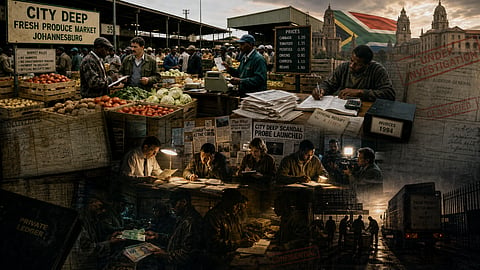
Key topics:Probe uncovers parallel economy inside Joburg market systemEvidence exposed, but institutions absorb rather than resolvePattern shows corruption persists through systemic containment.Sign up for your early morning brew of the BizNews Insider to keep you up to speed with the content that matters. The newsletter will land in your inbox every morning on weekdays. Register here.Support South Africa's bastion of independent journalism, offering balanced insights on investments, business, and the political economy, by joining BizNews Premium. Register here.If you prefer WhatsApp for updates, sign up to the BizNews channel here..By Bart Henderson.It doesn't matter how good an artisan is. If he doesn't know a problem's history and tries to diagnose that problem’s fault using only his "wealth of knowledge and experience" - then he is no more learned or effective than the average fool.IntroductionIn the mid-1990s, Johannesburg was in the early stages of institutional reinvention following South Africa’s democratic transition. Systems were being rebuilt, oversight mechanisms were still forming, and governance structures were under significant strain.It was in this environment that I conducted a forensic investigation at one of the city’s most critical commercial nodes—the Johannesburg Fresh Produce Market at City Deep.What began as a standard audit did not remain one.The deeper the work progressed, the clearer the pattern became: I was not examining isolated misconduct inside a functioning system. I was observing a parallel system operating within it.A second economy, embedded inside the first..Read more:.Rob Hersov: The systematic corruption of SA's ANC government - A four-pronged analysis of cadre deployment and state capture.What followed—detection, exposure, institutional escalation, and eventual containment— revealed something more significant than corruption itself. It exposed how governance responds when pressure exceeds its capacity to resolve.Detection: The Parallel SystemOn the surface, the market appeared structurally sound: high-volume trade, formal accounting systems, and digitised controls.But those controls did not govern behaviour. They documented it after the fact. A consistent operational pattern emerged:Systematic under-reporting of turnoverParallel sets of financial recordsDiversion of produce before formal captureRoutine bypassing of internal controlsSuppression of declared transaction values This was not opportunistic fraud.It was structured.An operating system embedded inside the official one.Initial losses were estimated at approximately R30 million. As the analysis deepened, that figure expanded toward R400 million in undeclared cash flows.At that point, the conclusion was unavoidable: this was not corruption within a system—it was a parallel economy operating through it.Exposure: When Evidence Enters the SystemThe findings entered the public domain through investigative reporting, including Star Line, and journalists such as David Shapshak, June Bearzi, and Theo Rawana.At first, the attribution was clear. I was identified as the investigator and primary source. That changed over time.References shifted from named sourcing to “the report” and “the investigation.” While I did not object, the evidentiary record began to fragment during its transition into formal review processes.In my contemporaneous records, I documented 272 individual items of evidence. These were physically presented in person to journalist Peter de Ionno of the Sunday Times at their offices after identifying that key materials were not reflected in the Auditor-General Shauket Faki’s consolidated reporting.From my perspective, the gap between primary evidence and formal record was not procedural noise—it was material distortion.Once evidence is fragmented, accountability is no longer linear. It becomes selective.Resistance: When Exposure Becomes ContestedAs visibility increased, resistance followed.The most significant escalation point occurred when journalist June Bearzi and her cameraman, covering the investigation, were assaulted.That incident marked a clear transition:From administrative review to contested environmentFrom financial irregularity to systemic exposureFrom disclosure to defensive responseAt that point, the investigation ceased to be purely forensic. It became adversarial.Escalation: Institutions Enter the FrameGiven the scale of the findings, the matter moved through formal governance channels:Auditor-General of South AfricaGreater Johannesburg Transitional Metropolitan CouncilOffice for Serious Economic Offences On paper, the sequence was coherent:Detection → Reporting → Oversight → EnforcementIn practice, the trajectory diverged, acknowledgement increased, resolution did not.Containment: When Process Replaces Outcome Despite institutional engagement, closure did not follow. Instead, the process slowed into procedural absorption. Reports were:Completed but not releasedCirculated internally but withheldDelayed through administrative sequencingAccess frameworks limited disclosure to directly entitled parties. The effect was not denial.It was containment.The system did not reject the findings. It absorbed them.Cross-System Pattern Recognition: The Arms Deal ContextAt the same time as the Fresh Produce Market investigation, I was also engaged in examining elements of the Arms Deal offsets. While structurally different in scale and sector, the underlying behavioural dynamics were strikingly similar.Both environments revealed systems where formal architecture existed in parallel with operational reality—where documentation, compliance, and oversight mechanisms functioned, but did not determine outcomes.Taken together, these experiences began to form a single interpretive frame: that corruption is not only a matter of isolated transactions, but of how systems behave when formal accountability structures are stressed by scale, incentives, and opacity.What the Pattern RevealsAcross the sequence, a consistent structural pattern emerges:DetectionPublic exposureInstitutional engagementResistanceProcedural containmentThis is not system failure in the conventional sense. It is system behaviour under strain.Exposure does not resolve corruption.It triggers a second-order process—one that determines whether findings become consequences or disappear into procedural latency.The Economic Signal Behind the Market CaseThe financial range identified—R30 million to R400 million—was only the surface expression of a deeper distortion.The underlying effects included:Reduced municipal revenue integrityDistorted pricing mechanismsEmbedded unfair competitive advantageErosion of institutional trustAs certainty declines, compliance weakens.As compliance weakens, enforcement loses traction.What emerges is not episodic corruption, but a self-reinforcing economic environment in which irregularity becomes structurally sustainable.Broader Context: A Pattern That PersistedThe Johannesburg Fresh Produce Market was not an anomaly. It was an early expression of a broader systemic pattern.Over subsequent decades, similar dynamics have been documented through:Auditor-General reports on persistent irregular expenditureSpecial Investigating Unit findings on municipal corruption networksThe Zondo Commission’s examination of state capture across entities such as Eskom and TransnetAcross these cases, the structure remains consistent:Exposure → escalation → resistance → delay → incomplete resolutionOnly the scale has changed. Not the sequence.These dynamics do not occur in isolation. They are reinforced by institutional weakening, uneven capability, and the gradual blurring of boundaries between administrative function and political influence.In such environments, the distinction between formal oversight and operational reality becomes increasingly difficult to sustain.Conclusion: The Real Test of GovernanceWhat the Market case, together with the Arms Deal, ultimately revealed is not simply the presence of corruption.It is the behaviour of systems when corruption is fully exposed.I approached both investigations as forensic exercises: evidence, quantification, attribution. Different sectors. Different scales. Same structural outcome.What emerged was not complexity—it was a pattern.A second-order governance reality in which systems are capable of identifying irregularity, but not consistently capable of converting that recognition into consequence.Across both cases, the sequence remained unchanged:detection → exposure → institutional engagement → resistance → procedural containmentNot once. Repeatedly.At the time, I did not fully anticipate the secondary effects that would follow either investigation—media pressure, institutional resistance, and legal or procedural pressure tied to my refusal to participate in processes I regarded as conflicted or structurally compromised.But the more important point is this: neither case behaves like an exception in isolation.The Fresh Produce Market showed how a municipal system can sustain a parallel economy beneath formal controls without collapsing.The Arms Deal demonstrated how the same logic can scale into national procurement systems, embedded within oversight, contracting, and institutional interfaces that remain formally intact while operationally porous.Different domains. Same operating logic.And once seen in two structurally unrelated environments, it becomes difficult to dismiss as coincidence..Read more:.Brian Benfield: The more numerous the laws, the more corrupt the State.What begins to emerge is not isolated corruption, but a repeatable governance condition— one in which exposure does not resolve the problem, it activates a containment response.Not breakdown. Adaptation. Not failure. Absorption.And in doing so, they are not learning how to end corruption—but how to live with it, and extract value from its continuation.Taken together, these cases point to something more structural: how South Africa has drifted toward a status quo in which systemic corruption is no longer episodic, but endemic— normalised through repetition, absorbed by institutions, and sustained by limited consequence.