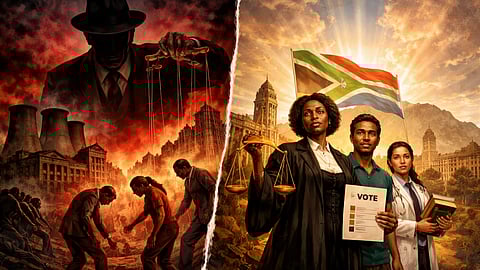
Key topics:ANC self-interest often harms South Africa, undermining institutions.Leaders exploit history to deflect accountability and manipulate voters.Civic maturity and active citizenship are crucial for democratic renewal..Sign up for your early morning brew of the BizNews Insider to keep you up to speed with the content that matters. The newsletter will land in your inbox every morning on weekdays. Register here.Support South Africa's bastion of independent journalism, offering balanced insights on investments, business, and the political economy, by joining BizNews Premium. Register here.If you prefer WhatsApp for updates, sign up to the BizNews channel here..By Solly Moeng.There was a time, not so long ago, when what was good for the African National Congress was almost automatically accepted as what was good for South Africa. For many of us, the two were indistinguishable, both wrapped in the moral glow of freedom’s victory after the long night of apartheid. The ANC’s narrative of struggle, forgiveness, and nation-building underpinned our collective sense of purpose.Its triumphs were our triumphs; its heroes were our collective icons, now scattered all over the country in statues, street names, town names, building names, school names, informal settlement names, stadium names, and a whole lot more. For many years, we either tacitly supported the renaming or kept our silence believing that it all made better sense than what went down during the long dark night of colonialism and apartheid.Those days are gone. And while nostalgia tempts us to pretend otherwise, we do South Africa a disservice by allowing that romantic illusion to persist. Today, it is clear – painfully clear – that what is good for the ANC has long ceased to be good for South Africa. In fact, in many instances, what is good for the ANC is bad for South Africa.At every turn, evidence mounts that the ANC places its own survival above the country’s progress. Cadre deployment, once justified as a mechanism to infuse the state with loyal and ideologically aligned officials for positive change, has instead become a web of patronage and protection. The result is an eroded civil service, one where competence often plays second fiddle to political allegiance.Consider Eskom, Transnet, SAA, municipalities – institutions that were meant to be the engines of delivery and economic stability. Instead, they have been hollowed out by years of political interference, politically malleable appointments, and an inability to hold connected individuals accountable. The party’s internal power struggles and endless factionalism have left state institutions paralysed, while citizens pay the price through, first, loadshedding, and now, fast rising electricity tariffs, decaying infrastructure, and rising levels of unemployment and poverty..Read more:.ANC’s Iran posture is undermining SA’s national interests: Ofentse Donald Davhie.The tragedy is that, for the ANC leadership, electoral survival has become an end in itself. Decisions are weighed not by their benefit to the nation, but by their short-term political pay-off: will it secure another municipality/province? Will it buy more time before the next party conference? Will it keep internal alliances intact? That sort of calculus corrodes democratic governance. It moves us from principle to expediency, from policy to populism, from statesmanship to self-preservation. Parallel to this corrosion is another, equally insidious pattern: the political exploitation of historical pain. Some of our so-called leaders – across parties, but especially within those whose legitimacy rests on liberation credentials – have become experts in weaponising the trauma of colonialism and apartheid.To be clear, our history must never be denied or forgotten. The wounds of dispossession, structural exclusion, and racial humiliation are real and enduring. But the constant invocation of past injustice as a shield against present accountability and scrutiny is manipulative and, ultimately, damaging. South Africans deserve leaders who acknowledge history while also summoning a future-oriented vision that liberates people from dependence, cynicism, and perpetual resentment. Yet, what we too often get are leaders who pull at emotional scars whenever their misgovernance is exposed, or when they campaign for votes. They do this to deflect criticism by accusing their opponents or critics of being “anti-transformation”, “agents of white monopoly capital”, of being “nostalgic of apartheid”, or worse. Such rhetoric may still win applause at rallies and other political echo chambers, but it delays our national healing. Worse, it infantilises the electorate. By framing citizens – especially poor black South Africans – as eternal victims who must vote from loyalty rather than logic, these politicians deny the agency and dignity of choice. They thrive not because they uplift people, but because they keep them emotionally captive. It is politics by manipulation rather than inspiration. The pain and material helplessness of the poor have been turned into fine political currency. Personalising democracy is dangerousPart of why South Africa finds itself stuck in this cycle is our overreliance on political personalities rather than democratic institutions. Fo far too long, our democracy has depended on the goodwill – or sometimes the personal weakness – of individuals in power. When they happen to be ethical – such as during the tenure of then Advocate Thuli Madonsela in the Office of the Public Protector - the system seems to work. When they don’t – like when her successor took over that office - everything collapses into capture and chaos. That is no way to run a country. It is a fragile model cannot survive another decade. Healthy democracies rest on strong, independent institutions that act as buffers between politics and public interest. Whether it’s the judiciary, Chapter 9 Institutions, the Reserve Bank, the SABC, etc., these bodies must be protected from toxic political interference and intimidation. Yet, every election cycle seems to bring renewed efforts to undermine their autonomy – often under the guise of “transforming” them. Transformation must never become code for control. True transformation strengthens systems, so they serve citizens more fairly and effectively. It doesn’t bend them into tools for factional influence, rentseeking, of retribution. We should insist on a South Africa where the Public Protector is not chosen for party loyalty but for competence; where the SABC’s editorial choices aren’t swayed by political directives; where municipalities appoint administrators through transparent meritocratic processes, not party slates. That vision is far more powerful – and far more transformative – than the rhetoric of “deployment” could ever be.South Africans must start asking themselves some difficult questions. When a policy benefits the governing party/coalitions but harms the economy, who will have the courage to oppose it? When civil servants are forced to attend political rallies, or when party regalia appears at state funerals, what message does that send about who the government serves?It is time that ordinary citizens reassert that the state is not a branch of the ANC – or any party, for that matter. Public offices are public trusts, not political assets.This also applies to the private sector and civil society. Too often, business leaders and NGOs tiptoe around accountability for fear of losing favours or access. That deference undermines democracy as effectively as political corruption. Institutions survive only when people – inside and outside of government – are willing to act in defence of principle, even at personal cost. We need a new civic maturity We need to rebuild civic courage, that moral muscle memory that compels South Africans to speak out not because it is convenient, but because it is right. For just over three decades, South Africa’s political imagination has hovered between gratitude for liberation and outrage at unfulfilled promises. It is time for something new: civic maturity. By that I mean collective capacity to distinguish between what serves a political party and what serves the nation’s long-term wellbeing.This maturity will mean:Refusing to vote purely on historic sentimentDemanding accountability even from “our own”Valuing competence over slogans and rhetoricDefending institutions even when they challenge our preferred leaders.Furthermore, we must learn to separate emotional identity from rational national interest. That doesn’t mean denying history or ignoring structural inequality – it means refusing to let them to be endlessly manipulated for toxic political gain. I truly believe that the moment a nation matures beyond personality politics is the moment it begins to govern itself coherently. We are not there yet, but we can be, if we start rewarding those who build rather those who blame.South Africa’s middle class – especially the educated black professionals – cannot continue to sit on the sidelines, tut-tutting on WhatsApp groups and social media while governance continues to decay. Their silence and occasional cynicism – as well as the complicity of some among them as rentseekers – only serve to reinforce the dominance of those who exploit desperation for power. Every democracy relies on active citizenship: people who organise, volunteer, monitor budgets and processes, join public hearings, and insist that state appointments follow the law. Professionals in law, accounting, engineering, and science must reclaim their ethical voice. When institutions falter, these are the very people whose technical competence and moral clarity can push them back on course.There is no neutral ground between apathy and renewal. Silence, at this stage, is complicity. As we edge deeper into the next Local Government Elections cycle, the temptation to retreat into political fatalism will grow. Many citizens already confess that they feel “trapped’ – unconvinced by alternatives or disappointed by the ones they took a chance on, the last time – yet exhausted by the status quo. But democracies do not renew themselves through despair; they renew themselves through participation, through brave conversations and principled choices..Read more:.Solly Moeng: Beyond voter education, let’s build South Africa through civic education.The ultimate test for South Africa’s political class must be whether they can differentiate between their party’s interests and the nation’s. The ultimate test for citizens must be whether they reward leaders who make that distinction. It is not naïve to demand better. It is patriotic.Our Constitution did not promise a South Africa beholden to liberation credentials forever; it promised a free, prosperous, and accountable republic. That vision requires us to graduate from liberation politics to governance politics – from sentimental loyalty to disciplined citizenship. We must build a democracy that depends not on the moral perfection of its governors, but on the resilience of its institutions and the vigilance of its people. Now is the time for such vigilance.