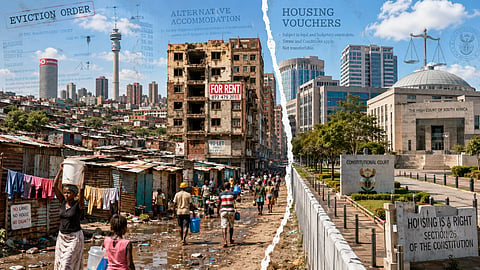
Key topics:Housing backlog grows despite billions spent on state housing buildsLegal eviction rules cripple rental market and deter private investmentRental vouchers proposed to unlock supply and fix housing access system.Sign up for your early morning brew of the BizNews Insider to keep you up to speed with the content that matters. The newsletter will land in your inbox every morning on weekdays. Register here.Support South Africa's bastion of independent journalism, offering balanced insights on investments, business, and the political economy, by joining BizNews Premium. Register here.If you prefer WhatsApp for updates, sign up to the BizNews channel here..By Richard Wilkinson.For thirty years, the South African state has tried to solve the housing crisis by building houses. It has spent billions of Rands and has delivered millions of units – and yet somehow, year after year, the backlog has only grown. Informal settlements have expanded, with more than 300 illegal settlements in Johannesburg now lacking basic services such as water, sewage and electricity. Meanwhile, the inner city has deteriorated to the point of being a slum. Poor households still live far from jobs, with workers tragically paying a huge portion of their income on dangerous and unreliable transport. There is a persistent myth that the housing crisis is primarily about insufficient supply of houses. That is not correct. The problem is not a lack of effort. It is a flawed model that makes providing housing impossible. At the centre of that failure is a simple reality: the City of Johannesburg cannot control where people want to live, and it cannot build housing fast enough or cheaply enough to meet demand. But more importantly, legal reforms enacted in the 1990s effectively destroyed the one system that could scale to meet that demand – the low-income rental market.The reason is legal..Read more:.Waterfall city: The Gauteng smart hub where you lease, not own.In 1998, Parliament enacted the Prevention of Illegal Eviction Act. In terms of this law, no one may be evicted without a court order, and courts are required to consider whether alternative accommodation is available. In practice, this has been interpreted by the courts to mean that evictions may not proceed unless the tenant has alternative accommodation – and inevitably it has fallen to the state to provide that housing. This has had a predictable effect:Property owners cannot reliably remove non-paying or unlawful occupiersDevelopers face legal and financial uncertaintyInvestors avoid low-income rental housingBuildings are abandoned or hijacked rather than refurbishedThe result has been a collapse of formal, affordable rental supply.Why the current approach failsThe state’s response has been to build ever more houses. This approach fails for four reasons:Firstly, it is too slow. Large-scale housing projects take years to plan and deliver. The backlog grows faster than the state can build.Secondly, housing projects too expensive. Formal housing delivery absorbs vast amounts of public funding while reaching relatively few people.Thirdly, the housing is poorly located. New housing is typically built on cheap land far from economic opportunities, reinforcing spatial inequality.Finally, it does not scale. The state cannot meet the demand of a large, mobile urban population through fixed housing alone.Most importantly, this approach ignores the role that private rental housing plays in every successful city in the world.The key constraint: alternative accommodationThe housing crisis in Johannesburg is not primarily a question of land, construction capacity, or even funding. It is a legal constraint. Courts will not grant eviction orders if doing so would result in homelessness and no alternative accommodation is available.This is a legitimate and important protection. But in practice, it has created a system in which:The state is expected to provide alternative accommodationThe state cannot do so at scaleEvictions stallThe rental market collapsesThe result is a system that protects occupation in the short term, but reduces access to housing in the long term. If this constraint can be resolved, the entire system changes.In short, Johannesburg does not have a housing shortage. It has a failure of law, incentives and execution. The real problem that Johannesburg – and the rest of urban South Africa faces is a broken rental market. If Johannesburg is serious about solving the housing crisis, it must stop trying to build its way out of the problem and start enabling the market to house people. That requires one key shift: Give people the means to rent accommodation in the private sector, and make it legally possible for that sector to function.Johannesburg has thousands of underutilised or abandoned buildings, particularly in the inner city. It has large tracts of well-located land. It has a construction sector capable of delivering units at scale. And it has millions of people willing to pay for accommodation.What it does not have is a functioning low-income rental market.At the same time, poor households are not able to access what limited formal rental stock exists. They are forced into overcrowded, unsafe, and often illegal accommodation – or into informal settlements on the urban periphery.This is the core of the crisis.The solution: rental housing vouchersThe City of Johannesburg cannot repeal the Prevention of Illegal Eviction Act which is national legislation. It cannot remove the requirement for alternative accommodation. But it can meet that requirement in a smarter way.The solution is simple: Provide qualifying households with a monthly rental housing voucher – for example, R1,000 – that can be used to secure accommodation in the private sector.Beneficiaries will receive a physical voucher each month that looks something like this:.The beneficiary will be free to redeem this voucher with the landlord of his or her choice. The landlord will then submit the voucher to the City of Johannesburg in order to be reimbursed in cash. .Read more:.South Africa’s smart waterfront project hits a wall.The landlord – known as an “Accredited Housing Supplier” – will need to be registered on the City’s database and must meet certain standards in order to retain his or her accreditation status. Alongside other controls, City officials will be entitled to inspect the Accredited Housing Supplier’s premises in order to prevent fraud and abuse. This changes the system in three fundamental ways. 1. It creates legally recognised alternative accommodationA rental voucher is not a house. But it is something more powerful: it is access to housing.If a household has the means to secure accommodation in the private market, then an eviction does not leave them without options. Courts can recognise this as satisfying the requirement for alternative accommodation.This unlocks the legal system. Evictions become possible again – not arbitrarily, but lawfully, and with a viable alternative in place.2. It restores confidence to the rental marketOnce eviction risk becomes predictable and manageable:Property owners are willing to rent againDevelopers are willing to refurbish buildingsInvestors return to the marketInner city buildings that are currently abandoned or hijacked become economically viable.The effect is not theoretical. It is immediate.3. It stimulates a massive increase in supplyAt the same time, vouchers increase demand in a targeted way:Low-income households can now participate in the formal rental marketSmall landlords can let rooms and backyard unitsInformal supply becomes formalisedThis is the critical point: The city does not need to build the housing itself. It needs to enable thousands of private actors to do so.The result is a rapid expansion of available accommodation, particularly in well-located urban areas.Addressing the obvious concernsAny serious proposal must confront its weaknesses.Is R1,000 enough?In many cases, it will not fully cover rent. But that is not the objective. The voucher bridges the gap, allowing households to combine it with their own income. As supply increases, prices will adjust downward, especially in the low-cost segment. Ultimately, the value of the voucher should be as much as is necessary to move people into housing, but not more than that, so that as many people as possible can be assisted using the budget available. Will people be made homeless?No. The purpose of the voucher is precisely to prevent that. It provides a portable, immediate means of accessing accommodation. The city can supplement this with short-term emergency housing where necessary.Will landlords exploit tenants?Only in a constrained market. The solution to exploitation is supply. When tenants have options, landlords must compete. And any unlawful abuse can be countered by revoking the landlord’s Accredited Housing Supplier status. Is this fair?More fair than the current system. Today, a small number of beneficiaries receive heavily subsidised houses, while millions receive nothing. Vouchers spread support across a far larger population.What this unlocks for JohannesburgThis policy is not only about housing. It enables a broader transformation of the city.Inner city regeneration: Hijacked and derelict buildings can be reclaimed and redeveloped.Better urban integration: People can live closer to jobs, reducing transport costs and improving quality of life.Economic growth: Construction, refurbishment, and small-scale rental activity create jobs and income.Improved governance: The city moves from being a direct provider of housing to an enabler of a functioning system. A different model for the cityThe current model treats residents as passive recipients of state housing. This proposal treats them as active participants in the housing market.It recognises that:People value location, mobility, and opportunityRental housing is not a failure, but a feature of successful citiesThe private sector, properly enabled, can deliver at scaleMost importantly, it replaces a system that tries to deliver everything to a few with one that delivers something meaningful to many.ConclusionJohannesburg’s housing crisis will not be solved by building more houses in the same way. It requires a shift in thinking. The key is not to remove legal protections, but to make them workable..Read more:.Johannesburg’s housing crisis: Squatting and squalor.By providing and administering rental housing vouchers, the city can satisfy the requirement for alternative accommodation, unlock lawful evictions, restore the rental market and dramatically increase the supply of housing. This is not a theoretical solution. It is a practical, scalable and legally grounded approach.It is, in short, a smart and serious way to fix the housing crisis.