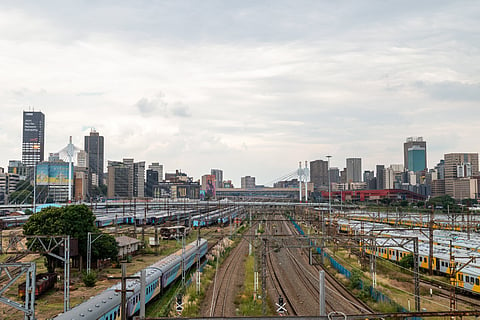
An Italian property developer's restoration of Johannesburg's Barbican building has become a symbol of what the city could be, not just what it needs to fix. Writer Sindile Vabaza argues that while competent municipal government matters, service delivery alone will not restore Johannesburg's confidence or appeal. Drawing on the city's architectural inheritance, from Marshalltown to Sophiatown, the piece calls on incoming political leaders to pair basic repairs with genuine ambition, turning neglected buildings and public spaces into assets that draw residents, investors and visitors back to a city once known as the City of Gold..By Sindile Vabaza*.There is something about the story of Michele Ciani that has stayed with me.Ciani is an Italian property developer from Rome who came to Johannesburg as a tourist, became fascinated by the city’s architecture and ended up buying some of its most remarkable buildings. His latest project is the restoration of the Barbican in Marshalltown, a 1931 Art Deco landmark, long ago abandoned and left to deteriorate.What struck me most was not simply what he has done with the building. It was the way he saw Johannesburg; he saw something that many of us had stopped seeing. He saw a city with character.He saw extraordinary architecture, jacaranda-lined streets, historic buildings, old neighbourhoods and an inner city with a rawness and personality that has become increasingly rare in other parts of the world. He describes discovering the city centre almost as if he had stumbled upon a secret.His wonder and awe should be intoxicating to those who love the city, because there is a real danger that we have become so accustomed to the city’s decline that our ambitions simply do not apply to it.We talk about fixing potholes. Fixing electricity. Fixing water. Fixing billing. Fixing policing. Fixing buildings.And we should.Johannesburg desperately needs competent municipal government. Helen Zille is right that the fundamentals matter, and that there are lessons to be learned from Cape Town’s experience of getting the machinery of local government working.But Johannesburg cannot simply become Cape Town. It is not Cape Town.It is a different city, and I think that distinction matters enormously.Cape Town has an extraordinarily powerful identity built around its natural beauty, coastline, mountains, history and lifestyle. Johannesburg’s appeal is different. It is an urban creation. It is restless, ambitious, eclectic, commercial, creative and constantly reinventing itself.It is a city that was built remarkably quickly and has repeatedly reinvented itself.Needs something moreThat is precisely why Johannesburg needs something more than a municipal recovery plan.It needs a vision, not another ten-point strategy document, a slogan, or a consultant’s presentation, but a genuinely tantalising idea of what Johannesburg could become.I keep thinking of an old house.Imagine buying a magnificent old Johannesburg home that has been badly neglected. The roof leaks. The plumbing is broken. The wiring needs replacing. The floors are damaged. The garden has become overgrown.The first job is obvious; fix the roof. Thereafter, you repair the plumbing, replace the wiring, restore the floors, and secure the property.But if you care about the house, you don’t stop there.You notice the original pressed ceilings, the beautiful wooden staircase, the old tiles, the stained glass and the fireplaces, and the doors and handles that nobody makes anymore.You restore them. And then you add something of your own.That is how I think about Johannesburg. The city absolutely needs its plumbing fixed, but the plumbing is not the point of the house; there is something much bigger underneath all of this.InvisibleJohannesburg has a remarkable architectural inheritance that has been allowed to become invisible. The Barbican is only one example. The Rand Club, the old City Hall precinct, the Rissik Street Post Office, the buildings around Marshalltown and Newtown, the great houses of Saxonwold, Houghton and Killarney, the Art Deco buildings scattered throughout the city – these are not merely old buildings, but pieces of the city’s identity.And they can become part of its future.Ciani’s restoration of the Barbican is interesting precisely because he didn’t simply repair a derelict building. He gave it an identity again. He restored its rooftop sign. He brought in Bridge Books. He is bringing David Tlale’s fashion academy into the building.The building isn’t being preserved as a museum, but is being brought back to life.That distinction is important. Johannesburg should not be trying to recreate some frozen version of “old Joburg”. Nor should heritage become an excuse for turning the inner city into a nostalgic theme park.The opportunity is much more exciting than that.Imagine a Johannesburg where the restoration of historic buildings becomes part of a much larger urban renaissance, where the old buildings are filled with independent businesses, restaurants, galleries, design studios, universities, fashion houses, hotels, apartments and cultural institutions, where neglected squares become beautiful public spaces, and where the city’s extraordinary Art Deco and Modernist architecture becomes a tourism asset.The next chapterImagine a Johannesburg where the jacarandas are treated as part of the city’s visual identity rather than simply something we happen to have, where walking through Marshalltown, Newtown, Braamfontein or Yeoville becomes an experience rather than an act of endurance, where Johannesburg’s old buildings aren’t simply protected from destruction, but become desirable places to live in, work in and visit, and where new architecture is allowed to stand alongside the old and tell the next chapter of the story.That is the part I think is missing from the conversation about Johannesburg.We desperately need to restore order, but order alone doesn’t make a great city. Great cities give people something to fall in love with. They make people want to come back. They make talented people want to stay. They make investors want to take risks. They make young people believe that their future is somewhere other than an enclave behind a security gate.Johannesburg once had enormous confidence in itself. You can see it in the buildings.There was an assumption that this city was going somewhere, that it was going to become something important. People built accordingly.That confidence has largely disappeared.Perhaps the most important thing Johannesburg’s next leaders can do is bring it back. And this is where I think the current political conversation needs to become much more ambitious.If the new political leadership of Johannesburg is serious about turning the city around, the objective cannot simply be to inherit a broken machine and make it function better.The objective should be to make Johannesburg the City of Gold again; the place where dreams are made, where the electricity of Sophiatown and Hillbrow once confidently held its glamour and jazz and pizzazz, where Killarney was once the world’s richest suburb.The objective should be not just to make Johannesburg safer, cleaner, or better administered, but exciting and invigorated, a city that people across Africa want to visit, where international investors want to establish themselves, and young South Africans want to build their careers, and a city where artists, architects, entrepreneurs, restaurateurs, designers and developers can see enormous possibility.City with a storyIn short, a city with a story. Because Johannesburg already has one. It is just buried underneath years of neglect.The remarkable thing about Ciani’s story is that he came from Rome – a city whose historical identity is so overwhelming that it barely needs explaining – and looked at Johannesburg and saw something worth falling in love with.He saw a city still writing its story. Perhaps we should start seeing it too.To be clear, I am desperately hoping the new leaders of Johannesburg will start with the basics..Read more:.Paul Maritz: The five urgent reforms that can save Johannesburg.I want competent people to fix the roof, repair the plumbing, replace the wiring and restore the foundations. But once they have done that, I hope they look around. I hope they notice the ceilings, the staircases, the old tiles. I hoped they see the beautiful buildings, the jacarandas, the streets, the history, and the sheer strangeness and energy of this city.And I hope they understand that the job is not simply to make Johannesburg functional again, but to make it magnificent again.Because if all we do is fix the plumbing, we will have saved the house, but we will not have restored the home and made it a place where we love to live and make memories..*Sindile Vabaza is an avid writer and an aspiring economist..This article was first published by Daily Friend and is republished with permission..Sign up for your early morning brew of the BizNews Insider to keep you up to speed with the content that matters. The newsletter will land in your inbox every morning on weekdays. Register here.Support South Africa's bastion of independent journalism, offering balanced insights on investments, business, and the political economy, by joining BizNews Premium. Register here.If you prefer WhatsApp for updates, sign up to the BizNews channel here.