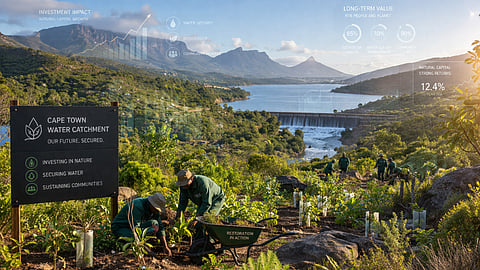
Key topics:FirstRand issues $149M bond tied to Cape Town ecological restorationInvestors earn more if invasive plants are cleared, boosting water supplyModel aims to scale conservation funding for biodiversity and catchments.Sign up for your early morning brew of the BizNews Insider to keep you up to speed with the content that matters. The newsletter will land in your inbox every morning on weekdays. Register here.Support South Africa's bastion of independent journalism, offering balanced insights on investments, business, and the political economy, by joining BizNews Premium. Register here.If you prefer WhatsApp for updates, sign up to the BizNews channel here..By Antony Sguazzin.FirstRand Ltd. sold a 2.5 billion rand ($149 million) bond that rewards investors based on improvements in a Cape Town water-catchment area, measured by the removal of invasive vegetation. The bond is the first issued by a commercial bank that ties investor returns to ecological restoration outcomes, the South African-based lender said in a statement on Wednesday. It was arranged by Rand Merchant Bank, a unit of FirstRand, and backed by International Finance Corp. The Nature Conservancy will implement the vegetation removal program. FirstRand’s issuance is the latest attempt to create new asset classes to preserve biodiversity and fund conservation. In 2021, the World Bank sold a bond linking returns to growth in endangered black rhino populations in two South African nature reserves and has since sold outcome-based bonds based on targets related to water, reforestation and emissions reduction across the world. The water-catchment bond comes as South Africa’s fast-growing cities increasingly struggle to meet rising demand. In the Western Cape province, where Cape Town is based, catchment areas are in places overrun by water-hungry invasive plant species such as wattle and blue gum trees. Their removal is expected to boost dam inflows for the city’s 4.8 million residents who almost ran out of water in 2018, while helping protect the Cape Floral Region, home to about 9,000 indigenous plant species..Read more:.City of Cape Town targets rate parity between Airbnb-style lets and hotels.“We have been talking about innovative funding for so long and we need good examples of replicable and scalable instruments,” said Louise Stafford, South African country director for the Nature Conservancy. “This is one.”The bond, which has a duration of five years and three months, will pay interest of 60 basis points above the Johannesburg Interbank Agreed Date, or Jibar, which was 6.758% on Wednesday. That would rise to 105 basis points if the project is terminated. A success payment equivalent to 1 basis point will be made when the bond reaches maturity for every six hectares (14.8 acres) of land cleared above 5,970 hectares, rising to a maximum of 70 basis if more than 6,390 hectares is cleared. Conservation Alpha, which worked on the World Bank’s rhino bond, will adjudicate its success.Securing funding for the invasive vegetation clearance program for the next five years is aimed at “unlocking additional water yield at a fraction of the cost of traditional infrastructure,” said Monica Jaglal, co-head of credit at Johannesburg-based Aluwani Capital Partners, which bought 350 million rand of the bond. “We are delivering measurable environmental and social impact.”International Finance Corp. subscribed for 1.6 billion rand of the bond, while the UK’s FSD Africa Investments bought 234 million rand.RMB said it expects the deal to be the first in a series, creating a template to “finance restoration of priority catchments across South Africa.” The investment bank chose a water program because scarcity is a widely debated topic and easily understood issue, said RMB’s Martin Potgieter, who worked on the bond. The bank also has explored potential bonds based on increases in African wild dog and lion populations, though those haven’t come to fruition.“We will pursue what we think is easiest for investors to understand,” he said in an interview.The water-catchment bond sale will see $8.8 million directed to the Nature Conservancy, which, through the Greater Cape Town Water Fund, seeks to clear invasive vegetation from 54,300 hectares of land. So far, about three quarters of that goal has been met.Success will see about 55 billion litres (14.5 billion gallons) of additional water flow into water reservoirs annually, Stafford said. That’s equivalent to about two months supply for Cape Town. .© 2026 Bloomberg L.P.