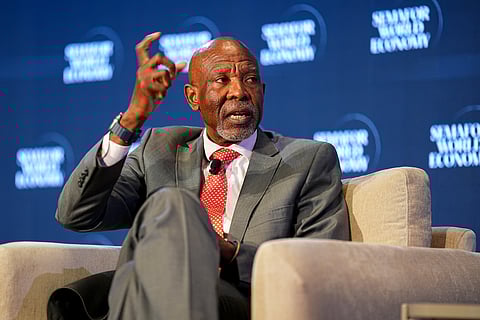
Key topics:SARB may hike rates if war-driven inflation persistsOil surge, weak rand raise inflation risks outlookMarkets price rate hikes amid global oil supply shock.Sign up for your early morning brew of the BizNews Insider to keep you up to speed with the content that matters. The newsletter will land in your inbox every morning on weekdays. Register here.Support South Africa's bastion of independent journalism, offering balanced insights on investments, business, and the political economy, by joining BizNews Premium. Register here.If you prefer WhatsApp for updates, sign up to the BizNews channel here..By Ntando Thukwana and Bonolo Mokonoto.The South African Reserve Bank will respond to inflationary pressures triggered by the US-Israeli war on Iran if they prove persistent, Governor Lesetja Kganyago said.“We do not know how long this conflict is going to last,” Kganyago told an audience on Wednesday at the Soweto Theatre, southwest of Johannesburg. When shocks like this arise, the central bank treats them as temporary, he said.“If it is temporary, there is nothing for us to respond to, but if it becomes persistent, we end up having to respond to that shock,” the governor said..Kganyago and his monetary policy committee retained the benchmark rate at 6.75% last month, warning that an oil-price surge and rand weakness caused by the conflict in the Persian Gulf pose risks to the inflation outlook. .Read more:.SARB want to scrap prime overdraft rate.The central bank’s quarterly projection model sees inflation peaking at 4.3% this month, after edging up to 3.1% in March, 0.1 percentage point above its target.The data was collected before South Africa hiked gasoline and diesel prices on April 1 by the steepest margin in almost two decades.“The jump in fuel price inflation is the largest in the history of inflation targeting,” David Fowkes, a member of the MPC, said at the forum.Forward rate agreements, used to speculate on borrowing costs, are almost fully pricing in a quarter-point rate increase at the next MPC meeting scheduled for the end of May. Traders are also pricing in one more hike of the same size by the end of the year.Countries around the world are grappling with inflation shocks triggered by the US-Israeli attacks on Iran that began on Feb. 28, rolling out measures from fuel rationing to tax cuts and price controls. Brent crude has surged more than 40% as flows through the Strait of Hormuz — a critical chokepoint for about a fifth of global oil and liquefied natural gas — have been constrained.Goldman Sachs Group Inc. which forecasts South African inflation at 3.8% for 2026, said higher oil prices skew risks toward a rate hike in the near term.“The near-term inflation outlook remains uncertain and subject to upside risks stemming from oil and the exchange rate, given the ongoing supply shock emanating from the Middle East,” Andrew Matheny and Ludovica Ambrosino of Goldman Sachs wrote in a note. “In the near term, we see risks tilted towards a rate hike in the event of continued disruption to oil flows in the Strait of Hormuz.”.© 2026 Bloomberg L.P.