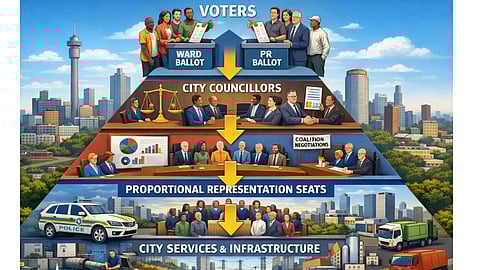
Key topics:Johannesburg’s two-ballot system shapes council composition and governance.Ward and party votes interact to influence mayoral control and stability.Splitting votes can weaken majorities, causing fragile coalitions and chaos..Sign up for your early morning brew of the BizNews Insider to keep you up to speed with the content that matters. The newsletter will land in your inbox every morning on weekdays. Register here.Support South Africa's bastion of independent journalism, offering balanced insights on investments, business, and the political economy, by joining BizNews Premium. Register here.If you prefer WhatsApp for updates, sign up to the BizNews channel here..By James Xanthios.In a previous article (The Johannesburg Pyramid: https://www.biznews.com/sarenewal/the johannesburg-pyramid), I described Johannesburg’s current crisis not simply as a list of municipal failures, but as a system in which multiple problems reinforce one another. To help explain this, I introduced a conceptual model called the Johannesburg Pyramid: a six layer structure showing how various parts of the city interact. At the base lies the physical infrastructure that supports daily life. Above it sit the economy, institutions, and governance, and at the very top, the apex of the pyramid, sits the electorate or more commonly known as the voters. The reason this matters is simple: decisions made at the top of the pyramid flow downward through every layer of the system. Electoral choices shape the leadership of the city, which influences the stability of government, which in turn affects economic confidence, institutional performance and the condition of Johannesburg’s infrastructure and services. The problem felt in the lower layers then in-turn affect the layers above them and the entire system turns into a negative feedback loop. The electorate, located at the apex, is not the sole cause of Johannesburg’s problems. But it remains the one layer capable of resetting the entire structure. Every election therefore represents an opportunity to change the direction of the system itself. Yet many voters are not fully aware of how their vote actually translates into political power inside Johannesburg’s municipal government. In local government elections in Johannesburg, each voter has two votes, not one. And those two votes shape the composition of the entire city council. Understanding how this system works is essential for anyone who wants to influence the future direction of the city. The Two Votes Every Voter Receives Johannesburg’s municipal council is made up of 270 seats. Half of these seats — 135 councillors — are elected directly by voters in local wards across the city. Each ward elects one councillor, and the candidate with the most votes wins that seat. The other 135 seats are allocated through proportional representation (PR). These seats are distributed to political parties so that the overall composition of the council reflects how the entire city voted. This structure is important because the mayor of Johannesburg is not elected directly by the public. Instead, the 270 councillors elect the mayor from among themselves. The party or coalition that controls a majority of seats therefore determines who becomes mayor and who governs the city. This is why the composition of the council matters so much.To create a balance between local representation and overall fairness, each voter receives two ballots during municipal elections. The first ballot is for a ward councillor, allowing the voter to choose the individual who will represent their neighbourhood in council. The second ballot is for a political party, determining which party the voter wants to run the entire city. This vote sets the party’s overall share of representation across the Johannesburg council. These are two distinct choices. • Together, these two votes influence three outcomes (using three different calculations): Who represents your ward. • How many ward seats each party wins. • The overall balance of power in the Johannesburg council..In effect, your two votes are used three times. This is why “vote splitting” — voting for a different party to govern the city (ballot 2) than the party your chosen ward councillor belongs to (ballot 1) — can have a ripple effect well beyond what you might intend. We’ll return to this later. A Citizen’s Guide: How Voting Works in Johannesburg To understand why your two votes are used in three different calculations, it is necessary to look more closely at how the system translates votes into seats. While the process behind proportional representation involves complex formulas, it can be understood in simpler terms. Let’s break it down using clear, accessible language rather than the technical calculations used by the Independent Electoral Commission (IEC). How Johannesburg Voters’ Two Votes Are Counted Three Times When you vote in Johannesburg, you get two ballots: 1. Ward ballot — YOU vote for a person to represent your neighbourhood (ward). 2. Party ballot — YOU vote for the political party you want to run the city. Even though you only mark two crosses, the IEC uses your votes in three linked ways. Step 1: Counting Ward Votes (First Use) • Each of the 135 wards chooses one councillor — whoever gets the most votes wins. • This is your direct representative in your are(ward). • These are called the ward seats and make up half of the council. .Example: If Party A’s candidate wins in Ward 56, they take that ward seat straight away. Step 2: Counting Party Votes (Second Use)• All the yellow Proportional Representation (PR) ballots across the entire city are added up for each party. • This decides what percentage of the total council (270 seats) each party deserves overall. • For example, if Party A gets 45% of all city votes, it should have roughly 45% of the council = 122 seats of the 270 total seats in council. .So, this count (from your second ballot) decides how “big” each party’s overall group in council should be. Step 3: Balancing the Ward Wins with Proportional Representation (PR) “Top-Up” Seats (Third Use) Here’s where your two votes meet. • The IEC looks at how many ward seats each party already has (from Step 1). • Then it compares that to how many seats the party deserves overall (from Step 2). • If a party won fewer wards than its overall share, it gets extra PR seats from its party list until it reaches its fair total. • If a party already won more wards than its share, it won’t get any PR seats. Example: • Party A deserves 122 seats in total (Step 2 result). • If Party A won 80 ward seats (Step 1). • So, it gets the 42 PR seats to “top up” to 122. .So, your two crosses are used in three counts: Ward seats, Overall party share, and Extra PR seats to make the council fair. What It Means for YOU: • Your Ward Vote: Directly chooses your local councillor—the person responsible for your area. • Your Party Vote: Decides who has the biggest team in council and a chance to govern the entire City of Johannesburg. • The Top-Up (PR): Acts as a safety net to keep the council fair and proportional to how everyone voted. .One cross for your street, one cross for your city – together they help build a fair 270-seat council.How the Mayor Is Chosen: A Closer Look You do not vote for the mayor directly. The mayor is elected by the 270 councillors after the election is over. • Majority Rule: If one party wins more than half the seats (136 or more), they will vote their leader in as Mayor. • Coalition Deals: If no single party has a majority, different parties must negotiate to form a Coalition. They agree to work together to reach the 136 votes needed to elect a mayor. • The Secret Ballot: In the very first council meeting, all 270 councillors vote via secret ballot. The person who gets the most votes becomes the Executive Mayor and forms the city’s government. .Why This Matters for 2026 Johannesburg is not voting in a vacuum. The choices made in the next municipal election will shape how, or whether, the city confronts a series of deepening crises: • Public Safety: Crime remains a central concern for residents across the city. The effectiveness of policing, by-law enforcement, and urban management depends heavily on a stable and functional municipal government. • Failing Infrastructure: Roads, traffic systems, electricity distribution, and waste management have all shown signs of deterioration. A fragmented or unstable council struggles to plan, maintain, and invest in the infrastructure a major city depends on. • Water Security: Recurring water shortages, aging infrastructure, and management challenges have exposed vulnerabilities in the city’s ability to deliver a basic service. Governance decisions directly affect how quickly and effectively these issues are addressed. • Financial Stability: Johannesburg faces significant financial pressure, including rising debt and constraints on service delivery. The composition of council determines fiscal discipline, budgeting priorities, and long term sustainability. • Governance and Decision-Making: Perhaps most critically, the city has experienced instability at the political level, with shifting coalitions and inconsistent leadership. Without a clear and functional majority, councils can become reactive, slow, and unable to take decisive action.What This Means for Your Vote The system explained above is not just technical — it determines who holds power in a city facing real challenges. How you use your two votes will shape: • Whether there is stable leadership or continued political fragmentation • Whether service delivery improves or continues to decline • Whether long-term planning is possible, or short-term survival politics persists .In short: Your two votes do not just choose representatives — they determine whether Johannesburg can govern itself effectively..The Hidden Effect of Splitting the Vote Once this system is understood, another important reality becomes clear: splitting the two votes between different parties can significantly alter the final balance of power inside the council. Because voters cast two ballots, it is possible to vote for one party in the ward election and a different party in the proportional representation vote. Many voters do this without fully understanding the consequences. In a politically fragmented environment like Johannesburg’s, splitting the ward vote and the party vote between different parties can unintentionally weaken the ability of any one party to form a stable governing majority. For example, a party may win several ward races but lose overall strength in the council if many of its supporters give their PR vote to other parties. The final result can be a council in which no party has enough seats to govern decisively. This dynamic has contributed to the political instability that Johannesburg has experienced over the past decade. While coalition governments can function effectively under certain conditions, Johannesburg’s recent experience has often been characterised by fragile alliances, shifting political loyalties and frequent leadership changes..For voters who want to see Johannesburg move beyond this cycle, it is important to recognise that the combination of the ward vote and the party vote can either strengthen a clear governing mandate or contribute to another fragmented council. In the coming election, voters should therefore think carefully about how their two votes work together. Over the past decade, those choices have helped determine whether Johannesburg had stable leadership or ten mayors in ten years. Why This Matters for Governance Because proportional representation balances the final composition of council, the party vote plays a decisive role in determining whether a party can govern alone or must rely on coalitions. Over the past decade, Johannesburg has experienced significant fragmentation inside the council chamber. No single party has consistently secured a clear governing majority. Frequent changes in leadership disrupt policy continuity, weaken long-term planning, and make it far more difficult for a city administration to implement coherent strategies for infrastructure, service delivery, and economic development. When leadership changes repeatedly, decisions are delayed, priorities shift, and the machinery of municipal government struggles to function effectively. For a city as complex as Johannesburg, stability in governance is not a luxury, it is a necessity. Choosing Leadership for a Complex City Johannesburg is the economic engine of South Africa and one of the most important urban centres on the African continent. Governing a city of this scale requires pragmatic and professionalised leadership capable of managing complex infrastructure systems, restoring basic services, and rebuilding the administrative capacity of municipal government. After years of instability, Johannesburg requires leadership with experience, a vision, and a plan, and with the organisational depth and technical competence necessary to restore effective governance in a city as large and complex as Johannesburg. For voters considering how to use their two votes, it may therefore be worth reflecting on which major political party has demonstrated the ability to govern major municipalities with consistent service delivery and administrative discipline. However, the decision rests with voters themselves. Finally: Make Sure You Are Registered Before anyone can vote, they must first be registered with the Independent Electoral Commission. If you are unsure whether you are registered, you can check quickly by sending an SMS with your ID number to 32810. The IEC will respond with your registration status and the location of the voting station where you are registered to vote..Knowing your voting station is important, because voters must cast their ballot at the station where they are registered. You can also check your registration status online at: https://registertovote.elections.org.za/ If you are not registered, you can make an appointment to register at your local IEC office responsible for your voting district. It is advisable to phone ahead and arrange a time. Additional voter information is available through the IEC’s Voter Information Centre at: https://www.elections.org.za/pw/voter/voter-informationRegistration must take place well before election day. Waiting too long may mean losing the opportunity to vote in the coming election. Johannesburg is not simply a place. It is a living system, and its future will depend on whether those who live within it understand how their choices at the ballot box shape everything that follows.