
Rebuilding the Fortress: Steven Brown on turning around one of the JSE's toughest situations
*This content is brought to you by Peregrine Capital
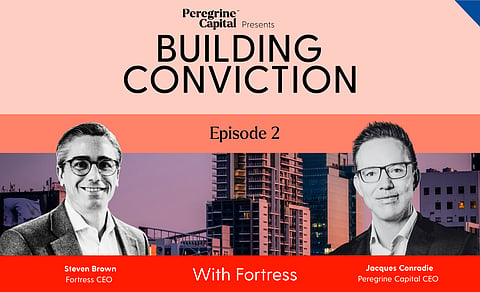
Building Conviction is Peregrine Capital's podcast on the leaders behind some of South Africa's most compelling businesses. “Our job is to identify businesses led by people with genuine long-term conviction and develop a deep understanding of those businesses, so that we are ready to invest when the right opportunity presents itself,” says Conradie. “Building Conviction is our way of pulling back the curtain on that process, through conversations with the leaders who've built and lead these businesses. Episode 2 does exactly that.”
Steven Brown joined Fortress Real Estate Investments in 2016, when Capital Property Fund was absorbed into it, and took over as CEO in 2019, just as listed property was entering one of its toughest periods in a decade. “I really took the job as CEO without any euphoria,” he says. “It was more panic, and I heard drinking from the poisoned chalice more than once.” Since then, Fortress, now focused on premium-grade logistics in South Africa and Central Europe, plus commuter and convenience retail at home, has delivered what Conradie calls “one of the best turnarounds on the JSE.”
The rebuild started with what Brown calls housekeeping. Fortress had been paying out distributions larger than the free cash the business generated, “compounding your liabilities, borrowing to pay the dividend,” as he puts it, so he took the approach to limit payouts to real cash generated, after expenses, interest and maintenance. It wasn't popular in a yield-obsessed sector, “they were not happy,” he says of shareholders at the time, but the disciplined approach held through COVID and the shocks that followed, and it's a principle he won't revisit: “We can have some debt, but let's make sure the liabilities aren't compounding on us.”
The deeper problem was structural. Fortress had listed in 2009 with a dual share class capital structure, a capped A-share ("FFA") for income-hungry investors, and a highly geared B share ("FFB") for those chasing equity-like returns. It worked spectacularly while the market rose, and the B share was amongst the best performers on the exchange, until the cash tightened, and the objectives of the two share classes diverged. “You gave them the same voting rights,” Brown says. “It would be a little bit like giving the captain of Argentina and the captain of England voting rights on the referee's decision... they're never going to come together and agree” Once Fortress could no longer meet the A share's minimum distribution, the two camps turned on each other in prolonged legal disputes, “dark, dark days,” Brown calls them, spilling into contested board re-elections and years of distraction.
The fix came from an unusual place. Peregrine Capital built meaningful stakes in both share classes, turning itself from an outside mediator into what Brown calls a principal rather than an agent, with standing to then broker a deal. The insight was to use Fortress's stake in NEPI Rockcastle, worth about as much as the company's entire market cap at the time, as the currency to settle the dispute. Under the scheme that finally succeeded, after three earlier failed attempts, Fortress handed shareholders roughly R7 billion of NEPI shares to cancel the B shares and converted the old A shares into today's single share class. It only worked once Fortress gave up its REIT status, removing the JSE rule that forced a dividend and kept both camps entrenched. “While we're still a REIT... no one's going to budge,” Brown says of the realisation that shaped the whole approach.

Brown agrees that the outcome was a “win-win-win.” B shareholders received NEPI shares worth roughly double their 2022 price; A shareholders became Fortress's only shareholders, with dividends restored and the share price re-rating sharply; and a lower cost of capital enabled the company's first major equity raise in more than a decade. Giving up REIT status proved a further advantage: Because its development pipeline generates substantial tax shields, Fortress currently pays a low effective corporate tax rate and distributes an ordinary dividend taxed at 20% in an individual's hands, which, for a taxable individual investor, can be more tax efficient than a JSE REIT distribution, taxed as income at a marginal rate of up to 45%.
More than anything, Brown credits the Fortress team with getting him through it. Asked what he'd tell his 2020 self, facing warring shareholders, no dividend in sight, his answer was one word: “vasbyt”, “grit your teeth and see it through”. He often repeated a line from Winston Churchill to staff: “You'll never reach your destination if you stop and throw stones at every dog that barks.”
With the capital structure fixed, Brown's focus has shifted to growth. Logistics remains the core engine, near-zero vacancies, e-commerce tailwinds, and unlevered development pre-tax returns of 15–16% for what he calls low risk. On retail, Fortress has taken a controlling stake in Balfour Mall, a once-iconic Johannesburg centre that had lost its way, brought in by JV partners. In Poland, Fortress has built a reputation as a long-term co-owner rather than a build-and-flip developer, a distinction that is starting to win it better deals in a developer-led market. Capital allocation, Brown says, follows a strict order: protect and complete existing assets first, then logistics, then selective retail, with pure cash-flow buys, like long-let warehouses, off the list.
Brown closes the episode with his Conviction Card: property, he says, endures as an asset class for as long as a country protects private ownership, and he is bullish on Southern Africa specifically. He points to favourable demographics against shrinking, ageing populations in parts of Europe, low exposure to natural catastrophe, and relative stability compared to other countries on the globe. “If you wanted a conviction play, it would be real estate in Southern Africa,” he says, “but leave it to the professionals.”
The full conversation is available now on Building Conviction, Peregrine Capital's podcast series, on all leading podcast platforms, with new episodes every few weeks.
Listen or Watch
This podcast is produced by Peregrine Capital (Pty) Ltd, an authorised Financial Services Provider Views expressed by speakers are their own at the time of recording, may change without notice, and don't necessarily reflect those of Peregrine Capital. Nothing in this podcast is an offer, solicitation or recommendation to buy or sell any security; Peregrine Capital and its associated funds may hold positions in companies discussed, which listeners should bear in mind. Statements on strategy, targets or expected performance are forward-looking, involve risk and uncertainty, and actual results may differ materially — past performance is not a reliable indicator of future performance. Listening does not create a client or advisory relationship with Peregrine Capital. This episode was recorded on 13 July 2026.