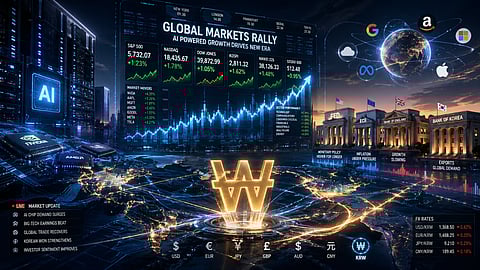
Key topics:DOJ drops Powell probe; FOMC, BoE, ECB & Big Tech earnings week aheadBroad relief rally: data-centre/hardware stocks lead, not just AI namesKorea pushes won internationalisation under new BoK governor Shin Hyun-song.Sign up for your early morning brew of the BizNews Insider to keep you up to speed with the content that matters. The newsletter will land in your inbox every morning on weekdays. Register here.Support South Africa's bastion of independent journalism, offering balanced insights on investments, business, and the political economy, by joining BizNews Premium. Register here.If you prefer WhatsApp for updates, sign up to the BizNews channel here..By Robert Armstrong & Hakyung Kim.Good morning. The US Department of Justice has dropped its witch-hunt investigation of Jay Powell. So this week’s FOMC meeting will probably be the last under his chairmanship. We are glad this sorry episode is behind us. This week, the BoE and ECB also have rate decisions, and earnings reports from Alphabet, Microsoft, Amazon, Meta, and Apple all land. It’s not just a tech rallyTen days ago Unhedged wrote that the best interpretation of the sharp rally that began March 30 is relief: the market is trading on the belief that the worst of the war is over, and animal spirits are running free. Since then, the upward momentum has continued, especially in tech. So headlines have proclaimed the rally to be a return of AI frenzy. This is only true to a degree; what is remarkable about the rally is still its breadth. It is true that the magnificent seven tech stocks have contributed 60 per cent of the dollar increase in the value of the S&P 500 (in descending order of their contribution, the seven are Nvidia, Alphabet, Amazon, Broadcom, Microsoft, Apple and Meta). But this is partly a function of these companies being very large to begin with. If you look at percentage gains, it’s been a data centre rally, not an AI rally — and there is a difference. Astonishingly, the top 15 percentage returners in the S&P sell either semiconductors or computer networking equipment. None of the mag seven are in the top 30 in percentage return. At the margin, investors are betting on jam today (the hardware going into the data centres that are being built right now) before jam tomorrow (the hyperscalers building the AI models themselves). .Read more:.DOJ targets the Fed as Powell draws a line against political pressure.Lots of stocks that have nothing to do with AI are performing well, too — in sectors from industrials to finance. The 150 components of the S&P that are down since March 30 are tightly clustered in four areas: energy stocks, defensives (staples, healthcare, telecoms), aerospace and defence, and a few software companies considered vulnerable to AI (ServiceNow, Salesforce). This fits perfectly with a wide, war-is-over-let’s-party rally. Small- and mid-cap stocks have bounced off the bottom in unison with big-caps:.As Katie and Hakyung have pointed out, bonds have not retraced their losses from the first month of war, the way equities have. But there are signs of improving appetite for risk in fixed income, too: implied bond volatility has fallen in line with equity volatility and, as Dec Mullarkey at SLC Management points out, flows into fixed income ETFs have been positive. There is dip buying in bonds, too. All of this looks sustainable, at least inasmuch as corporate earnings have been strong so far in the first quarter. The only question is whether investor risk appetite, which looks remarkably sturdy on all fronts, has any room left to rise.Won internationalisationA new Bank of Korea governor typically doesn’t make headlines in the way, say, a new Fed chair does. But Shin Hyun-song, the new head of the BoK, is a star among central bankers after a distinguished tenure at the Bank for International Settlements. He’s stepping in at a tricky time for Korea, with an oil shock, trade worries, slow growth and the won at its weakest level since 2008.The won is of particular interest, as a key backdrop to the spectacular rally in Korean stock indices over the past 12 months:.Restrictions on won trading is one of the main reasons Korea is still classified as a developing market in MSCI indices. But this is set to change. Here is Shin in his inaugural speech as governor: The internationalisation of the Korean won is a key task in building a monetary infrastructure commensurate with the stature of our economy. In co-operation with the government, we will pursue 24-hour foreign exchange market operations and establish offshore won settlement systems. This will improve the accessibility and resilience of foreign exchange transactions, consistent with international standards. These efforts will support won-denominated capital and trade transactions, enhance the currency’s international standing, and contribute to the orderly development of the foreign exchange marketThe Korean government has pledged won internationalisation in the past. But Shin’s comments reflect determination to provide won access and liquidity to global investors.According to the BIS’s Triennial Central Bank Survey, daily over-the-counter foreign exchange trading reached $9.6tn last year, and won trading was only a tiny fraction of that. The tiny volume is out of proportion with Korea’s status as one of the top 10 trading nations. Internationalising the won will benefit Korean multinationals that have had to deal with sharp foreign exchange fluctuations and high hedging costs. A more substantial benefit could come in the longer term. According to Elias Haddad at BBH (who provided the Bloomberg charts below), a small change in central bank reserve managers’ exposure to the won will make a big difference. Traditional reserve currencies are the vast majority of FX reserves: The dollar has inched down slightly in its dominance, while the group of “others” — which includes the won — is steadily rising: A minor reallocation to the won would mean a significant relative rise in demand for Korean sovereign debt, lowering yields and changing the fundamental exchange-rate dynamics.The benefits of internationalisation have been clear for a long time. But memories of the 1997 Asian Financial Crisis, when the won plummeted, have slowed progress. Shin is taking helm of the BoK during a time of unprecedented interest in Korean markets. We hope he can seize the moment..© 2026 The Financial Times Ltd.