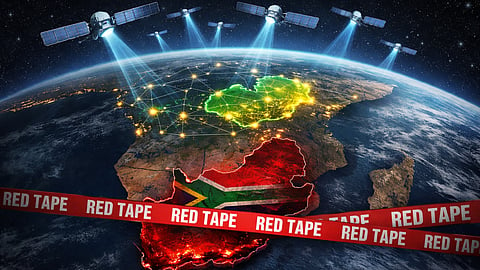
Key topics:SA risks losing tech leadership over blocked satellite connectivityZambia, Airtel and Starlink race ahead while SA stallsBEE rules delay Starlink despite rural internet demand.Sign up for your early morning brew of the BizNews Insider to keep you up to speed with the content that matters. The newsletter will land in your inbox every morning on weekdays. Register here.Support South Africa's bastion of independent journalism, offering balanced insights on investments, business, and the political economy, by joining BizNews Premium. Register here.If you prefer WhatsApp for updates, sign up to the BizNews channel here..By Jan Vermeulen.South Africa’s position as regional technology leader is under threat as neighbouring countries race ahead with direct-to-cell satellite connectivity services that are effectively blocked locally.Last week, MTN Zambia became the first African operator to complete field testing of Starlink’s direct-to-cell service, transmitting a data session and mobile money transaction via satellite.Airtel Africa has signed a deal with SpaceX to roll out the same service across 14 African markets. Vodacom and Starlink will deliver high-speed, low-latency broadband Internet to millions of African businesses.South Africa, the continent’s most advanced telecoms market, is absent from all of these developments — not for lack of demand, but because of a destructive ideology that has infected laws and regulations.While many people do not regard South Africa as a technological powerhouse, it has been largely unrivalled in the Sub-Saharan region.South Africa has fibre and mobile broadband networks that are second to none, powered by Internet exchange points in world-class data centres that have helped reduce data costs by over 99% in 25 years.We get the latest gadgets at relatively reasonable prices, SARS and rand-dollar willing, and what official domestic and regional distributors don’t bring in, we can import through Amazon and AliExpress..Read more:.SpaceX launches first Starlink satellites for global mobile coverage – Could SA fall further behind?.When global companies want to launch products and services on the continent, South Africa has most often acted as the gateway or pilot territory because of its leadership.We are the country many Africans aspire to reach for the opportunities it offers, much as South Africans look abroad for countries that can liberate them from the fear of crime and infrastructure collapse.However, our status as Africa’s land of milk and honey is not guaranteed. Zambia launching Starlink Mobile before South Africa even permits the service is a dead canary in South Africa’s struggling mines.A rollout like the one in Zambia will not happen in South Africa soon because SpaceX has refused to capitulate to race- and other demographic-based quotas for obtaining telecommunications licences.To obtain the network, service, and spectrum licences it needs, SpaceX must work through middlemen or enter into a BEE deal to transfer 30% of its local entity to historically disadvantaged groups (HDGs).HDGs include people who are Black, women, youth, and people with disabilities. The definition of “Black” includes people of black African, Coloured, and Indian descent.It’s worth pointing out that SpaceX’s objection to these requirements isn’t moral; it’s business. It has a policy against diluting its equity and only works with middlemen for its cellular and enterprise Starlink services.The Equity Equivalent Investment Programme solution.Starlink has proposed meeting its transformation obligations through an Equity Equivalent Investment Programme (EEIP) — starting with connecting 5,000 rural schools with free Internet, valued at R500 million.EEIPs are explicitly recognised in the ICT Sector Code and have been used by Microsoft, IBM, and AWS for more than two decades in South Africa.Icasa’s licensing regulations, however, do not recognise EEIPs as a substitute for the 30% ownership requirement. It also conflicts with South Africa’s BEE laws in other ways, but that’s a separate issue.However, the introduction of EEIPs as an option for telecommunications licences is at least a year away — and that’s if the process runs smoothly, which it almost certainly won’t.The consequences are not theoretical. According to Statistics South Africa’s 2023 General Household Survey, only 1.7% of rural households had an Internet connection at home.This compares to 23.8% for metro households and 12.1% for urban households. While 66.3% of rural households reported some form of mobile data access, the figure lagged behind urban areas at 76.1%.Because Starlink cannot obtain the necessary licences, thousands of individual South Africans, businesses, and even government departments already use the service illegally — demand the government is choosing to ignore.Ideology over infrastructure.The South African government has made its position clear. Presidency spokesperson Vincent Magwenya told Bloomberg the government would not pursue investment from SpaceX owner Elon Musk.Magwenya cited what he described as Musk’s “unprogressive, racist views” and said investment would not be welcomed at the expense of South Africa’s constitution and values.At the same time, Musk is asking why South Africa has “openly racist ownership laws” — an incendiary but not entirely irrelevant question about race-based equity requirements.In addition, Parliamentary communications portfolio committee chair Khusela Diko has dismissed Starlink’s offer to connect 5,000 schools as part of its EEIP, saying it would not “move the needle an inch”.She argued that mobile operators had committed to connecting over 22,000 schools under their spectrum licence obligations and that Starlink’s offer was redundant.The reality is less flattering. Three years into that rollout, basic education minister Siviwe Gwarube revealed that 16,033 schools still lacked Internet connectivity.Starlink’s 5,000 schools would represent over 22% of the total — and more than 80% of the remaining backlog. Dismissing that contribution requires a particular set of priorities.Waiting for Starlink competitors is a mistake.Starlink’s direct-to-cell service is already commercially available in the United States, New Zealand, Canada, Ukraine, and soon Zambia through partnerships with local mobile operators.South African operators have also not been idle, with MTN South Africa trialling a satellite voice call with Lynk Global in March 2025 and plans further LTE-based tests.However, while MTN South Africa does tests on a five-satellite constellation, its Zambian sister company is working with the largest low-Earth orbit (LEO) network ever built.Starlink’s constellation comprises 9,943 active satellites, dwarfing every competitor. It is the only commercially proven LEO provider operating at any meaningful scale.With 650 direct-to-cell–capable satellites in orbit, Starlink Mobile is not just the world’s largest satellite-to-mobile constellation; it is the only commercially available one..Read more:.South Africa explores Chinese satellite broadband to bridge digital divide.The regulatory impasse means South African consumers and rural communities cannot access this network, even as users in countries with far less developed telecoms markets begin to benefit.Communications minister Solly Malatsi has issued a policy directive instructing Icasa to amend its licensing conditions to accommodate EEIPs, with backing from the Presidency.Whether that directive translates into regulatory change — and how quickly — will determine whether South Africa keeps pace or watches from the sidelines..This article was first published by MyBroadband and is republished with permission.