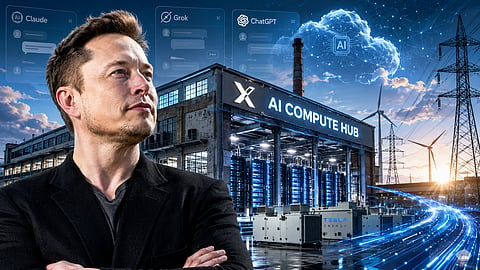
Key topics:Musk repurposes Memphis Colossus to lease AI compute to Anthropic’s ClaudeGrok lags ChatGPT and Claude, with weak market share and revenueMusk bets on fast-built data centres and neocloud model vs hyperscalers.Sign up for your early morning brew of the BizNews Insider to keep you up to speed with the content that matters. The newsletter will land in your inbox every morning on weekdays. Register here.Support South Africa's bastion of independent journalism, offering balanced insights on investments, business, and the political economy, by joining BizNews Premium. Register here.If you prefer WhatsApp for updates, sign up to the BizNews channel here..By Parmy Olson.Elon Musk’s ambitions for artificial intelligence are coming together in a former vacuum-cleaner factory in Memphis, Tennessee. It houses a data center known as Colossus 1, containing racks of servers spanning an area more than 13 football fields in size and chugging 300 megawatts of electricity at any given moment (enough for hundreds of thousands of homes). As of this month, those computers will be powering Claude, the chatbot created by Musk’s new frenemy, Anthropic PBC.The Tesla Inc. billionaire was in a very different headspace in February, when he called Anthropic an “evil” AI lab that hated Western civilization. But it’s become clear that Musk’s AI model, Grok, doesn’t have hope of competing with either Claude or OpenAI’s ChatGPT. The former is on track to bring in $40 billion in revenue, mostly from the lucrative business of selling to companies; Grok barely registers in IT department spending anywhere..Read more:.Musk’s xAI unveils Grok-3, outperforms top AI rivals.Hence Musk changed his tune last week. "Claude is good for humanity,” he posted on X after meeting Anthropic management. “No one set off my evil detector." Musk’s moral epiphany hit just when Anthropic went from competitor to potential customer. Claude’s success has made Anthropic desperate for the racks of computers that were sitting idle in Colossus 1; although the data center was built to train and run Grok, weak demand meant the chatbot was only using 11% of its computing power.Leasing computers for AI offers much better margins than selling AI directly. Though financial terms for the Anthropic deal weren’t disclosed, estimatessuggest Musk’s new tenant could contribute between $3 billion and $5 billion in annual revenue for SpaceX, which operates the Memphis data center.And there could be more money to make from Colossus 2, Musk’s new facility in Mississippi that should harness nearly five times the power of its predecessor.The billionaire’s efforts in building software have always been hit and miss. X , the platform formerly know as Twitter, has lost advertisers and users since he took it over; Tesla’s self-driving technology has consistently underdelivered. Grok itself has lagged behind other AI models in capability benchmarks, capturing just 3% of market share for chatbot web traffic versus 65% for ChatGPT and 22% for Google’s Gemini, according to market intelligence firm SimilarWeb. “The model fight is one that xAI is not well-suited for, temperamentally and economically,” analyst Ben Thompson recently wrote on his blog Stratechery.Musk has a much stronger footing in building physical systems: Starlink is the largest satellite constellation ever created, while Tesla operates the world’s biggest fast-charging network with more than 75,000 electrical stations globally. In building data centers, Musk’s knack for infrastructure has helped him skirt issues that bedeviled other hyperscalers. The likes of Alphabet Inc.’s Google and Amazon.com Inc. have faced delays in their computing build-out thanks to bottlenecks in power and equipment, with nearly half of planned facilities in the US for 2026 facing delays or cancellations. Such projects often take two years or more to build and suffer from chronic limits in the US power grid..Read more:.Google’s free ride on web data threatens fair play in the AI race: Parmy Olson.But Musk spun up Colossus 1 in 122 days. He did it by harnessing the former Electrolux appliance factory instead of constructing a warehouse from scratch, and building his own power plant among other unconventional methods to accelerate the process. Musk’s xAI — which is now part of SpaceX and known officially as SpaceXAi — trucked in enormous mobile natural-gas turbines to create power on-site, rather than wait months or years for permission to siphon it from the city grid.His pivot to data centers plays to his strengths in an area where hyperscalers are struggling, particularly if he can also turn Colossus 2 into a revenue generator. Though that site will almost certainly be used to power Cursor, the AI coding tool Musk partnered with in April, he could also look for potential tenants among tech firms like Meta Platforms Inc. Mark Zuckerberg’s company has also grappled with infrastructure hurdles and rented power from third-party “neoclouds” like CoreWeave Inc. and Nebius Group NV, a new breed of AI companies that lease data-center equipment, and who typify the current gold rush’s sellers of picks and shovels.The question is whether Musk goes down the more streamlined route of being a neocloud – renting out to just one or two customers and offering no frills beyond raw computing power — or if he capitalizes on the more lucrative opportunity of turning SpaceXAi into something that looks more like a hyperscaler. After all, SpaceXAi is targeting a hyperscaler-like valuation of $1.75 trillion. That would mean offering more high-margin services such as managed databases and AI development tools, pulling in much more revenue. But it would also put Musk squarely back in an area he has grappled with: software..Read more:.BizNews portfolio: Elon Musk is betting his business empire on AI.The difference will be measured in billions of dollars and require more than the ability to construct computer-filled warehouses faster than anyone else. Growing his AI real estate into a bigger business will force Musk back into an area where he has yet to claim a major win — and still might not. .© 2026 Bloomberg L.P.