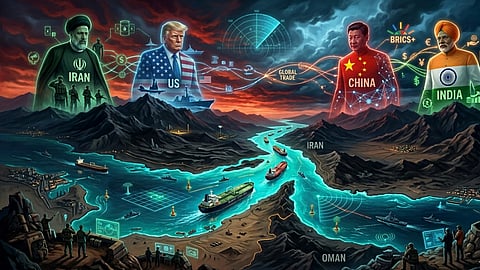
Key topics:US-Iran ceasefire leaves Hormuz Strait central to Trump’s exit strategyGulf doubts US guarantees as influence shifts toward China, India, BRICS+Energy markets, Xi–Trump talks and US election pressure limit escalation.Sign up for your early morning brew of the BizNews Insider to keep you up to speed with the content that matters. The newsletter will land in your inbox every morning on weekdays. Register here.Support South Africa's bastion of independent journalism, offering balanced insights on investments, business, and the political economy, by joining BizNews Premium. Register here.If you prefer WhatsApp for updates, sign up to the BizNews channel here..By Jim O’Neill*.LONDON—With the United States and Iran agreeing to a two-week ceasefire, many are using this pause to wonder what, if anything, would allow US President Donald Trump to declare victory and end the fighting. One necessary condition, it seems, is the permanent reopening of the Strait of Hormuz, through which around one-fifth of the global oil supply flows. But even with the ceasefire temporarily reopening the Strait, Trump has not secured lasting stability for shipping. Of course, had Trump simply refrained from attacking Iran in the first place, the Strait never would have been closed.The first month of the war delivered several other lessons. One concerns the Israeli leadership’s thinking. Prime Minister Benjamin Netanyahu knew that he could get Trump’s attention by presenting him with the prospect of a big, showy victory, and that this US administration would not pause to consider the second- or third-order consequences. Perhaps it was merely a coincidence that the strikes on Iran came soon after the US Supreme Court struck down Trump’s International Emergency Economic Powers Act tariffs, but perhaps not.The apparent lack of US strategic planning points to a second lesson: The Gulf states’ trust in US security guarantees may not have been justified. While some leaders are quietly hoping that the war will still lead to a dramatic, positive change in Iran, hope is not a strategy—and their desired outcome looks increasingly unrealistic. The Iranian regime has already shown that there is no line it will not cross to ensure its survival and deter its enemies..Read more:.FT: Trump says US could soon destroy Iran ‘in one night’, demands opening Strait of Hormuz.That is why it is hard to avoid the conclusion that this conflict will shift the region’s strategic balance eastward, toward rising powers like China and India. Along with Russia, both are central players in the BRICS+, which now includes Iran, and which has an opportunity to present itself as an inevitable leader of whatever new global order is emerging.China is especially likely to play an important role in whatever follows from the war. Both it and Russia were almost certainly behind the push to include Iran in the BRICS’s expanded membership. At the same time, India will host the next BRICS+ summit this September, and it is relishing its newfound role as the de facto champion of the Global South, owing to its central geographic position in the 21st-century economy and its massive population.Of course, India’s relationships with its immediate neighbors remain complicated. But even longstanding historical tensions are not deal-breakers. As Heiwai Tang and Brian Wong Yue Shun show in their edited volume Towards a Future for BRICS+, India has a strong interest in mining the potential for mutual benefits within the bloc. A top concern is access to Middle Eastern energy supplies, both for itself and for its neighbors.Asian economies have been hit especially hard by both the energy price shock and the supply shortfall, and Iran knows that. Occasional statements over the past month suggest that Iran would welcome pricing oil destined for friendly countries in renminbi. These dynamics are even more pertinent in light of the increased role that Pakistan has played as a mediator between the US and Iran. If the Pakistanis help bring the energy crisis to a close, not even India could complain.The war, if it continues, also has obvious implications for Trump and Chinese President Xi Jinping’s planned bilateral meeting, which has been rescheduled for mid-May. Whenever it does take place, Xi will probably feel that China has a strong hand, not only to apply leverage on Iran but also to drive a hard bargain with the US. Markets will be watching closely for any hints of possible developments ahead of the summit.Given these converging forces, the rising efficiency of oil consumption, and the ongoing increase in alternative energy sources, I continue to doubt that this crisis will cause as much market turmoil as the 2008 financial crisis, the arrival of COVID-19, or the 2022 Russian invasion of Ukraine..Read more:.Ray Dalio: It all comes down to who controls the Strait of Hormuz — The “Final Battle".After all, Trump cannot afford to preside over rapidly rising gas prices as Americans head into their peak driving season—and then head to the polls for the midterm elections coming in November. His increasingly unhinged social-media posts suggest that he is beyond frustrated with the situation and desperate for an off-ramp. If the ceasefire doesn’t provide him with one, China may have a potential trump card..*Jim O’Neill is a former UK Treasury minister and a former chairman of Goldman Sachs Asset Management.Copyright: Project Syndicate, 2026.www.project-syndicate.org