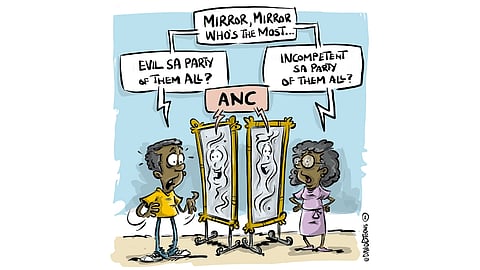
Key topics:ANC’s failures stem from incompetence, not necessarily deliberate malice.Power and ideology foster collective “stupidity,” worsening inequality.Consequences blur lines between moral decay and systemic corruption..Sign up for your early morning brew of the BizNews Insider to keep you up to speed with the content that matters. The newsletter will land in your inbox at 5:30am weekdays. Register here.Support South Africa’s bastion of independent journalism, offering balanced insights on investments, business, and the political economy, by joining BizNews Premium. Register here.If you prefer WhatsApp for updates, sign up to the BizNews channel here..By Rob Hersov.The African National Congress (ANC) has governed South Africa since the dawn of its democracy in 1994, inheriting a nation pregnant with hope and the ambitious vision of a “South African Dream.”This dream, as articulated in a manifesto for shared prosperity, was built on pillars of dignity, economic justice, and Ubuntu.Yet, decades later, the dream remains largely deferred for millions, overshadowed by systemic corruption, staggering inequality, and failing infrastructure.This has led to a soul-searching national question: are the ANC’s failures a product of deliberate malevolence, or are they the result of staggering incompetence? Are we witnessing a government of evil, or one of stupidity? I now start by considering this question using Hanlon’s Razor, the principle that advises us to “never attribute to malice that which is adequately explained by stupidity.” From this perspective, the ANC’s trajectory can be seen as a tragic epic of incompetence. The party’s inability to translate its own laudable goals—such as those in “The Pillar of Economic Justice and Shared Growth”—into tangible outcomes points to a profound failure of execution.The persistence of youth unemployment, the collapse of state-owned enterprises, and the daily struggles for basic services like electricity and water can be framed not as a malicious plot to immiserate the populace, but as the consequence of a government simply unequal to the task of governing. In this view, corruption is not a centrally orchestrated scheme of evil, but a symptom of a weak state, unable to enforce its own rules or hold its own members accountable. And cadre deployment!However, to label these systemic failures as mere incompetence feels insufficient; it sanitizes the profound moral and social decay that has taken root.A more incisive lens is provided by the theologian Dietrich Bonhoeffer in his wonderful “Theory of Stupidity.”Writing from a Nazi prison cell, Bonhoeffer argued that stupidity is not an intellectual defect but a moral and sociological one. He posited that a “strong upsurge of power” can infect a large portion of humankind with this stupidity, causing them to be deprived of their “inner independence” and to surrender their autonomy to slogans and ideology. Bonhoeffer’s theory offers a chillingly resonant explanation for the ANC’s condition. The immense political power gained in 1994, rather than liberating the nation, may have paradoxically induced a form of this “stupidity” within the ruling party. Under the weight of power, individual critical thought gives way to party loyalty, and dissent is silenced in favour of a unified, albeit dysfunctional, front.The individual, as Bonhoeffer describes, becomes a “mindless tool,” possessed by the catchwords of revolutionary rhetoric while remaining blind to the consequences of their actions. This explains how a party of liberation can preside over (and even exacerbate) the very systems of inequality it fought to dismantle.The true danger, as Bonhoeffer warns, is that this form of stupidity becomes a vessel for malevolence. The stupid person, he writes, is “capable of any evil and at the same time incapable of seeing that it is evil.”Here, the line between incompetence and malice blurs into irrelevance. When a political elite, blinded by power and ideology, allows the state to be looted and the social fabric to be torn, the outcomes are indistinguishable from those of a deliberately malevolent regime. The intent of each individual actor becomes secondary to the destructive reality of the collective’s actions.In conclusion, while Hanlon’s Razor provides a starting point, it ultimately falls short of capturing the gravity of the ANC’s failure.The question is not a simple binary of evil versus stupidity. Rather, it is a story of how a profound, power-induced stupidity, as described by Bonhoeffer, has created the conditions for a system that produces malevolent outcomes. The ANC may not be a party of evil individuals, but it has become a party whose collective stupidity has allowed for the flourishing of evil.The tragedy of South Africa is not that its leaders are necessarily malicious, but that their moral and sociological blindness has led the nation down a path of ruin all the same.