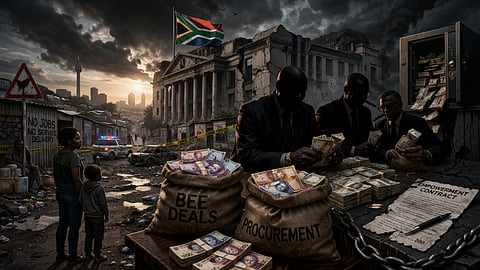
This article was first published in WSM’s JAUNDICED EYE column on PoliticsWeb.Key topics:South Africa faces extreme crime, with murder rates surpassing wartime losses.BEE deals transfer massive wealth to few politically connected elites.Public procurement and privatisation fuel ANC-linked corruption and patronage..Sign up for your early morning brew of the BizNews Insider to keep you up to speed with the content that matters. The newsletter will land in your inbox every morning on weekdays. Register here.Support South Africa's bastion of independent journalism, offering balanced insights on investments, business, and the political economy, by joining BizNews Premium. Register here.If you prefer WhatsApp for updates, sign up to the BizNews channel here..By William Saunderson-Meyer.The scale of the damage that the ANC has inflicted on South Africa defies easy comprehension. The numbers are so staggering that eyes glaze and attention drifts. But, just occasionally, someone comes up with an inspired juxtaposition that brings home the gut-wrenching horror behind the numerals.Take crime, a topic that preoccupies South Africans and anyone who wants to visit or invest here. Since 1994, there have been roughly 650,000 murders, making this one of the most murderous societies on Earth. But it takes a comparison with a state at war to make the number fully comprehensible. To grasp the grotesqueness of our society: since Russia invaded Ukraine in 2022, South Africa has lost almost twice as many civilians to murder each year as Ukraine has lost soldiers in battle; and in barely seven months, we match the roughly 15,000 Ukrainian civilians killed there over four years in total.Now take economics, where black economic empowerment (BEE)— I’ll flag my bias by ignoring the government’s preferred ‘broad-based’ acronym, B-BBEE — has become perhaps the most fiercely contested terrain in South African politics. Here, the numbers are so sprawling, the structures so opaque, and the beneficiaries so often concealed behind consortiums, trusts, shelf companies, fronts, facilitators, and political patrons, that the public cannot see the wood for the trees..Read more:.How BEE became a ladder for the elite, not the poor.Fortunately, one of our most respected public intellectuals, Prof William Gumede, has performed the same service on BEE as the Ukraine comparison does on crime. He has rendered the chaos comprehensible by reducing it to two savagely memorable propositions: that more than R1-trillion has been transferred to fewer than 100 politically connected individuals, and the same people are ‘empowered’ over and over again; and that in mining alone, 46 politically connected people secured 60% of BEE deals, becoming multi-millionaires or billionaires overnight.Gumede is undercutting the ANC’s very raison d’être, the vanity that it alone knows how to transform the contours of a post-apartheid economy to empower the masses. His critique also resonates with a sullenly alienated electorate that is staying away in droves, reducing the ANC vote to 40% in the last election, down from 67% at its peak.Nor is Gumede some fringe polemicist. He is the author of a magisterial biography of President Thabo Mbeki, is attached to the School of Governance at Wits University, and is a serious scholar who has spent two decades anatomising the political economy of the governing party. That is why the backlash has been so furious. He has incurred the displeasure of President Cyril Ramaphosa, been attacked for ‘sabotaging’ South Africa’s credibility in international investment markets, and been challenged to ‘prove’ his numbers. He is also the target of a campaign of character assassination and abuse.This is not a question that can be settled with a neat spreadsheet, though Gumede, this week, marshalled a formidable body of evidence in a private presentation** to the Black Management Forum, an organisation representing many beneficiaries of the system. It was received, he tells me, in ‘total silence’. It’s important to understand, Gumede stresses, that BEE operates across three deeply interlinked arenas. There are private-sector ownership deals. There is public procurement, where empowerment rules shape access to contracts and subcontracting. And there were the privatisation transactions of the early democratic years, where BEE participation was built into the disposal of state assets.Also, at least some of Gumede’s source material is political dynamite. For example, the claim that 46 ANC fellow-travellers snagged 60% of BEE mining deals rests, he says, on research done in 2015 by a top-tier audit firm and a major bank for the Chamber of Mines. The study, which was leaked to Gumede, remains confidential and, to this day, none of those involved will agree to be named. It is this lamentable reluctance of so many individuals and institutions to put their heads above the parapet that caused American ambassador Brent Bozell to urge business leaders to have the courage to say publicly the things they tell him privately about how BEE is damaging growth, distorting ownership, and rewarding proximity to power.So, while the evidentiary problem — always a problem in the social sciences — is real, that is not the same thing as saying the underlying claim is fanciful.Starting with the part that is actually visible, Intellidex calculated in 2015 that BEE deals by the 100 largest JSE-listed companies had generated R317bn in net value by the end of 2014. Of that, R196bn accrued to strategic investors, against R52bn for staff schemes and R69bn for community schemes. Mining alone accounted for R101bn of value creation, with banks on R57bn and industrials on a similar figure. Long before one gets to procurement, privatisation, and state capture, the visible, listed-company slice of BEE had already produced vast wealth transfers. But these were heavily skewed towards insiders rather than workers or broader communities.Then there is the much larger and murkier reservoir of procurement. The National Treasury put South African public procurement at around R932bn in 2021/22, roughly 15% of GDP. In his fuller presentation, Gumede notes that the state now spends ‘almost R1-trillion’ a year this way, and cites Treasury official Willie Mathebula’s evidence to the Zondo Commission that of the 2017 procurement bill of R800bn, more than half was lost to ‘intentional abuse of the system’, including the manipulation of BEE rules for personal benefit.That does not mean half the national budget became private loot. But it emphatically means that any attempt to cost BEE while ignoring tenders leaves out the single biggest river of money in the system. And when the scandals are unpacked, the pattern is grimly familiar: the proceeds flow upward, through fronts and facilitators, to the highest reaches of the ANC, including Cabinet ministers.In the same vein, it would be naïve to imagine that the private sector has been a pillar of rectitude. Few, if any, of the ANC-linked billionaires amassed their fortunes through the slow, mundane business of building companies from scratch. The official B-BBEE Commission has itself recorded major empowerment transactions worth tens and even hundreds of billions. In 2018/19 alone, it logged R112bn in major deals, with the financial sector accounting for almost 40% of the total; in 2023/24, it reported a further R24bn. Even those figures capture only the deals that were formally reported. They do not include the vast backlog of earlier transactions stretching back to 1994, nor the procurement flows linked to the state, nor the privatisation-era deals on which Gumede places such emphasis.Gumede’s examples before the BMF show why his broader estimate is not a thumbsuck. In the 2005 privatisation of Telkom, the Elephant consortium acquired an estimated R9bn stake. He says key politically connected figures in that consortium later pocketed more than R3bn from the sale of Telkom and Vodacom BEE shares, plus another R1.4bn in dividends.He points also to Gupta-linked companies securing more than R57bn in state BEE deals, and to the Hitachi Power Africa contract, where Chancellor House’s 25% stake sat inside contracts worth around R38bn. There are also the wider Eskom and Transnet collapses, where procurement, cadre deployment, and empowerment patronage fused into one system of extraction. Eskom load-shedding, which includes sabotage and contract inflation, was estimated by the CSIR to have cost as much as R2.9 trillion; Transnet’s dysfunction was estimated at R353bn in 2023 alone..Read more:. RW Johnson: Painful unintended consequences of BEE – new elite parties while a nation suffers.Once one accepts that these are not isolated curiosities but specimens of a governing method, the scale of the cumulative transfer ceases to sound outlandish. Gumede stresses that, if anything, he errs on the side of caution: ‘I am talking here only about the private sector, and I’m very, very generous.’ If one takes all three areas of BEE, ‘it is just humongous numbers, and we're not getting the development impact.’At the end of the day, the proof of Gumede’s thesis lies all around us. The heavily compromised ANC intelligentsia may refuse to see it, but on the ground, the evidence is mounting. Social surveys and voting patterns increasingly suggest that ordinary South Africans understand that the benefits of BEE are not what was promised — and are certainly not flowing to them..This article was first published in WSM’s JAUNDICED EYE column on PoliticsWeb and is republished with permission.