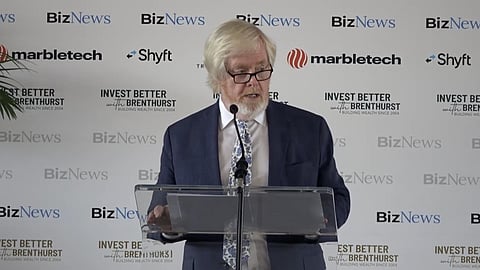
Key topics:US Ambassador Bozell urges South Africa to align on investment, reforms.ANC reacts angrily to Bozell, citing sovereignty and diplomatic overreach.South Africa resists US “asks,” exposing internal policy and ideological rifts..Sign up for your early morning brew of the BizNews Insider to keep you up to speed with the content that matters. The newsletter will land in your inbox every morning on weekdays. Register here.Support South Africa's bastion of independent journalism, offering balanced insights on investments, business, and the political economy, by joining BizNews Premium. Register here.If you prefer WhatsApp for updates, sign up to the BizNews channel here..By William Saunderson-Meyer.It was pretty much on the cards from the get-go. The ANC has been smarting terribly over President Donald Trump’s open disdain for the race-driven policies that constrain American investment, and his opposition to South Africa’s anti-Western alliances. So, this week’s démarche to US ambassador Leo Brent Bozell III was almost inevitable. It’s the discharge of 16 months of bruised pride and partisan resentment.Only weeks into his tenure, Bozell was hauled into Pretoria’s foreign ministry for the diplomatic equivalent of the headmaster’s reprimand. Ronald Lamola, Minister of International Affairs and Cooperation (DIRCO), said the government took ‘a dim view’ of Bozell’s remarks and would ‘act appropriately’ if his conduct did not improve. In other words, ‘Pull up your socks, boyo, or you’re out of your ear.’ This knuckle-rapping reaction transcends the ambassador’s relatively innocuous remarks at a BizNews conference in Hermanus. It’s the culmination of ANC irritation that its ‘non-aligned’ tilt toward the global left faces increasing US pushback. It also follows a string of humiliations, including the expulsion of Ambassador Ebrahim Rasool for labelling Trump a white supremacist, and President Cyril Ramaphosa’s embarrassingly inept White House encounter with the US leader..Read more:.David Ansara for TCS: The US Ambassador speaks truth on South Africa.Hence the disingenuous indignation. Bozell said nothing fundamentally outlandish or provocative. He merely set out in public the four-item list of complaints that Washington had lodged with Pretoria almost a year earlier and to which, he said, the US was still awaiting the courtesy of a response. Far from the South African government’s depiction of threatening and bullying, his speech was full of optimism about the scope for a renewed SA-US partnership.Bozell praised South Africa’s ‘immense potential’, its entrepreneurial depth, its financial sophistication, and its strategic importance, saying that Trump saw us as one of the top ten investment opportunities in the world. He stressed that more than 500 US companies already operate here, employing more than 250,000 South Africans. He cited recent investments by Visa, Google, Microsoft, and Amazon as evidence that American capital has not written the country off. He launched a SelectUSA initiative to help South African firms access the US market. And he framed the relationship not as one to be dismantled, but as one with ‘great untapped potential’ if both sides could align around growth, opportunity, and security.The misstep — eagerly seized on by the ANC and its familiar media chorus — came in the Q&A, when Bozell said he did not care what the Constitutional Court had ruled about ‘Kill the Boer’ being hate speech. It was an ill-judged and diplomatically clumsy formulation, and he hurriedly retracted it afterwards on X, stressing that while his personal view remained unchanged, the US respected the independence and rulings of South Africa’s judiciary.Commenting in the Daily Friend, Institute of Race Relations CEO John Endres writes that Bozell is not here ‘to please all of the people, all of the time’. He is here ‘to make a point and, if the conditions are right, a deal’. Endres importantly notes that Bozell made the ‘unusual … remarkable … and fair request’ that South African business leaders should say publicly what they tell him privately.This goes to the heart of South African failure. A handful of liberal think tanks and Afrikaner pressure groups have long argued that the US, far from being merely punitive or intransigent, remains eager to engage. Yet opposition politicians, most conspicuously the DA, the corporate sector, and most of the mainstream media, have shown little appetite for grappling openly with Washington’s ‘asks’. Instead, the official version of reality, endlessly recycled, is that South Africa’s sovereignty is under threat from a bullying superpower bent on dictating our domestic and foreign policy.The US asks are not in the slightest revolutionary: recalibrate black empowerment rules so that American companies are not forced to surrender 30% of investment equity; tighten the Expropriation Act to make unambiguous that land reform will proceed on fair-market compensation terms; condemn the ‘Kill the Boer, kill the farmer’ song clearly and publicly, regardless of its constitutional status; and treat farm attacks as a priority crime, investigated with the urgency currently accorded to other serious offences. None of these changes would be difficult. What is lacking is not public consent, but political will. Indeed, opinion polling suggests that most South Africans, including ANC voters, already broadly support them.Yet Presidency spokesperson Vincent Magwenya — lest we forget, the official voice of Ramaphosa — claimed that the ambassador sounded as though he were talking to ‘a colony or a subsidiary of the US government’, while ANC Secretary-General Fikile Mbalula declared that South Africa would not be ‘dictated to’. Kingsley Makhubela, South Africa’s former chief of protocol, accused Bozell of suggesting that the US enjoyed ‘extraterritoriality over South Africa’ and could ‘overrule and judge our judges’.Sunday Times editor Makhudu Sefara is perhaps the fullest expression of this sour mood. He wrote last week that accepting the appointment of the ‘vile’ Bozell was ‘diplomatic capitulation’ and ‘a monument to our own self-disrespect’. That Trump had sent an envoy who was ‘unabashedly pro-apartheid and anti-ANC’, and Ramaphosa had ’sheepishly’ just ‘swallowed the insult’. Collectively, these are extraordinary readings of Bozell’s tone since he arrived. In an earlier News24 interview, he said his mission was not merely to seek détente but to build a bilateral relationship ‘stronger than ever before’. ‘Temperatures went up,’ he said, but ‘can come right back down’. What Washington wanted was not a grudging truce, but a ‘new partnership’. He was particularly enthusiastic about critical minerals, suggesting that the US could offer South Africa something better than China — beneficiation at source, local processing and refinement, and potentially vast numbers of jobs.So why the fury and vitriol, so wildly out of proportion to the modest concessions needed to meet Washington’s formal asks? It’s because South Africa’s refusal to grasp the olive branch has far less to do with those four points than with the big, fifth issue, raised in Trump’s original Executive Order suspending aid and trade preferences — our foreign policy. A largely veiled struggle is underway within the ANC, the military, and DIRCO over this country’s ideological place in the world. Meanwhile, the opposition parties that keep the unity government afloat, the corporate sector that keeps the economy turning, and the media that are supposed to guard our constitutional democracy, have all allowed themselves to be pointedly excluded from the argument..Read more:.John Endres reports from BNC#8: Bozell means business.Bozell’s unenviable task, which will continue to make him a scapegoat, is to impress upon the South African establishment — which is far wider, deeper and less radical than the ANC — that the US can tolerate a foreign policy that is genuinely what the ANC claims it to be: principled non-alignment. What it will not tolerate indefinitely is a diplomatic posture that remains provocatively hostile to the US and its allies while pretending to be even-handed. Such a stance will carry increasing costs.What those costs are likely to be, and whether South Africans are willing to pay them for the privilege of aligning themselves, rhetorically and diplomatically, with an array of bloody, dictatorial regimes, is the public debate that ought to be occupying the country. Instead, we are invited to rage at the messenger, so that we never have to confront the message..This article is reproduced with permission from the author and Politicsweb.co.za, where it was first published.