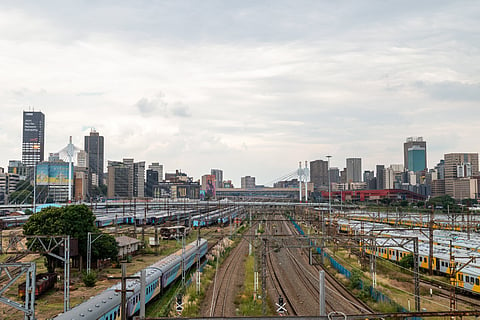
Johannesburg, home to about 70 per cent of Africa's corporate headquarters, is buckling under collapsing municipal services. Sauce maker Libstar shifted production from the city to the Western Cape after water outages cost it R17mn in lost profits, forcing it to truck in water for months. The city has had ten mayors in a decade, owes Eskom R3.8bn, and loses R12bn a year to irregular spending. National Treasury briefly withheld funding in July over mismanagement. With no clear alternative, businesses are paying to fix potholes and maintain infrastructure themselves, and November's local elections may bring more coalition deadlock rather than change..By Monica Mark.For 25 production shifts, a crucial ingredient was missing in a factory that makes sauces for supermarkets across southern Africa: running water.Near-constant water outages in southern Johannesburg meant the Dickon Hall Foods factory, which historically used about 240,000 litres of water daily, could not reliably cook ingredients, generate steam or clean equipment.The company was forced to “literally truck in water” to the “perpetually difficult site”, Charl de Villiers, chief executive of parent company Libstar, said recently. The disruptions contributed to a R17mn ($1mn) shortfall in expected profits in the first five months of 2026, he said.The company closed its Johannesburg plant, transferring production to the country’s Western Cape province as part of a planned restructuring.The case was a stark sign of how Johannesburg’s decline is spilling into company balance sheets. Despite hosting about 70 per cent of Africa’s corporate headquarters, the city’s services are collapsing after years of teetering on the edge of bankruptcy.Johannesburg has had 10 mayors in the past decade, in a revolving door of coalition governments that has made long-term planning almost impossible.Overflowing rubbish bins are often left uncollected amid pay disputes with refuse companies. Its road maintenance fleet and police vehicles were briefly grounded in June after it failed to pay for fuel. And electricity utility Eskom has threatened to cut off parts of the city over debt arrears that in late July stood at R3.8bn.“If [Johannesburg] was a business, it would have been declared bankrupt by now,” said Peter Attard Montalto, managing director at Johannesburg-based consultancy Krutham.The national government took drastic action in July, withholding a month’s funding from Johannesburg and more than 60 other towns and cities, in an unprecedented attempt to stop wasteful spending and financial mismanagement. A few weeks later, finance minister Enoch Godongwana announced the “conditional release” of the funds to avoid harming local communities, but warned they could be held back again.Though patchy local government services have become a growing cost of doing business across South Africa, nowhere are the economic stakes higher than in Johannesburg.“The city is too big and too important to fail . . . the ripple effects would be seismic for South Africa’s economic growth, investor confidence and employment,” said Nomvuyo Guma, a former Treasury official and research fellow at the Bureau for Economic Research. “Unfortunately, we’re on the brink of that now.”The warning signs have long been building. Johannesburg’s budget has almost doubled to R80bn over the past decade, but the share of investment in new infrastructure has fallen by more than half over the same period, from 13 per cent of total spending to 6 per cent.An earlier budget contained a R2.1bn funding gap, including a controversial wage agreement that will add R10.3bn to staff costs over two years. The pay deal, which the finance minister branded “illegal and unaffordable”, is at the centre of the dispute.The office of mayor Dada Morero, who has insisted the deal will be honoured, did not respond to a request for comment.But there are very few good alternatives to the city.“Where else do you go?” said Busisiwe Mavuso, chief executive of Business Leadership, an influential business lobby. “The cost of uprooting is enormous. The problem is everywhere. Companies find themselves between a rock and a hard place.”Libstar’s move to the opposition-run Western Cape offers no guarantee against water risk. Although the province, home to Cape Town, is widely seen as South Africa’s benchmark for governance and service delivery, it narrowly avoided a catastrophic water shortage during Cape Town’s 2018 “Day Zero” crisis.Libstar, which declined to comment on this story, has said the recent Johannesburg shortages were not the reason for the factory move. But chief financial officer Terri Ladbrooke told investors in July that the risk of further water supply issues was “reducing” owing to the move since the problems were “specific to the area and to municipal-related items”.With local governments unable to fulfil many basic tasks, private companies have adapted by repairing potholes, funding water sanitation systems and maintaining electricity substations themselves.“You take the hit, you are effectively paying double taxes but that is the price you pay. It brings costs down overall,” said the chief executive of a Johannesburg Stock Exchange-listed company.Analysts said the Treasury’s intervention would help tighten Johannesburg’s finances in the short term but would do little to resolve the structural problems underpinning the crisis.“Underneath it all, there’s just massive under-investment, a massive lack of capacity, a massive lack of technical skills,” said Krutham’s Attard Montalto.Attard Montalto said he expected Johannesburg to muddle through to local elections in November rather than undergo a meaningful change.The city’s problems are not primarily financial, analysts say, instead pointing to corruption and years of unstable coalition governments, mainly led by the African National Congress. Johannesburg loses about R12bn a year — 15 per cent of its budget — through unauthorised and irregular expenditure, according to the Auditor-General..Read more:.New water bill risks deepening the crisis - Anthea Jeffrey.The local elections may do little to break its cycle of instability.“You want a credible party and mayor to emerge with a significant enough majority to be able to make the kind of difficult choices and trade-offs that will be required to turn the city around,” said Guma, the former Treasury official.But polls suggest no single party will win an outright majority, raising the prospect of further instability.“There is a key possibility that you get another complex, messy coalition, and then essentially nothing changes,” Attard Montalto said..© 2026 The Financial Times Ltd..Sign up for your early morning brew of the BizNews Insider to keep you up to speed with the content that matters. The newsletter will land in your inbox every morning on weekdays. Register here.Support South Africa's bastion of independent journalism, offering balanced insights on investments, business, and the political economy, by joining BizNews Premium. Register here.If you prefer WhatsApp for updates, sign up to the BizNews channel here.