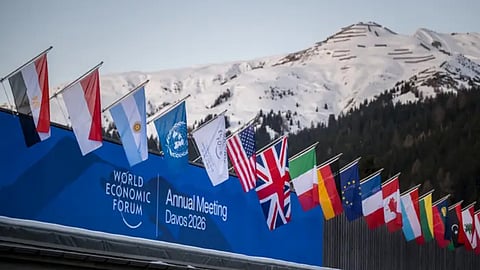
Key topics:Multipolar world shifts power via finance, leverage, and controlled stability.Africa risks external management without strong institutions or unity.Strategic planning, governance, and regional cooperation are crucial..Sign up for your early morning brew of the BizNews Insider to keep you up to speed with the content that matters. The newsletter will land in your inbox at 5:30am weekdays. Register here.Support South Africa’s bastion of independent journalism, offering balanced insights on investments, business, and the political economy, by joining BizNews Premium. Register here.If you prefer WhatsApp for updates, sign up to the BizNews channel here..By Dr. Joan Swart*.The recent World Economic Forum in Davos offered more than the usual platitudes about cooperation, sustainability, and global growth. Beneath the familiar language, a quieter but more consequential shift was evident: the world’s political and financial elites are no longer pretending that the old liberal, rules-based order is intact. Beneath the language of stability management, financial restructuring, strategic redevelopment, and pragmatic power balancing lie the signs of a darker and more competitive rearrangement of the world order.From speeches by influential financial figures such as Mark Carney, to transactional geopolitical proposals linked to Gaza’s future, and even to the emergence of elite-driven “peace governance” concepts, a pattern is taking shape. The global system is moving away from ideology and towards managed multipolarity — a world where power is exercised less through universal norms and more through leverage, capital, reconstruction, and controlled stability.For Africa, this shift carries profound implications..The continent is not entering a new era of benevolent multipolar cooperation. It is entering a world in which large powers and financial institutions increasingly prioritise order, access, and influence over sovereignty, political autonomy, or ideological alignment. Those without strong institutions, strategic clarity, or collective leverage risk becoming managed spaces rather than equal actors.At Davos, the emphasis on financial reform, debt restructuring, and new mechanisms for global economic stability sounded cooperative on the surface. Yet history suggests that financial architecture has often functioned as a tool of influence. In a multipolar context, where no single hegemon enforces rules, capital itself becomes the primary mechanism through which power is exercised.One credible hypothesis is that weaker states will increasingly face “restructuring” packages tied not only to economic reforms, but to strategic concessions — access to resources, infrastructure control, regulatory changes, or political alignment. This is not classical colonialism, but a modern form of economic leverage that can shape policy choices just as effectively.At the same time, geopolitical proposals around Gaza’s future illustrate another emerging trend: conflict zones treated less as political communities with rights to self-determination, and more as redevelopment spaces to be stabilised, rebuilt, and integrated into new economic frameworks. Reconstruction becomes geopolitics by other means.This logic is not limited to the Middle East. In a world increasingly focused on managed stability, regions plagued by conflict, weak governance, or economic fragility may find themselves subject to external “solutions” that prioritise security and investment over sovereignty and local agency..The appearance of elite-led “peace boards” or technocratic governance structures fits squarely into this trajectory. While framed as neutral mechanisms to resolve conflict and foster development, such bodies risk bypassing democratic processes and embedding external interests directly into domestic governance. Historically, similar arrangements — from international financial oversight bodies to externally managed transitional authorities — have often limited rather than strengthened long-term sovereignty.Seen together, Davos-style financial restructuring, transactional redevelopment of conflict zones, and technocratic peace governance point to a world where stability is engineered from above, often at the expense of political autonomy below.This is the environment Africa is now navigating.As I argued recently in examining Africa’s position in the emerging multipolar order, the continent sits outside formal spheres of influence claimed by major powers. Unlike the Americas under the Monroe Doctrine, Russia’s “near abroad”, or China’s growing East Asian focus, Africa remains the one major region where all powers compete but none assume long-term responsibility.On the surface, this offers flexibility and opportunity. In reality, it also creates exposure.In the absence of strong institutions, unified regional strategies, and clear red lines, African states risk being pulled into fragmented, transactional relationships driven by external agendas. Some governments may leverage multipolar competition to their advantage, diversifying partnerships and securing investment on favourable terms. Others may become increasingly constrained by arrangements that trade long-term policy autonomy for short-term financial relief and security support..A plausible longer-term outcome is a growing divergence across the continent, with some states emerging as strategic actors in the multipolar system, while others effectively operate within externally shaped frameworks that limit independent decision-making.Another credible trajectory is increased pressure on African countries to “choose stability over politics”. In practice, this could mean accepting externally supported governance arrangements, security partnerships with minimal accountability, or economic reforms shaped primarily by foreign capital priorities.This does not require overt coercion. In a world of constrained budgets, rising debt, and security challenges, leverage naturally favours those with capital, technology, and military capacity.The risk is not foreign engagement itself. Africa has always been interconnected with global powers. The danger lies in engagement without agency — without collective bargaining power, institutional strength, or long-term strategy.Yet this moment also offers opportunity.Multipolarity does not automatically condemn Africa to dependency. It can, in principle, expand options, increase competition for partnerships, and create space for African states to negotiate better terms. But this requires a fundamental shift in approach.Ideological alignment — whether with the West, China, Russia, or any bloc — will matter far less than pragmatic interest-based strategy. Emotional politics rooted in historical grievances may offer rhetorical satisfaction, but they do little to secure infrastructure, trade access, security, or economic growth.What will matter is governance capacity, regional cooperation, and strategic clarity.African blocs such as the African Union, regional economic communities, and trade frameworks like the African Continental Free Trade Area could serve as collective leverage mechanisms — but only if strengthened beyond symbolic diplomacy. Acting as unified markets and negotiating blocs would significantly increase Africa’s bargaining power in a world of competing global actors.Equally crucial is internal stability. States with predictable institutions, transparent governance, and long-term development planning will be far better positioned to navigate multipolar competition than those trapped in cycles of corruption, political volatility, and elite rent-seeking..In a system increasingly focused on managed stability, weak governance does not invite assistance — it invites management.The uncomfortable reality is that the emerging global order is not built around fairness, nor around universal rules applied equally. It is built around power, leverage, and interests. Davos no longer pretends otherwise. The language has simply become more technocratic and less ideological.For Africa, the core question is no longer who offers the best rhetoric about partnership or development. It is who respects African agency — and whether African states themselves are prepared to assert it.The coming decades will likely see intensified competition for resources, strategic locations, markets, and influence across the continent. This can either translate into sustainable growth and stronger sovereignty, or into a new era of dependency dressed in the language of stability and investment.From Davos boardrooms to redevelopment plans in conflict zones, the new multipolar order is being shaped in real time. Africa will not be insulated from it.The choice facing the continent is not between engagement and isolation. It is between strategic participation and passive management.Those who build institutions, cooperate regionally, plan long-term, and negotiate pragmatically will shape their futures. Those who drift, delay reform, or cling to ideological alignments risk being shaped by others.Multipolarity offers no guarantees. But it does offer a narrow window for African agency — if seized with clarity and purpose..Author bio: Dr. Joan Swart is a forensic psychologist and independent security analyst with a particular focus on governance, sovereignty, and Africa’s geopolitical environment.