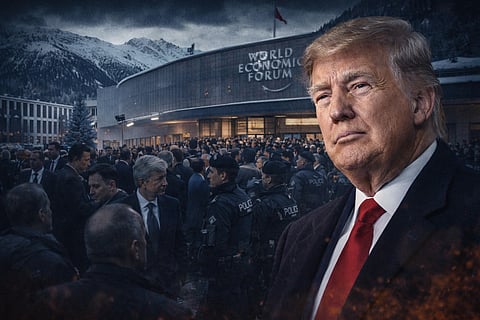
Key topics:.Trump’s presence dominated Davos debates on trade, tech and geopoliticsUS policy threats sparked tension, walkouts and uneasy diplomacyAI optimism surged, but Europe fretted over US unpredictability.Sign up for your early morning brew of the BizNews Insider to keep you up to speed with the content that matters. The newsletter will land in your inbox at 5:30am weekdays. Register here.Support South Africa’s bastion of independent journalism, offering balanced insights on investments, business, and the political economy, by joining BizNews Premium. Register here.If you prefer WhatsApp for updates, sign up to the BizNews channel here.By Ortenca Aliaj, Mercedes Ruehl, Stephen Morris and Arash Massoudi in Davos.Even before executives gathered in the sun-drenched Swiss Alps for the annual World Economic Forum meeting this week, it was clear that the event would not live up to its official theme: the spirit of dialogue. The reality was an event dominated by Donald Trump. From security to trade to technology, any debate was shaped less by competing ideas than by the overriding question of how the president and a more assertive US might bend the global order next. “It’s a pity Trump just took Davos hostage,” said one European chief executive. “No other voice mattered.” The annual event, now in its 56th year, had record attendance. “It has been the biggest, most exciting Davos ever. We had 70 heads of state and almost 1,000 CEOs,” said Marc Benioff, chief executive of Salesforce and WEF governing board member. Even Elon Musk, the Tesla chief executive and head of SpaceX, was not immune to the famous Davos Fomo, making an appearance on Thursday. “Elon called me . . . and asked to speak,” said Benioff. “Previously he had deeply committed to me never to come to Davos.”Amid the US president’s threats to use force to take control of Greenland and to impose tariffs on European trading partners, discourse in Davos descended into slights and snubs with icier conditions inside the congress centre than outside.At the USA House, attendees including executives and officials crowded in to hear Treasury secretary Scott Bessent deliver daily rebukes to European leaders and others. Tensions hit a climax at a dinner on Tuesday where European Central Bank president Christine Lagarde walked out after combative remarks about Europe by US commerce secretary Howard Lutnick. Relations had thawed by Wednesday evening as Trump walked back his threats on Greenland and tariffs on European countries that opposed his ambitions to take over the Arctic island.Lagarde was even able to joke at a BlackRock dinner later that day: “I promise I’m not walking out tonight,” according to people who attended.For business executives, anxiety and trepidation quickly turned into confusion over the US president’s U-turn on Greenland. Many also expressed frustration that Trump’s chaotic visit had absorbed all the energy at the summit, usually renowned for its opportunities for business schmoozing.“It was the most high-profile Davos possibly ever in terms of concentration of political and economic power and it was consumed by the Greenland ‘crisis’ which emerged out of nowhere,” said David Bach, president of business school IMD, who attended. “So many other critical issues such as Ukraine did not get enough attention,” he added.At a reception for Trump on Wednesday evening, more than 100 senior executives waited an hour for his arrival and listened to an extended address that echoed much of his earlier speech. Some, including JPMorgan Chase boss Jamie Dimon and Shell chief Wael Sawan, left before Trump had arrived but those who stayed were prevented from leaving the room for close to 30 minutes after his departure thanks to security protocols.“You had people like [Nvidia chief executive] Jensen Huang needing to leave to catch a plane but being forced to sit around like penned animals,” said one person who was in the room. One chief executive who attended described the delay before Trump’s attendance as “waiting for the king”.Business leaders were quick to point out that few of America’s CEOs were willing to publicly stand up to Trump. “He’s surrounded by sycophants,” said one senior European venture capitalist.Even Dimon, arguably the most outspoken executive on Wall Street and a self-avowed globalist, would not be drawn into criticising the US president’s foreign policy.Dimon, who took the stage at Davos on Wednesday for the first time in years, instead took a swipe at the “liberal media” and its need for a “headline” as well as the WEF itself.“I’ve been coming to Davos all these years and listen to chatter and stuff like that,” he said. “And you didn’t do a particularly good job making the world a better place,” he added, a comment that provoked laughter in the room. But Dimon’s diplomacy failed to avert Trump’s ire on Thursday when the US president launched a lawsuit against his alleged debanking by JPMorgan, seeking $5bn in damages.BlackRock chair Larry Fink, who became interim co-chair of WEF’s governing board in August, publicly acknowledged criticism that the flagship event is too elite and out of touch. He has also privately discussed whether it needs to change location, the FT reported. Perhaps the only dissenting voice among influential American executives was that of Citadel founder Ken Griffin who addressed delegates on Wednesday. “Why are we fighting over a piece of rock covered by ice,” he asked. “We have frayed relationships with our European allies in ways that I don’t understand or appreciate.” But Griffin and Dimon agreed that Trump’s actions have galvanised European leaders and encouraged the continent to develop its military and grow its economy. For those seeking levity, another transatlantic rupture was dominating conversations at parties and in hallways — the Beckham family. David Beckham was at the WEF as his son Brooklyn released a long statement detailing his estrangement from his parents, with attendees keen to determine whose side everyone was on. Others were more focused on business, such as the AI companies and their financiers buoyed by breakneck investment and a pipeline of huge potential stock market listings.Anthropic CEO Dario Amodei hosted a pop-up on the promenade as he finalises a new funding round at a $350bn valuation ahead of a potential initial public offering.Executives at arch-rival OpenAI, which is raising as much as $80bn at a $750bn valuation, spent the conference pitching to customers and talking to bankers behind the scenes about its own public listing, which would be one of the biggest of all time.“The theme here obviously has been AI and it underlines the enthusiasm we’re seeing from customers and hearing on the ground,” said Brad Lightcap, chief operating officer of the start-up. “This is just the beginning for us,” he added. Their bullishness was shared by the bankers vying to lead their blockbuster listings.“There was a sense of anxiety heading into Davos due to the unpredictability and geopolitical dynamics, but on the ground it felt very much like business as usual,” said Kim Posnett, global co-head of investment banking at Goldman Sachs. “Geopolitical surprises will happen. I think CEOs have become accustomed to this operating environment.”KKR co-chief executive Scott Nuttall said “the sentiment is more cautious on the US and on the dollar” this year, but cautioned that “the group think at Davos is often not the reality”.While American exceptionalism was the unifying theme last year, not everyone was convinced of US prosperity. “I’m a little worried about how bullish people are about the US. There is this view that Trump is going to keep stimulating the economy into the midterms. I’m not sure that’s correct,” said a senior US bank executive. Another said the US reliance on the AI boom is equivalent to “putting it all on red” and hoping for the best.But some are still willing to gamble. “The US might be a one-trick pony with AI but it’s a hell of a pony,” said a large bank CEO. “It’s a racehorse and I’d put my money on that racehorse.” .© 2026 The Financial Times Ltd.