
From Pretoria to the world: How hearX’s De Wet Swanepoel took hearing care global
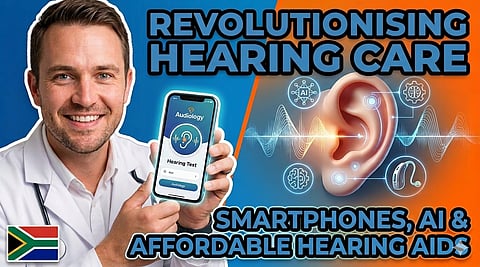
With one in five people in the world suffering from hearing loss, hearing care remains one of the least accessible areas of healthcare globally. A South African innovation led by University of Pretoria professor De Wet Swanepoel has helped to change that reality, using smartphones to take hearing screening, diagnostics and even treatment out of clinics and into communities. In an interview with BizNews, Prof Swanepoel explains how hearX, a company he founded and which was spun out of the university, developed digital tools for screening, clinical testing and selftest solutions that caught the attention of the World Health Organisation. Prof Swanepoel highlights how hearX developed a probe to enable hearing screening for newborns, and how the company is addressing the exorbitant cost of hearing aids, which are now available over the counter in the United States. He says other countries, including South Africa, are watching this space closely. hearX has also launched a free AIenabled WhatsApp training programme for teachers, which he says is delivering measurable improvements in awareness and knowledge of hearing loss. – Linda van Tilburg
Sign up for your early morning brew of the BizNews Insider to keep you up to speed with the content that matters. The newsletter will land in your inbox every morning on weekdays. Register here.
Support South Africa's bastion of independent journalism, offering balanced insights on investments, business, and the political economy, by joining BizNews Premium. Register here.
If you prefer WhatsApp for updates, sign up to the BizNews channel here.
Watch here
Listen here
Edited transcript of the interview
Linda van Tilburg (00:02.401)
De Wet Swanepoel is a South African innovator whose work has reshaped hearing care around the world. A professor at the University of Pretoria and founder of the hearX Group, he helped turn the smartphone into a medical grade device for hearing testing and ear imaging. What began as a South African solution has now been adopted globally.
Hi Prof, so nice of you to join us today.
De Wet Swanepoel (00:27.148)
Hi Linda, it’s good to be with you.
Linda van Tilburg (00:30.176)
So let’s start from the beginning. How did it all start? Why the interest in this, and what exactly did you develop?
De Wet Swanepoel (00:37.784)
Yes, Linda, I’ve always been interested in how we can get hearing healthcare to where people actually are. Hearing loss is far more common than people realise. Globally, one in five people has a hearing loss, and the reality is that around 90% of those people are unable to access the hearing healthcare services they need.
Back in 2012, I was serving on a Department of Health implementation committee for the Integrated School Health Policy. We were looking at how to screen a million Grade 1 pupils every year in South Africa. When I looked at the technologies available, and at the shortage of professionals, I realised it was going to be absolutely impossible.
At the same time, mobile technology was changing so many industries - banking, agriculture - and I thought, if someone can do banking on an app in a rural village, why can’t we offer a hearing test on a smartphone in that same setting? That was really the trigger. From there, it was about doing the research, the due diligence, and connecting with the right people to develop an array of solutions that run on a mobile phone.
Linda van Tilburg (02:06.122)
For people who might not know what those solutions are, can you list them for us? What tools and apps do you have?
De Wet Swanepoel (02:14.508)
Sure. The first thing we developed was a hearing screening application that ran on a R500 Android smartphone. That was our breakthrough innovation, and we patented it. It allowed us to have medical grade screening technology on a mobile phone. Because it was mobile based, it also allowed for automation. The idea was that anyone should be able to facilitate the test. The user interface was designed to be extremely simple, so even people with minimal literacy could run the screening.
That meant we could give it to community health workers, teachers, and nurses to screen children in schools using a mobile device. That first application was called hearScreen, and it’s still used globally today - not only for children, but also for adults. The big idea was that people no longer needed to come into clinics; we could take screening to schools, community centres, and low-income settings.
At the same time, we wanted a consumer application that anyone could download and use on their own phone. For that, we developed a different technology based on speech and noise testing. We used digits from 0 to 9, because they’re universally known. You hear three digits in background noise, and if you get them right, the noise gets louder; if you get them wrong, it gets softer. This tests your ability to hear speech in noise.
That technology eventually worked well on mobile phones, and in 2016, on World Hearing Day, we released it as South Africa’s national hearing screening test. It was a massive success - tens of thousands of people were screened in the first few days.
After that, the World Health Organization contacted us and asked whether we could develop an app for them using the same technology. That became the official WHO hearing screening app, hearWHO, which is freely downloadable and has been used in more than 190 countries.
Linda van Tilburg (05:08.926)
It’s incredible how a South African idea ended up shaping international hearing care strategy. How else are you involved internationally?
De Wet Swanepoel (05:18.636)
We’ve expanded the technology range beyond screening. We also wanted to do diagnostic testing using mobile devices - again, taking services to people instead of making them come to professionals.
We developed hearTest, which is essentially the diagnostic version of hearScreen. It’s used in occupational health, for example, where workers need annual hearing tests, and in clinical trials, where pharmaceutical companies need to monitor whether drugs affect hearing.
We also developed a small device that plugs into a phone and allows us to visualise the ear canal and eardrum. Working with partners at the University of Victoria, we developed an AI algorithm that classifies what it sees - whether the ear is normal, infected, blocked with wax, or shows another abnormality that needs referral. That solution is called hearScope.
Eventually, we also moved into hearing aids. The idea was not just to identify and diagnose hearing loss, but to provide treatment as well.
Linda van Tilburg (07:17.786)
Let’s talk about hearing aids. Anyone who’s tried to help elderly parents knows how expensive they are. What can be done to bring down the cost and make them more accessible?
De Wet Swanepoel (07:35.278)
You’re absolutely right, Linda. Cost is one of the biggest barriers. In the US, the average cost is about $4,500 for a pair of hearing aids. In Africa, less than 2% of people who need hearing aids actually get them. Even in the US, only about 20 to 25% of people who need hearing aids access them. Cost is a major reason.
Through hearX, we wanted to offer the full range - screening, diagnostics and intervention - but not in the conventional clinic based way. When the US announced regulatory changes allowing over the counter hearing aids, we were in a unique position because we already had the mobile testing ecosystem in place.
We worked with early investor Bose Corporation, which partnered with us by providing sound technology. That allowed us to launch over the counter hearing aids at a fraction of the traditional cost. In 2022, we launched in 11,000 stores across the US.
People could buy the hearing aids in a pharmacy or online, download our app, do a hearing test through the devices, and customise them at home. It’s been a real industry shift.
Linda van Tilburg (10:33.338)
That’s the US. What about the UK and South Africa?
De Wet Swanepoel (10:41.122)
Other countries are watching this space closely. Australia already allows it. In the UK, with long NHS waiting lists, alternative models are becoming increasingly important. In South Africa, the Health Professions Council is looking at how over the counter models can coexist with medical models. It’s not about replacing clinicians - it’s about offering an additional access point.
We’ve also seen big consumer players enter the space. Apple, for example, released over the counter hearing aid functionality through AirPods Pro via a software update.
Linda van Tilburg (12:14.373)
What’s next for you? What can we expect going forward?
De Wet Swanepoel (12:24.418)
One exciting development is newborn hearing screening using a mobile phone and a small probe. The technology has existed for years but was expensive and difficult to use. We’ve now made it simple, affordable and mobile. The test takes about a minute per ear and allows us to identify hearing loss early. If hearing loss isn’t picked up in infancy, it can change a child’s entire life trajectory.
We’ve also launched the hearX Foundation, which focuses on low income communities. On World Hearing Day, 3 March, we launched a free AIenabled WhatsApp training programme for teachers. It’s a short, practical course on identifying hearing problems in young children and supporting them in the classroom.
We’ve already trained over 10,000 teachers, and we’re seeing measurable improvements in awareness and knowledge.
Linda van Tilburg (15:29.880)
Tell us the business model. Are you a university spinoff?
De Wet Swanepoel (15:37.263)
Yes. hearX is a technology spinout from the University of Pretoria. We licensed the technology into a private company in 2016. We started with two employees and have grown to around 250 people, based mainly in Pretoria, serving a global market.
Linda van Tilburg (17:15.031)
Lastly, some advice for people on protecting their hearing?
De Wet Swanepoel (17:28.398)
Hearing is something we take for granted. The biggest preventable cause of hearing loss is loud sound. It’s not about avoiding sound - sound is part of life - but managing exposure.If you’re exposed to loud noise at work or through hobbies, wear hearing protection. The damage often only becomes noticeable years later.
For young people, safe listening is key. Keep volumes at safe levels, take listening breaks, and give your ears time to recover.
